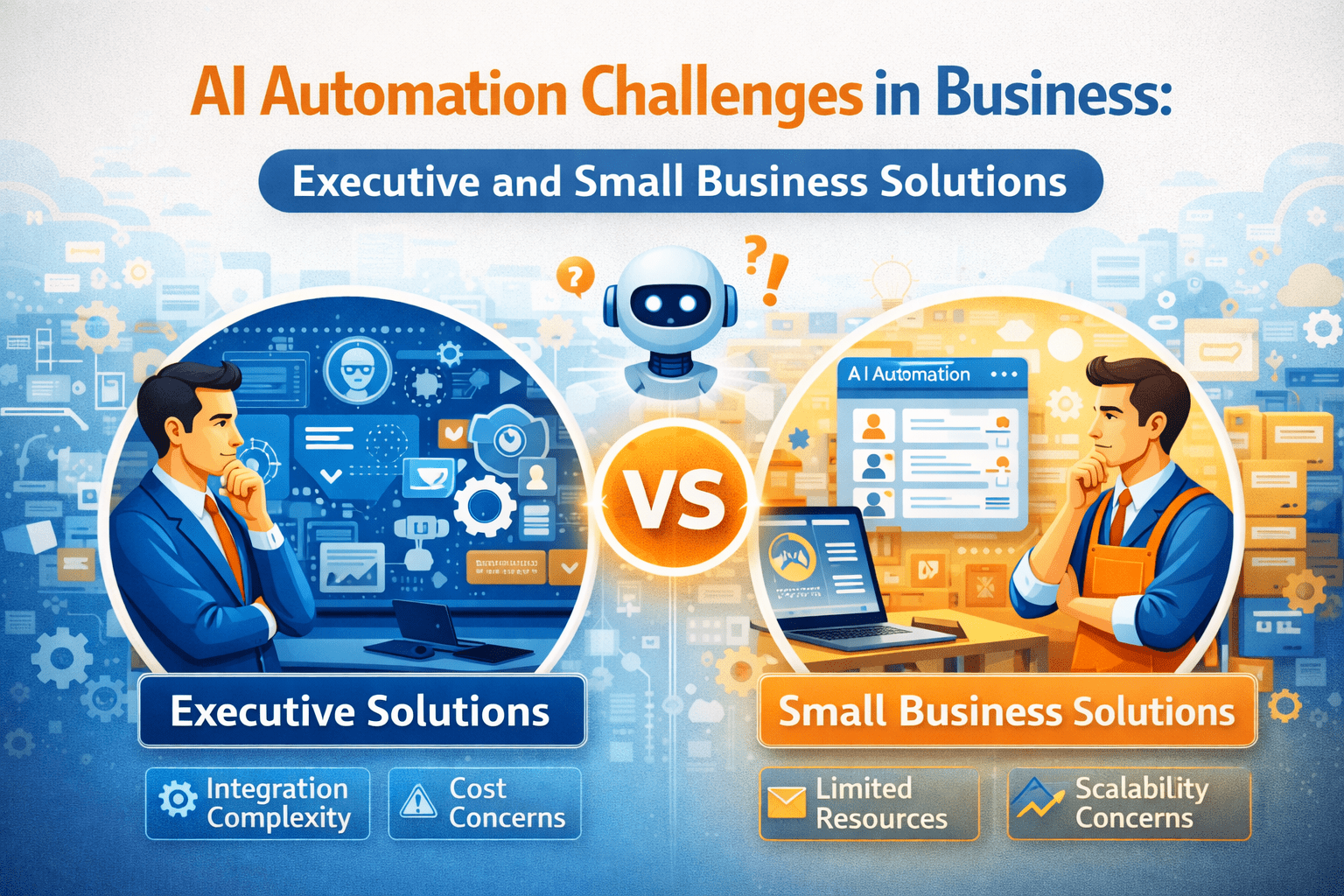
AI automation promises efficiency, but poorly executed automation creates new problems. Businesses often experience tool overload, integration confusion, unclear ROI, employee resistance, and escalating subscription costs. The technology itself is rarely the issue. The challenge lies in strategy, sequencing, and governance.
The broader operational framework is outlined in AI Process Automation for Business: Complete Guide to Operational Excellence, where automation is positioned as a structured operational transformation rather than a quick software purchase.
Understanding common challenges allows both executives and small business owners to deploy automation intelligently.
Challenge 1: Automating Undefined Processes
Many businesses automate workflows that are already inefficient.
Common symptoms include:
• Replicating broken approval chains
Automation does not fix structural inefficiency.
• Digitizing spreadsheet chaos
Errors become faster, not fewer.
• Ignoring process mapping
No clarity on workflow dependencies.
Solution:
• Audit and redesign processes before automation
Remove unnecessary steps.
• Document workflow logic clearly
Improve execution consistency.
Process elimination strategies are expanded in How to Eliminate Manual Business Processes with AI Agents.
Challenge 2: Integration Complexity
Automation often fails at system connections.
Typical issues:
• CRM and accounting platforms fail to sync
Create reporting inconsistencies.
• Duplicate data across tools
Reduce visibility accuracy.
• API permission misconfiguration
Increase security risk.
Solution:
• Validate system compatibility before deployment
Prevent costly rework.
• Use structured provider comparison
Ensure scalability.
Integration discipline is reinforced in Business AI Automation Providers: Comparing Enterprise and Local Options.
Challenge 3: Over-Automation Too Quickly
Businesses sometimes attempt to automate everything simultaneously.
Risks include:
• Staff overwhelm
Resistance increases.
• Increased error rates
Poor testing leads to instability.
• Subscription cost spikes
Over-investment without ROI validation.
Solution:
• Start with one high-impact workflow
Build internal confidence.
• Expand gradually
Maintain control.
Rollout sequencing is detailed in AI Agent Implementation: Reducing Business Operational Overhead.
Challenge 4: Unclear ROI Measurement
Without measurable outcomes, automation appears expensive.
Common mistakes:
• No baseline performance metrics
• Failure to track time savings
• Ignoring indirect revenue gains
• Comparing subscription cost without efficiency context
Solution:
• Establish measurable KPIs before deployment
• Track administrative hours saved
• Monitor revenue acceleration metrics
Structured validation is provided in The Business AI Automation Checklist for Leaders and Owners.
Challenge 5: Executive vs Small Business Complexity Differences
Enterprise organizations face:
• Compliance oversight requirements
• Multi-department orchestration
• Centralized monitoring integration
Small businesses face:
• Budget constraints
• Limited technical resources
• Need for rapid ROI
Selection discipline is covered in How to Choose AI Process Automation for Your Business Operations.
Challenge 6: Workforce Resistance
Automation can trigger uncertainty.
Concerns include:
• Fear of job replacement
• Lack of training
• Confusion about new workflows
Solution:
• Communicate clearly
Position AI as support, not replacement.
• Provide training resources
Reduce uncertainty.
• Automate guidance and knowledge support
Improve employee confidence.
Workforce enablement is explored in Employee Training AI: Automating Staff Support and Guidance.
Challenge 7: Choosing the Wrong Automation Model
Selecting traditional automation for complex workflows can create limitations.
Selecting AI automation for simple repetitive tasks may create unnecessary expense.
Comparison clarity is detailed in Business Process Automation: AI Agents vs. Traditional Solutions.
Key Takeaways
AI automation challenges arise from poor process mapping, integration misalignment, rushed deployment, unclear ROI tracking, workforce resistance, and selecting inappropriate automation models. Both executive leaders and small business owners must approach automation strategically by auditing workflows, validating system compatibility, sequencing rollout gradually, establishing measurable performance metrics, and supporting employees through transition. When automation is implemented intentionally rather than impulsively, it becomes a powerful operational advantage rather than a source of disruption.