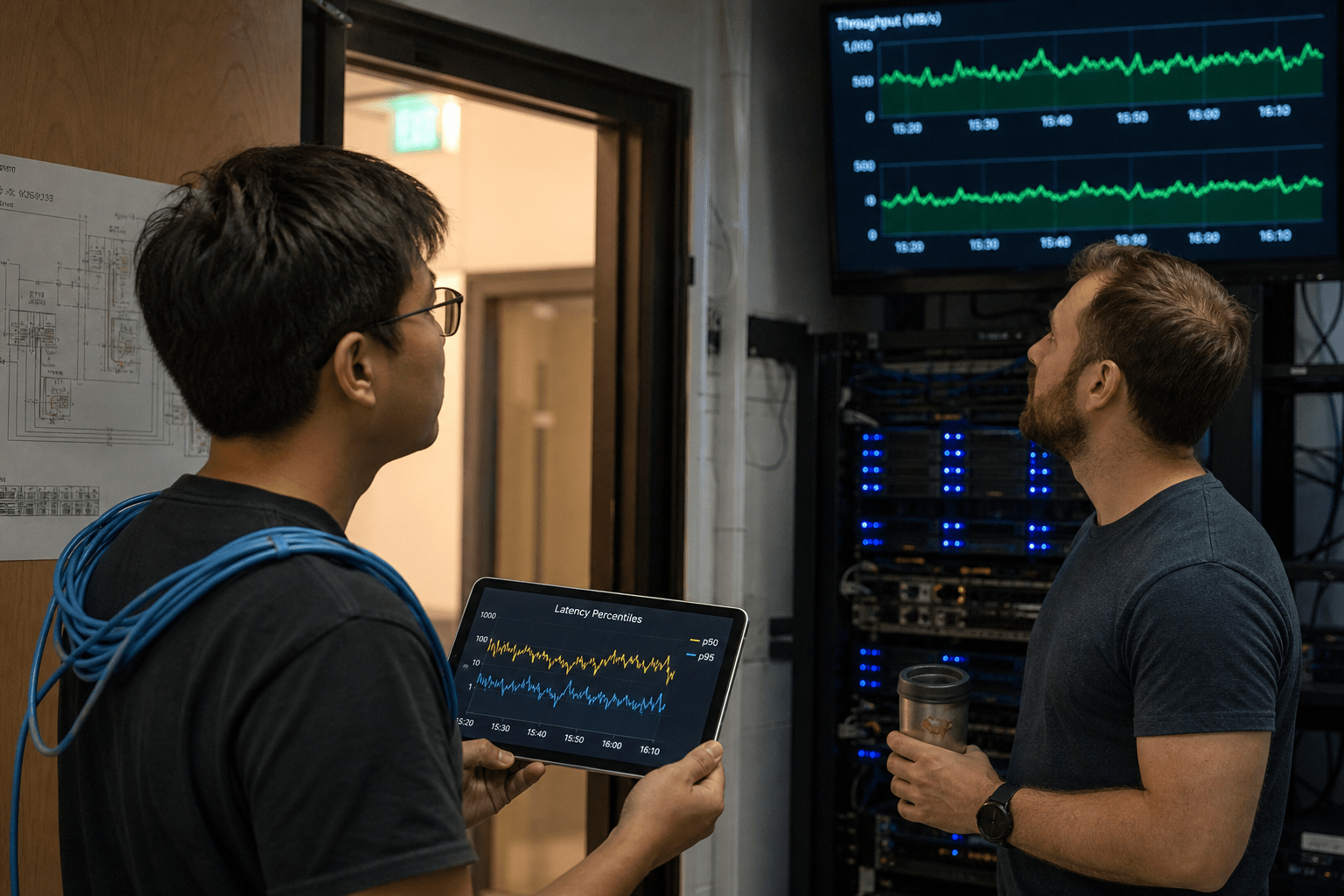
An IT team is accountable for a service, and public AI benchmarks measure a model. Those are different objects. A leaderboard reports how a model scored on academic reasoning tasks under ideal conditions; the question on your desk is whether the assistant answers inside three seconds when forty people are using it at four in the afternoon, and what that costs per ticket it actually resolves. No published benchmark answers either. The measures that decide a rollout are service measures, and a team that goes looking for them on a leaderboard will find nothing and ship anyway.
Overview: five measures that decide an AI rollout
- Time to first token, not total generation time. Perceived responsiveness is set by when text starts appearing, which is why a slower model that streams early feels faster than a quicker one that does not.
- Tail latency under concurrency, not median latency. The median is fine on every platform. The ninety fifth percentile at your real peak is what generates complaints.
- Cost per resolved task, not cost per token. Token pricing is an input. What the business cares about is the cost of a ticket closed or a document produced, including the retries.
- Quality on your domain, not on a public set. Benchmarks use published test data that models may have encountered, and your tickets are not in any of them.
- Failure behaviour under load. What a system does when rate limited or degraded decides whether a busy afternoon is a slowdown or an outage.
This is written for IT directors and operations leads at firms between 50 and 500 people putting an AI feature in front of staff or customers and needing to size and defend it. If the wider deployment questions are still open, our AI agents operations guide covers the ground before this.
Why public benchmarks do not predict production behaviour
Agentic task benchmarks and academic leaderboards both measure capability under controlled conditions, and production is neither controlled nor about capability alone. The gap is not a flaw in the benchmarks. It is a mismatch between what they measure and what you are accountable for.
Contamination and the test set problem
Public benchmark questions have been on the internet for years, which means models may have encountered them during training. A high score can reflect exposure rather than reasoning, and there is usually no way to tell from the outside.
The reasonable defence is that the better maintained benchmarks rotate questions and hold out private splits, which genuinely helps. It does not solve your problem, because even an uncontaminated benchmark measures a task distribution that is not yours. Fifty of your own examples beat a clean public benchmark for your purposes, every time.
Conditions that do not resemble your deployment
Benchmark runs use optimal hardware, generous timeouts, no competing traffic and often a larger context budget than production allows. The number produced is a ceiling under ideal conditions.
Hardware benchmark suites for training and inference are the exception worth respecting, because they measure system throughput under defined conditions and are genuinely comparable across vendors. Read them as capacity planning input rather than as a quality signal, which is what they are good for.
Capability that does not translate into resolution
A model can be entirely capable of answering a question and still fail to resolve a ticket, because it lacked context, could not reach a system, or gave an answer the user did not trust. Resolution rate is a property of the whole system rather than of the model.
That distinction is where most disappointed rollouts live: the model was fine and the system around it was not. Our piece on AI integration challenges covers the parts of that system that most often fall short.
The measures worth instrumenting before you go live
Time to first token and tail latency are the two service measures that most directly determine whether people keep using a feature, and both are cheap to instrument if it is done at build time rather than retrofitted after complaints.
Time to first token against total completion time
Streamed responses feel fast when text begins quickly, even if the full answer takes longer. Users judge responsiveness by the first word. A system with a two second start and an eight second completion is generally preferred to one that returns everything at five seconds in silence.
The argument against optimising for this is that it is perceptual rather than real, and total time is what matters for throughput. Both are true and they serve different purposes: measure first token for user experience, measure completion for capacity. Instrument them separately.
Percentiles at your actual peak concurrency
Median latency is reassuring and nearly useless. The complaints come from the tail, and the tail moves with concurrency, so a load test at your real peak is the only version of this measurement worth having.
Model the peak from your own traffic pattern rather than from an average. A support assistant sees a Monday morning spike, an internal tool sees an end of month spike, and the flat daily average hides both. That kind of service level thinking is covered in our guidance on evaluating IT service levels.
Cost per resolved task
Token cost is a component. Cost per resolved task divides everything spent, including retries, failed attempts and escalations, by outcomes actually achieved. It is the only measure that can be compared against the cost of the manual process it replaces.
Some teams object that resolution is hard to attribute, particularly when a person finishes what the system started. That is a genuine measurement problem and it is worth solving approximately rather than avoiding. A rough resolution rate with a documented definition supports a decision. A precise token cost does not.
Failure behaviour when the system is pressured
Establish what happens at the quota ceiling before you meet it. Does the system queue, shed load, fall back to a smaller model, or return an error to the user. Each is a defensible choice and the default is usually the worst of them.
Deciding this in advance is what separates a busy afternoon that feels slow from one that looks like an outage. It is the same discipline as any other capacity planning, and it belongs with the infrastructure work rather than with the model selection.
Building a benchmark that reflects your own workload
A private benchmark is less work than it sounds and it is the only measurement that answers the questions leadership will ask. The aim is a repeatable run you can point at any candidate system.
Sampling real traffic rather than writing test cases
Take a hundred real requests from a representative week, spanning the easy majority and the awkward minority. Do not write test cases from imagination, because imagined cases are cleaner than real ones and clean cases do not discriminate between systems.
Include the messy inputs: the half sentence, the wrong attachment, the question about something out of scope. How a system handles those is usually where candidates separate, and it is exactly what a curated test set omits.
Running the same set against every candidate
Run the identical set against each option, on the same day, with the same context and the same prompt structure. Record first token time, completion time, cost, and a quality judgement from somebody who knows what a good answer looks like.
The temptation to tune the prompt per candidate is strong and it invalidates the comparison. Tune afterward, on the winner. Keeping the set fixed also makes the run repeatable when you re-evaluate in six months, which is the point at which most teams wish they had kept it. Ongoing measurement of that kind is what our AI operations monitoring service covers.
Keeping the benchmark alive after launch
A benchmark run once before a decision has a short useful life, because models change underneath you. Rerunning the same set monthly against production configuration catches drift that nothing else will surface.
This is the step that reliably gets dropped, and attaching it to an existing monthly review rather than creating a new ritual is what keeps it alive. The broader pattern of gaps that appear when nobody owns a recurring check is covered in our piece on IT infrastructure service gaps.
Frequently Asked Questions
Which AI benchmarks matter for an enterprise IT team?
Hardware and inference throughput suites are useful for capacity planning because they measure systems under defined conditions. Academic capability leaderboards are useful only for narrowing a shortlist. Neither predicts how a deployment behaves on your data at your peak.
What is a good latency target for an AI assistant?
Aim for text beginning to appear within roughly two seconds, measured at the ninety fifth percentile during your real peak rather than on average. Perceived responsiveness is set by time to first token, so a streaming response that starts quickly is preferred to a faster total time in silence.
How do you measure the cost of an AI deployment properly?
Divide total spend, including retries and failed attempts, by outcomes actually achieved, such as tickets resolved or documents produced. Cost per token is an input that cannot be compared against the manual process the deployment is meant to replace.
Why does a model that scores well perform poorly in production?
Because resolution depends on the system around the model: available context, reachable data sources, prompt structure and whether the user trusts the answer. A capable model inside a poorly integrated system produces disappointing results.
How often should an AI benchmark be rerun?
Monthly against production configuration, using the same fixed set of real requests. Model versions and platform routing change without notice, so a benchmark run once before a decision has a short useful life.
Who is behind this guidance
Mindcore builds and operates IT and AI systems for small and mid sized firms across healthcare, legal, financial services and manufacturing, which means we are usually the ones answering for latency and cost once something is live. The measures above come from enterprise AI integration and managed IT engagements where the model choice was sound and the service behaviour under load had never been measured.
Matt Rosenthal, our chief executive, focuses on how firms hold new technology to the same operational standard they hold everything else. His view on AI performance is that a leaderboard score is a claim about a model while a service level is a promise to a user, and only one of those is yours to keep.
Measure the service, not the model
The work that makes a rollout defensible is small and specific. Pull a hundred real requests from a representative week, including the awkward ones. Run them against every candidate on the same day with the same prompt. Record time to first token, completion time, cost and a quality judgement from somebody who knows the domain. Load test at your actual peak and read the ninety fifth percentile rather than the median. Decide in advance what happens at the quota ceiling. Then rerun the same set monthly, because the thing you measured will change without telling you.
If you want help building that private benchmark from your own traffic, book a free strategy call and we will put one together against your workload.