

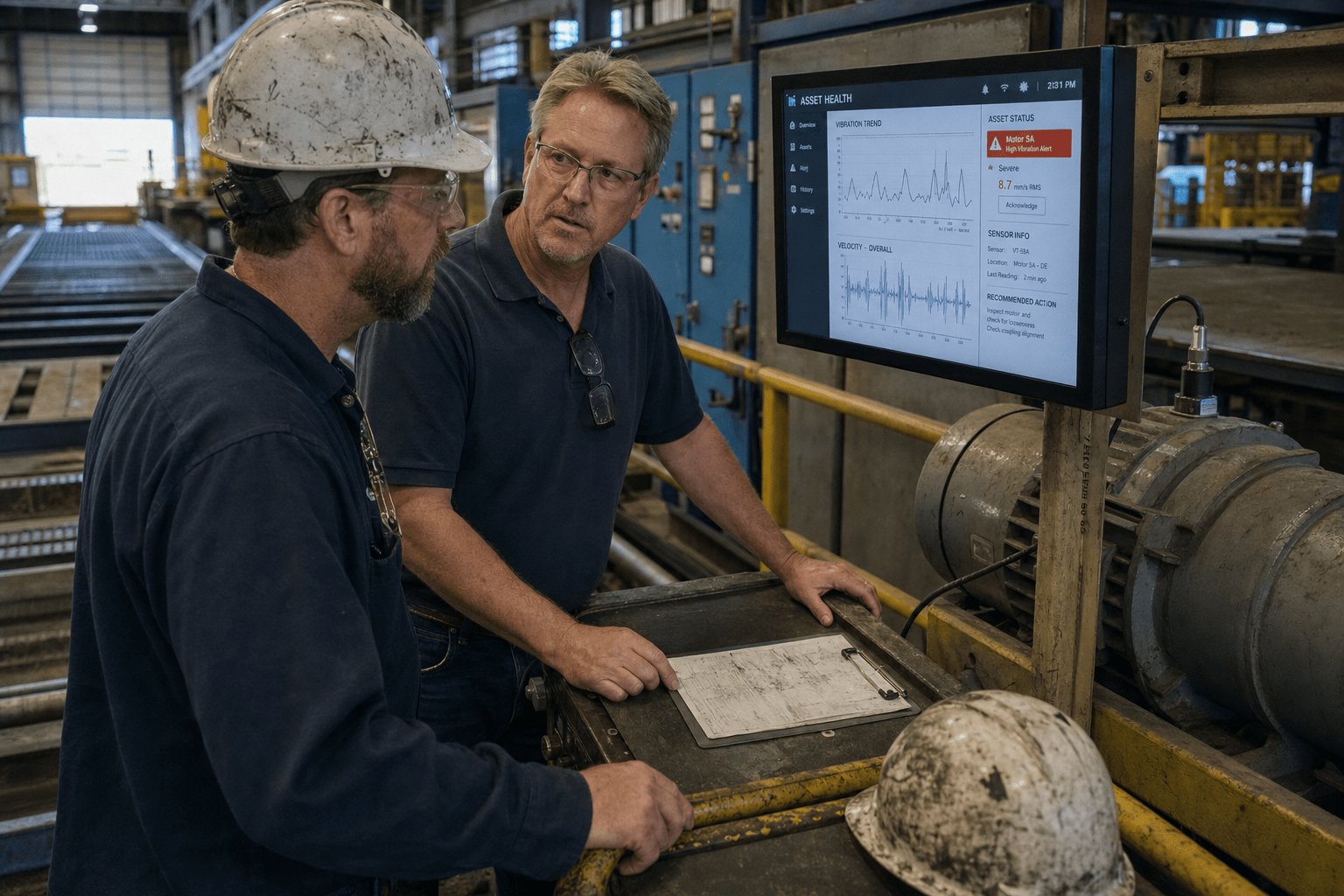
The best AI tools for manufacturers in 2026 are the ones a plant can actually feed. Predictive maintenance, visual defect inspection, production scheduling, and demand planning all have credible products now, and the models work. What decides whether a deployment reaches the second line is whether the machines emit usable signal, whether the plant network lets that signal reach an analysis layer without opening the control environment, and whether a maintenance supervisor trusts the output enough to change a work order. We rank by data readiness before capability, because a strong model starved of sensor history predicts nothing a plant manager will act on.
Why the Best AI Tools for Manufacturers Stop at the Pilot Line
Most stalled plant AI projects we have seen were not model failures. A vendor demonstrates on one asset, the results look good, and then someone asks what it takes to reach the other forty machines. The answer involves sensors that do not exist, a historian nobody maintains, and a network boundary the controls engineer will not open. The pilot then runs indefinitely on its original line while the business case waits.
Settle these five before signing anything:
- Inventory the signal you already have. Which assets emit vibration, temperature, current draw, or cycle data today, and where does it land? This answers more procurement questions than any demonstration will.
- Decide how data crosses from plant floor to analysis. A one-way path out of the control network is workable. A bidirectional link into programmable controllers is a different risk conversation entirely.
- Give the output an owner on the floor. Maintenance planning or quality, not corporate. Someone who changes a schedule because the model said so, and answers for it.
- Pick the asset class where downtime costs most. Not the newest machine, not the easiest one to instrument. The one whose unplanned stop hurts the schedule.
- Budget for instrumentation as part of the purchase. Sensors, gateways, and installation labor routinely exceed the software license in year one, and omitting them is how a project gets cancelled halfway.
Plants that answer those first buy narrower and deploy faster. Plants that answer them after the pilot usually restart the project under a new name.
How to Rank the Best AI Tools for Manufacturers by Plant Function
Ranking plant AI by function beats ranking by vendor, because maintenance, quality, and planning have different data requirements and different failure consequences. Start where the loss is measurable and the data already exists.
Predictive maintenance and asset health
This is the most mature category and usually the first purchase. These platforms read vibration, thermal, and current signatures from rotating equipment, learn a normal operating envelope, and flag degradation before failure. Augury, Tractian, Falkonry, and SparkCognition work in this space, while Limble, MaintainX, UpKeep, and Fiix approach it from maintenance management outward. The 2026 distinction worth watching is whether the analysis and the work-order system share a platform, since a prediction that does not generate an actionable work order with parts attached tends to be ignored.
The counter-argument is real. Predictive models need failure history to learn from, and a well-run plant that has replaced bearings on schedule for a decade may have very few failures on record. Those plants often get more value from anomaly detection framed as condition monitoring, which flags deviation without claiming to predict a date. Vendors sell prediction because it demonstrates better. Condition monitoring is frequently the honest fit.
Visual inspection and quality control
Camera-based defect detection has moved well past pilot maturity. Cognex Vision AI operates at production line speed on subtle defects, MakinaRocks handles process-specific inspection such as weld quality, and Landing AI, Neurala VIA, and Qualitas EagleEye target smaller manufacturers with lighter deployment requirements.
The opposing view is that inspection models inherit the labeling quality of the images used to train them, and plants rarely have a clean library of defect photographs sitting ready. Building that library takes weeks of deliberate collection on the line, including defects that occur rarely. Manufacturers who treat image collection as part of the project succeed. Manufacturers who expect the vendor to supply a generic model for their part geometry usually do not, because defects are as particular as the tooling that produces them.
Scheduling, planning, and supply coordination
Planning tools sit further from the machines and closer to the ERP, optimizing production sequence, changeover order, and material timing. Rockwell’s Plex platform combines manufacturing execution, planning, and quality with embedded analysis, and finite scheduling is the capability plants most often name.
The case against starting here is that planning output is only as good as the routing and cycle-time data in the system of record, and that data is stale at a large share of mid-size manufacturers. A scheduler optimizing against wrong standard times produces confident, unusable plans. The argument in favor is that fixing routing data has independent value, so the cleanup pays even if the AI purchase slips a year. Our overview of AI automation in production operations covers where that groundwork usually sits.
Where Plant Network Design Limits What Manufacturers Can Deploy
Network design constrains manufacturing AI more than budget does. Control systems were built for determinism and long life, not for data sharing, and much of the equipment on a plant floor predates any expectation that it would be queried by an analysis platform.
Getting data out without opening the control network
The pattern that works is a one-way path: sensors and gateways publish to a broker or historian on a separate segment, and analysis happens there. Nothing on the analysis side writes back to a controller. This keeps the production environment isolated while still feeding the model, and it is the arrangement most controls engineers will approve without a fight.
The other side deserves weight. A read-only path forfeits closed-loop capability, where a model adjusts a process parameter automatically. Some manufacturers genuinely want that, and in tightly bounded applications with proper interlocks it can be done safely. Our position is that closed-loop belongs in the second phase, after the plant has lived with the model’s recommendations long enough to trust them. Firms that start closed-loop are betting on a model they have not yet observed under their own conditions.
Why segmentation is the prerequisite nobody budgets
Adding an analysis layer to a flat plant network widens what an intruder reaches after one compromised laptop, from a few office files to the systems that run production. We have written about securing operational technology networks, and segmentation is the item most often deferred and most often regretted after an incident stops a line.
The balanced reading is that most plants are partway there. A firewall exists between office and plant, the rules have not been reviewed in years, and a handful of vendor remote-access paths bypass it. That plant can adopt AI responsibly if the segmentation review runs alongside the rollout rather than after it. Ongoing managed security monitoring covers the visibility gap in the meantime, which matters because plant floor traffic is rarely watched at all.
How cloud and edge placement changes the calculation
Where the analysis runs affects both latency and exposure. Vision inspection at line speed needs local processing, since a round trip to a cloud region cannot keep pace with a conveyor. Maintenance analysis and planning tolerate cloud placement comfortably and benefit from the elasticity. Most plants end up with both, and cloud infrastructure planning should account for that split rather than assume a single destination.
How Manufacturers Prove an AI Tool Earned Its Cost
A plant AI purchase justifies itself when a production number already on the daily report moves. Choosing the measure afterward guarantees a flattering one gets chosen.
The numbers a plant manager already trusts
Unplanned downtime hours, scrap rate, first-pass yield, mean time between failures, and schedule adherence all work, because operations reviews them weekly regardless of any technology project. Baseline one against the target asset class for a quarter before the pilot, then compare the same assets afterward.
The fair objection is that plants change constantly: product mix shifts, a line gets rebuilt, a shift pattern changes. A clean before-and-after is rarely available. The workable answer is comparing the instrumented assets against similar uninstrumented ones over the same period, which controls for most of the drift. Manufacturers who set that comparison up in advance avoid the argument entirely.
Where the recurring cost actually sits
Software licensing is visible and frequently the smaller half. Sensor hardware, gateway installation, network changes, historian storage, and the maintenance planner time spent responding to alerts all consume budget the business case tends to omit. Plants that fund only the license report disappointment at renewal, and the model is usually not at fault.
Against that, instrumentation is a one-time capital cost that keeps serving whatever platform runs next, so it is better thought of as plant infrastructure than as part of a vendor commitment. Judging on first-year cost alone pushes manufacturers toward the lightest deployment, which often means the one with too little signal to work.
Who should run the evaluation
Evaluation belongs to maintenance or quality, with controls engineering assessing the network path and someone qualified reading the vendor’s security documentation. A manufacturer without that internal capacity should bring it in rather than guess, and our manufacturing practice and intelligent process automation work both begin at that assessment. Teams weighing whether an agent-based approach differs from the automation they already run will find our comparison of AI agents against traditional automation and our operational excellence guide useful before vendor conversations start.
Frequently Asked Questions
What are the best AI tools for manufacturers in 2026?
The best AI tools for manufacturers in 2026 fall into three groups: asset health and predictive maintenance platforms such as Augury, Tractian, Falkonry, Limble, and MaintainX; visual inspection systems including Cognex Vision AI, MakinaRocks, Landing AI, and Neurala VIA; and production scheduling built into manufacturing execution platforms such as Rockwell’s Plex. The right entry point is the asset class whose unplanned downtime costs the schedule most.
Do we need new sensors before we can use predictive maintenance AI?
Usually yes, at least partially. Many plants have some vibration or current monitoring on critical rotating equipment and nothing on the rest. Vendors provide gateways and sensor kits, but the installation labor and the network path to move that data are the plant’s responsibility and belong in the budget from the start.
Is it safe to connect plant floor systems to an AI platform?
It is when data moves one way, out of the control network to a separate analysis segment, with nothing writing back to a controller. That arrangement keeps production isolated while still feeding the model. Closed-loop control, where the model adjusts a process automatically, is a larger risk decision that belongs in a later phase.
How long should a manufacturing AI pilot run?
At least a quarter, and longer for maintenance applications, because degradation on industrial equipment develops over months rather than weeks. A short trial produces too few events to judge the model. Baseline the production number you care about before the pilot begins, or the comparison afterward will not settle anything.
Can a mid-size manufacturer adopt AI without an in-house data team?
Yes. The categories with the shortest path are visual inspection with a vendor-supported deployment and maintenance platforms that bundle analysis with work-order management. Both avoid building a data pipeline from scratch. What a mid-size plant still needs is someone qualified to review the network path and vendor controls before data leaves the floor.
Who Is Behind This Guidance
Our team has worked inside manufacturing technology environments on the parts that decide whether new tooling is even deployable: plant network segmentation, vendor remote access, historian and data path design, and recovery after incidents that stopped production. That work shaped the ranking approach here. We have watched capable platforms stall at plants with no signal to feed them, and simpler deployments succeed at plants that instrumented first, and the pattern repeated across discrete and process operations alike.
Matt Rosenthal, our CEO, has built Mindcore around the operational groundwork that lets industrial businesses adopt new technology without widening their exposure. The principle guiding how our team runs these engagements is that on a plant floor a technology decision is an operations and safety decision first, and a product decision second.
Your Next Step Toward a Plant AI Deployment That Scales
Choosing among the best AI tools for manufacturers turns out to be the easier half of the work. Plants that inventory their existing signal, settle how data leaves the control network, name an owner on the floor, and pick a production number before the pilot reach a shortlist quickly, and that shortlist is short. Plants that begin with vendor demonstrations spend more, instrument less, and revisit the same decision the following year.
The sequence that works is straightforward. Walk the floor and write down what each critical asset already emits and where that data lands today. Review the boundary between plant and office networks, including every vendor remote-access path, because an analysis layer over a flat network turns one stolen credential into a production outage. Pick the asset class where unplanned stops hurt the schedule most, baseline downtime or yield against it, and run a pilot long enough for real degradation to appear. Then widen to a second asset class using what the first taught you about your own alert-response capacity.
None of that requires an enormous budget, though it does require someone who can read a vendor’s security documentation with a controls engineer’s caution and a systems engineer’s eye. That combination is what our team brings to manufacturers working through this decision, whether we run the whole technology function or work alongside plant engineering.
If your operation is weighing AI tooling this year and wants the groundwork assessed before capital is committed, book a free strategy call with our team. We will walk your current network and data setup, flag what needs attention before anything touches the control environment, and give you a straight answer about which category fits the assets you actually run.

