

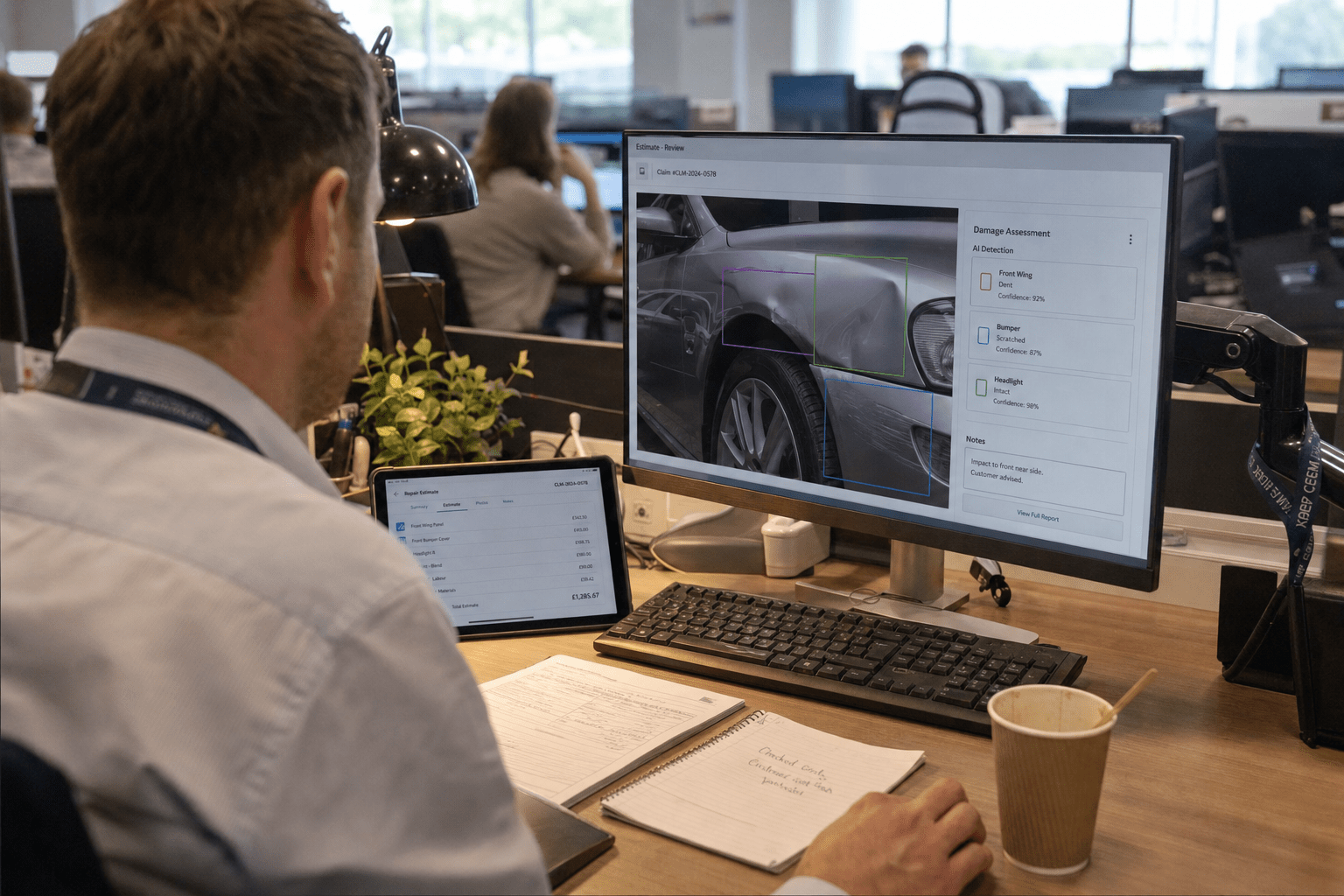
The best AI vision tools for insurance damage assessment in 2026 are separated by one setting rather than one capability, and it is not the one the sales conversation is about. The setting is the confidence threshold at which an estimate is approved without a human looking at it.
Vendors compete on accuracy figures. Ninety-five percent, ninety-seven, ninety-nine on particular damage types. Those numbers are measured against curated image sets under conditions your policyholders will not reproduce, and they tell you almost nothing about what the system will cost or save you.
What decides the financial outcome is where you draw the line for automatic approval. Set it low and you approve estimates the model was guessing at, and the leakage shows up quarters later in your loss ratio. Set it high and almost everything routes to an adjuster, which is the process you already had with a software licence attached.
Overview: five things that decide whether vision assessment works
- The confidence threshold is the product. It is the setting that converts model accuracy into money, in either direction.
- Photo quality is the binding constraint. The model is usually better than the images it is given.
- Hidden damage is a structural limit. A photograph cannot see behind a panel, and a repairer can.
- Integration with the claims system decides adoption. A separate portal gets used for a month.
- Every automated decision needs an audit trail. Regulators and complainants will both ask how a number was produced.
Accuracy figures are not comparable across vendors
Read any two vendor accuracy claims and you are reading two different measurements. One counts a correct damage classification. Another counts an estimate within a percentage of the eventual repair invoice. A third counts damage detection without assessing severity at all.
The only figure that means anything is the one produced on your own claims. Most serious vendors will run a retrospective: you supply several hundred closed claims with photographs and final settlement amounts, and they report how the model would have handled them.
Insist on that before signing, and insist on seeing the failures rather than the summary. The distribution matters more than the average, because a model that is close on most claims and badly wrong on a rare category is a different risk from one that is consistently slightly off.
Ask what happens on the claims it got wrong
For any vendor, the interesting question is what the confidence score looked like on the claims it mis-assessed. A system that was uncertain on its own errors is workable, because the threshold will catch them. A system that was confidently wrong is a much harder problem, and no threshold setting fixes it.
This is the same evaluation logic that applies to AI readiness more broadly: the question is never whether the model is good, it is whether its failures are detectable before they cost you.
The threshold setting is where the money is
Think of it as a dial between two costs. At one end you pay for adjuster time on claims that did not need it. At the other you pay leakage on claims settled at the wrong number. There is no setting that avoids both, and the right position depends on your book.
High-frequency, low-severity claims can tolerate a lower threshold, because the cost of an individual error is small and the volume saving is large. Low-frequency, high-severity claims should route to a human almost regardless, because a single bad settlement erases a quarter of automation savings.
Most implementations that disappoint set one threshold across the whole book. Segmenting by claim type and severity band is more work to configure and it is where the return actually lives.
Review the dial quarterly, with real numbers
The threshold is not a launch decision, it is an operating parameter. Track two figures monthly: the proportion of auto-approved claims later reopened or disputed, and the proportion of human-reviewed claims where the adjuster agreed with the model. The first tells you the threshold is too low. The second tells you it is too high.
Businesses that treat this as a settings exercise rather than an ongoing measurement end up with a number somebody picked in month one and nobody has revisited, which is how a reasonable tool produces an unreasonable loss ratio.
Photo quality is the constraint you did not budget for
The model is generally better than the photographs it receives. A policyholder standing too close, in poor light, photographing a wet vehicle at dusk, produces images no system assesses reliably.
This is why the capture experience matters as much as the assessment engine. Guided capture flows that tell the user where to stand, prompt for the angles the model needs and reject an unusable photograph at the point of capture are worth more than several points of headline accuracy.
The failure mode without it is not bad estimates. It is a slow drift back to manual, because adjusters learn that the automated estimate is unreliable on the images this population produces, and they start reviewing everything regardless of the confidence score. The tool is still licensed and no longer changes anything, which is the same quiet failure described in our overview of AI tooling for insurance operations.
Hidden damage sets a hard limit
A photograph shows the outside. Structural damage behind a panel, a bent subframe, water that has travelled further than the visible staining, none of it is visible to a camera and no amount of model improvement changes that.
Mature implementations handle this explicitly rather than hoping it averages out. They identify damage patterns statistically associated with concealed damage and route those claims to inspection regardless of confidence. A front-corner impact at certain angles is a known indicator, and a model that has learned the association can flag it even though it cannot see the underlying damage.
Ask any vendor directly how the system handles suspected hidden damage. If the answer is that the estimate is revised after the repairer strips the vehicle, that is the honest answer and it means your supplement rate will not improve. If there is a routing rule, that is a materially better product.
Integration decides whether anyone keeps using it
A vision tool that lives in its own portal is a tool adjusters visit when they remember to. One that produces an estimate inside the claims system where they already work is a tool they use by default.
This is unglamorous and it is the most common reason these deployments underperform. The technical capability is present, the workflow position is wrong, and adoption decays over the first quarter. Our case study with an insurance CFO covers the same pattern in a different system: the technology was fine and the integration decided the outcome.
Ask for the integration path with your specific claims platform, named, with a reference customer on the same platform. A vendor who has done it before will answer in a sentence. One who has not will describe an API.
The audit trail is a regulatory requirement, not a feature
When a policyholder disputes a settlement produced by an automated estimate, you need to show how the figure was reached. That means the images used, the damage classified, the confidence score, the pricing data applied, and whether a human reviewed it.
Several jurisdictions now require disclosure that an automated system contributed to a claims decision, and the direction of travel is toward more of that rather than less. A tool that produces a number without a retrievable explanation creates a problem that surfaces at the worst moment, and it is worth reading alongside the broader governance question in our AI risk assessment work.
The practical requirement is that the record survives independently of the vendor. If the explanation lives only in their platform and the relationship ends, you have lost the evidence for every claim they touched.
What a sensible first deployment looks like
Start with one claim type, high volume and low severity, where an error is cheap and the volume makes the saving visible. Run the model in shadow mode for a quarter: it produces an estimate, an adjuster works the claim normally, and you compare afterwards without the model affecting any outcome.
Shadow mode is the step most often skipped and the one that tells you where to set the threshold. It costs a quarter and it replaces a guess with a measurement, which on a book of any size is the cheapest quarter you will spend.
Then enable auto-approval only above the confidence level your shadow data supports, and only for that claim type. Expand by claim type rather than by threshold, because widening the scope is reversible and lowering the bar is where the leakage comes from. The same staged approach applies to any operational tooling, as our piece on managed IT software and streamlining operations sets out.
The security side nobody raises in the demo
Claims photographs contain more than damage. Number plates, house exteriors, documents on a dashboard, occasionally people. That is personal data flowing to a third-party processor, and the contract needs to say where it is stored, how long it is retained and whether it is used for model training.
The model training question is the one to press. A vendor improving their product on your claims data is a commercial arrangement, and it should be a negotiated one rather than a default buried in the terms. Insurers who have been through a coverage dispute already know how closely these arrangements get examined, which our note on cyber insurance coverage denial touches on from the other direction.
Anyone operating in the insurance sector should treat this as a procurement requirement rather than a technical footnote, because it is far easier to agree before signature than to renegotiate afterwards.
Frequently Asked Questions
How accurate is AI damage assessment in practice?
On clean photographs of common damage types, current systems are close enough to be useful. On poor images, unusual damage or anything involving concealed structural damage, accuracy falls sharply, and the vendor’s headline figure will not reflect that mix.
Can we auto-approve claims without any human review?
For a narrow band of low-severity claims above a high confidence threshold, yes, and it should be earned with shadow-mode data rather than assumed at launch. Treating auto-approval as the default across the book is how leakage starts.
What happens when the model is wrong?
The same thing that happens when an adjuster is wrong, with one difference: you need to show how the figure was produced. That is why the audit trail matters more than a few points of accuracy.
Do these tools detect fraud?
Some flag indicators such as image reuse, inconsistent metadata or damage patterns that do not match the reported incident. Treat those as triage signals for an investigator rather than findings, because a false accusation is more expensive than a missed one.
How long does a deployment take?
Technical integration is usually weeks. Getting to a defensible threshold takes a quarter of shadow-mode data, and skipping that step is the most common reason these projects disappoint.
Who is behind this guidance
Matt Rosenthal, our CEO, asks one question about any automated decision system: what does it do when it is unsure. A model that knows it is uncertain and says so can be operated safely at scale, while one that is confidently wrong cannot be operated safely at any threshold. That distinction is why this guide treats the confidence setting, rather than the accuracy figure, as the thing you are actually buying.
Run it in shadow before you run it live
If you are evaluating this category now, ask for a retrospective on your own closed claims and look at the failures rather than the average. Then run a quarter in shadow mode on one claim type before any estimate reaches a policyholder.
That sequence costs three months and it replaces a vendor’s number with your own. Every implementation that has disappointed skipped it, set a threshold on instinct, and found out where the line should have been from the loss ratio instead.
Book a free strategy call and we will look at your claims workflow and where automated assessment would genuinely pay.

