

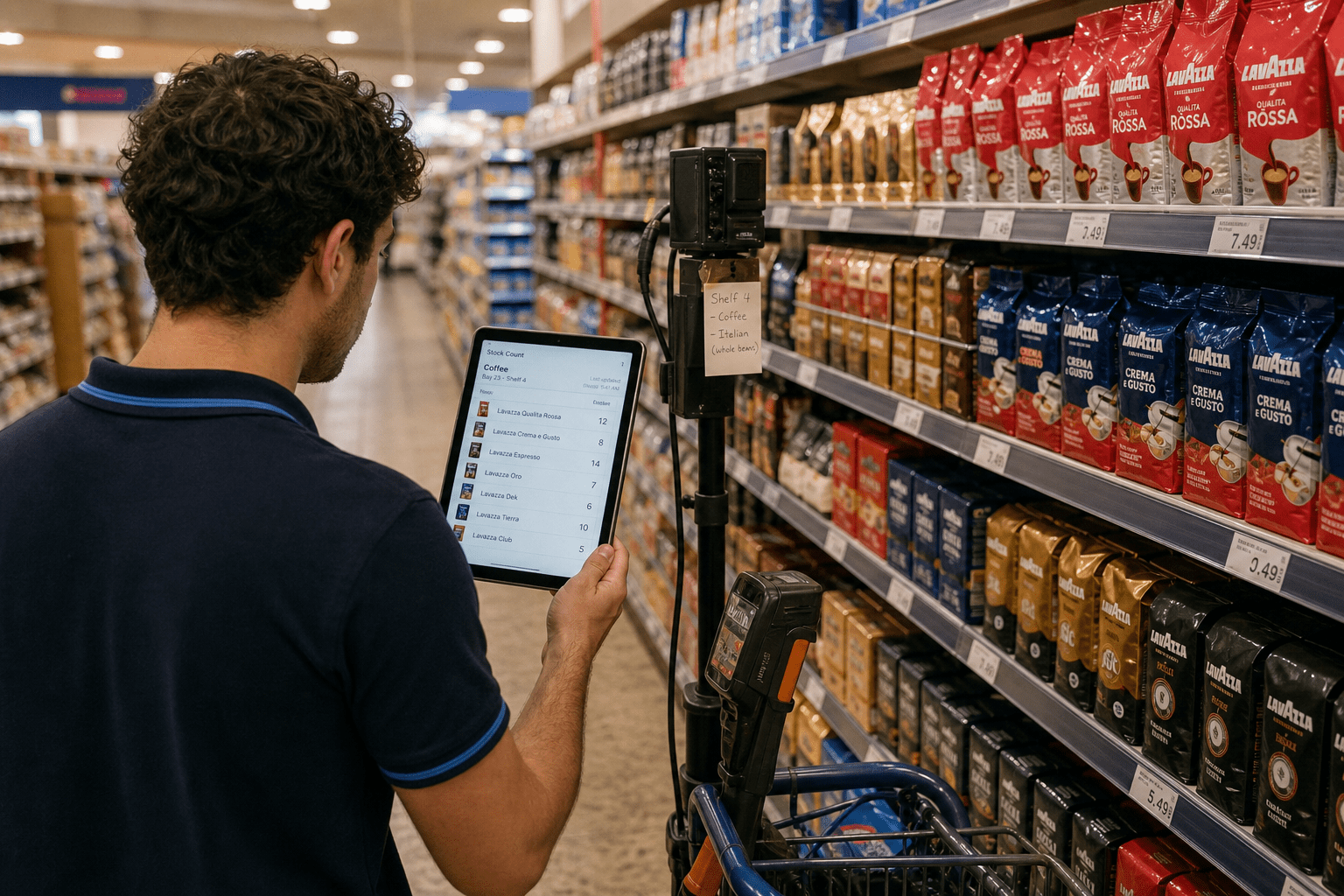
The best AI vision tools for retail inventory auditing are the ones that reduce reconciliation work, not the ones that count fastest. Counting was never where the money went. A team can walk a store with handheld scanners in a few hours, and the days that follow are spent arguing with a variance report: whether the eleven missing units are theft, a mis-scan at receiving, a unit sitting in the back room, or a product that was never counted because its packaging is reflective. A camera system that counts ten times faster and hands you a longer variance list has moved the bottleneck, not removed it. Judge these products on how they explain a discrepancy.
Why Retail Inventory Counts Are Wrong Before Anyone Automates Them
Retail inventory counts are usually wrong for reasons that predate any technology decision, which is why automation alone rarely fixes accuracy. Five causes account for most of what we see:
- Receiving errors enter the ledger as fact. A pallet booked as forty-eight units that held forty-two creates a permanent variance nobody traces back.
- Back-room stock is counted inconsistently. Some counts include it, some do not, and the rule changes with whoever ran the last audit.
- Returns re-enter stock late or never. A returned item sitting behind the counter is sold-and-returned in the system and physically present on the floor.
- The same SKU has several barcodes. Multipacks, promotional bundles, and supplier repacks fragment one product into several ledger lines.
- Counts happen at different times than the ledger snapshot. A count taken during trading hours against a snapshot from close will never reconcile cleanly.
Vision tools inherit every one of these. If the stock ledger is wrong, a more accurate physical count widens the gap rather than closing it, which reads as the new system making things worse. Our overview of AI agents in retail covers where automation fits across the wider operation.
Where AI Vision Tools for Retail Inventory Auditing Actually Work
AI vision tools for retail inventory auditing work well on repetitive, well-lit, front-of-house counting and poorly on everything else. That is not a criticism, it is a scoping fact worth knowing before a pilot. Our team looks at three things when a client asks about this: what hardware the store can realistically carry, how the recognition behaves on their actual product mix, and what happens to a variance once the system produces one.
Shelf-Edge Cameras, Handheld Capture, and Which Fits a Small Chain
Capture method is the first decision and it constrains everything downstream. In favour of fixed shelf-edge cameras: they produce continuous data, so out-of-stock detection becomes near real time and the count is a by-product of normal trading rather than an event. For a chain with consistent store layouts and the capital to fit hardware, that changes inventory from a quarterly project into a background process.
Against, and this matters for the firms we mostly work with: fixed camera installations are a construction project. Power, network drops, mounting, and a layout that does not change every promotion cycle. A five-store independent retailer that reorganises endcaps monthly gets poor value from fixed infrastructure. Handheld or trolley-mounted capture, where a staff member walks the aisle with a device, needs no installation and travels between stores, at the cost of only being accurate as of the walk. We generally start clients on handheld capture, because it proves the recognition quality on their product mix before anyone drills a hole. The AI readiness assessment we run covers exactly this sort of scoping question.
SKU Recognition Accuracy and the Packaging That Defeats It
Recognition accuracy is where vendor demos and store reality diverge most sharply. Supporting the technology: modern recognition models handle a well-merchandised aisle of visually distinct packaged goods extremely well, and accuracy on that population is genuinely high enough to trust for cycle counting. Grocery, health and beauty, and hardware aisles with consistent facings are the sweet spot.
Where it degrades, and no vendor volunteers this: reflective and transparent packaging, deep shelves where rear stock is occluded, near-identical variants distinguished only by a small flavour or size marker, soft goods that do not hold a shape, and anything stacked rather than faced. A store whose margin sits in exactly those categories will see accuracy well below the demo number. We ask every vendor to run their model against a hundred photographs of the client’s own worst aisle before any contract, and we treat a refusal as an answer. That evaluation habit is the same one we apply in our breakdown of automation tooling choices.
Counting Versus Reconciling: Where the Real Time Goes
Reconciliation is the part worth buying for, and it is where most products are thin. The argument for automated reconciliation: a system that holds both the physical observation and the ledger position can classify a variance before a human sees it, separating the eleven units missing from the shelf but present in the back room from the eleven that are genuinely unaccounted for. That turns a variance list of four hundred lines into a work list of forty.
The counterargument deserves weight. Automated classification depends on integration with the point of sale and stock systems, and those integrations are where retail projects stall. A vision product that ships with a connector for the two market-leading platforms and a spreadsheet import for everything else is a spreadsheet import for most independent retailers. Before evaluating recognition quality at all, we check what the product can actually read from the client’s stock system, because a perfect count that cannot see the ledger produces a list nobody can action. This is ordinary enterprise AI integration work, and it is usually the long pole.
The Shrink Question Vision Tools Can and Cannot Answer
Shrink is the reason most retailers look at this technology and the area where expectations need the most management. A vision system observes what is on the shelf. It does not observe why something is not, and the gap between those two statements is where a lot of disappointed pilots live.
Telling a Count Error From an Actual Loss
Distinguishing loss from error is the analytical problem underneath every shrink programme. In favour of continuous observation: frequent counts narrow the window in which a discrepancy arose. A quarterly count tells you eleven units vanished sometime in ninety days. A daily count tells you they vanished on Tuesday, and Tuesday has footage, staffing records, and transaction logs. Narrowing the window is genuinely the largest analytical gain on offer here, and it is underrated next to the counting speed vendors lead with.
Against over-claiming it: frequent counting also multiplies false variances, because each count carries its own error rate. Count something daily with ninety-eight percent accuracy and you generate a steady drizzle of two percent discrepancies that are not losses at all. Teams then either investigate noise or start ignoring the report, and the second happens more often. The workable pattern is to set a variance threshold that reflects the measured count accuracy for that category rather than treating every discrepancy as a signal, and to review the threshold quarterly against confirmed outcomes.
Planogram Compliance as a Side Effect
Planogram compliance is the benefit that most often justifies the spend, and it usually arrives unplanned. Supporting it: the same imagery that counts stock also shows whether the promotional endcap was built as specified, whether facings match the plan, and whether a supplier’s paid placement is actually being honoured. For retailers with trade agreements, that last point has direct revenue attached, and it is measurable in a way shrink reduction rarely is.
The limitation is organisational rather than technical. Compliance reporting names stores and, by implication, managers, and a system introduced as an inventory aid that starts generating performance reports will meet resistance that has nothing to do with its accuracy. We advise clients to decide up front who receives compliance output and how it will be used, and to say so plainly when the system is introduced. Getting that wrong poisons adoption faster than any false positive. Our AI implementation training work spends more time on this than on the software.
The Back Room Is Where the Method Breaks
Back-room and overstock areas defeat most vision deployments, and they hold a large share of the discrepancies worth finding. Supporting the honest scoping: shop-floor counting is a solved-enough problem, and a system that covers the floor accurately while explicitly excluding the stockroom is still worth having, provided the exclusion is stated. Many retailers get real value from exactly that arrangement.
Against pretending otherwise: stockrooms are stacked rather than faced, lit unevenly, reorganised constantly by whoever unpacked the last delivery, and full of mixed cartons whose contents are invisible from any angle. Recognition designed for shelf facings performs badly there, and a count that silently covers the floor while the ledger covers everything produces a systematic variance that looks like shrink. We have seen a pilot report a worsening loss rate for six weeks before anyone realised the back room was simply not being counted.
The practical arrangement we recommend is to treat the two areas as separate populations with separate methods. Vision handles the floor at high frequency. The stockroom gets a lower-frequency manual or barcode count, and the reconciliation runs against the combined figure. That is less elegant than a single system and it is honest about where the technology stops, which matters more when someone is reading a variance report and deciding whether to open an investigation.
How We Score AI Vision Tools for Retail Inventory Auditing
We score AI vision tools for retail inventory auditing on four questions, and counting speed is deliberately not among them. Can it read your stock ledger, natively, today, because integration decides whether output becomes action. Does it classify variances rather than only listing them, since a longer list is not progress. Does it report its own confidence per SKU, so you know which categories it is guessing at instead of receiving one flattering headline accuracy figure. Does it retain the imagery behind a count, because a variance you cannot revisit is a variance you cannot settle.
That third question separates serious products quickly. A tool reporting ninety-seven percent accuracy across a store is describing an average that hides the transparent-packaging aisle sitting at sixty. Per-category confidence lets you deploy the system where it is strong and keep manual counts where it is weak, which is a sensible operating model and the one most successful deployments settle into. Broader context on where this sits alongside other retail automation is in our piece on retail AI agents across inventory and customer experience, and the general capability set is described under our AI agents services and intelligent process automation work.
Frequently Asked Questions
How accurate are AI vision inventory counts in a real store?
Accuracy varies far more by product category than by vendor. Faced, opaque, visually distinct packaging counts very well. Stacked goods, transparent or reflective packaging, soft goods, and near-identical variants count considerably worse. Ask for per-category numbers rather than a store-wide average.
Will this replace our physical stocktake?
Not initially, and often not entirely. Most retailers keep an annual full count for financial purposes and use vision counting to replace cycle counts through the year. The saving comes from the cycle counts, which consume more staff hours in total than the annual event.
Do we need fixed cameras or is handheld capture enough?
Handheld capture suits smaller chains and stores whose layouts change often, since it needs no installation and proves accuracy before capital is committed. Fixed cameras pay back where layouts are stable and continuous out-of-stock detection has direct sales value.
Can vision tools detect theft?
They detect discrepancies, not theft. Frequent counting narrows the window in which stock went missing, which makes an investigation far more tractable, but attributing a loss still requires transaction data, footage, and staffing records alongside the count.
What has to be true before a pilot is worth running?
Your stock ledger needs to be trustworthy enough that a variance means something. If receiving errors and unprocessed returns are already producing large unexplained discrepancies, fix that first, or the pilot will simply measure the mess more precisely.
Who Is Behind This Advice
Our team has run these evaluations with retailers who expected a counting product and needed a reconciliation one. The pattern repeats: the pilot counts beautifully, produces a variance report longer than the manual process ever did, and stalls because nobody owns the next step. The deployments that succeed are the ones where somebody decided in advance who works the variance list, on what cadence, and what threshold is worth chasing.
We also tell clients when the answer is not to buy anything. A retailer whose stock ledger is unreliable at receiving will get more accuracy improvement from fixing that process than from any camera, and it costs a fraction as much.
Matt Rosenthal leads Mindcore and focuses on technology decisions that fit how a business actually operates, so a tool a team will not use does not get bought in the first place.
Fix the Ledger, Then Buy the Camera
The takeaway is worth applying before your next inventory cycle. AI vision inventory auditing is real and it works, inside boundaries that vendors are slow to name: well-faced, opaque, visually distinct products in stores whose stock ledger is already trustworthy. Start by testing recognition against your own worst aisle rather than a demo set. Check what the product can read from your stock system before you evaluate anything else, because an unintegrated count produces a list nobody can act on. Set variance thresholds from measured accuracy per category instead of treating every discrepancy as a signal. Decide who works the variance list and who receives compliance reporting before the first camera arrives. Done that way, the technology takes real hours out of the year and gives you a shrink investigation that starts on a Tuesday rather than a quarter. If you want help deciding whether your ledger is ready for it, book a free strategy call and we will look at your last variance report together.

