

You did not win a federal contract by cutting corners, and the agency on the other side of that contract knows it. So when a prime asks for proof that your environment meets CMMC, or when a contracting officer wants to see how you handle Controlled Unclassified Information, the answer cannot be “we’re working on it.” For government contractors across New Orleans, Baton Rouge, Shreveport, and the rest of Louisiana, cybersecurity is no longer an IT line item. It is a condition of staying eligible to bid.
The hard part is not deciding that you need help. It is figuring out which partner can actually carry the weight of a Department of Defense or federal civilian requirement without handing you a generic managed-security package that was never built for the defense industrial base. This guide gives you the criteria to evaluate the best cybersecurity companies in Louisiana for government contractors, so you can tell a real compliance partner apart from a vendor who learned the acronyms last quarter.
Why Louisiana Government Contractors Face a Different Bar
A retail business that gets breached loses data and trust. A government contractor that gets breached can lose its contract, its security clearance sponsorship, and its place in the supply chain. The stakes are structural, not just reputational.
Louisiana has a dense defense and federal services footprint, which increases demand for cybersecurity companies in Louisiana that understand federal contracting requirements. There is shipbuilding and maritime work along the Gulf, aerospace and manufacturing tied to NASA’s Michoud facility, and a long roster of professional services firms that subcontract to primes handling defense work. Every one of those relationships flows down security obligations. When a prime contractor signs a DoD contract, the clauses do not stop at the prime. They cascade to every subcontractor who touches the data.
That flow-down is where most small and mid-sized Louisiana contractors get caught off guard. You may never speak directly to a contracting officer, but the prime above you is contractually obligated to verify that you meet the same standards they do. A weak link in the chain is their liability, so they will push the requirement down to you, often with a deadline attached.
The Four Readiness Pillars That Actually Matter
Most “top cybersecurity companies” lists rank vendors on revenue, headcount, or how many badges sit on their homepage. None of that tells you whether they can get you through an assessment. For a government contractor, the right evaluation framework comes down to four readiness pillars. Hold every candidate against these.
Pillar 1: CMMC Level Mapping
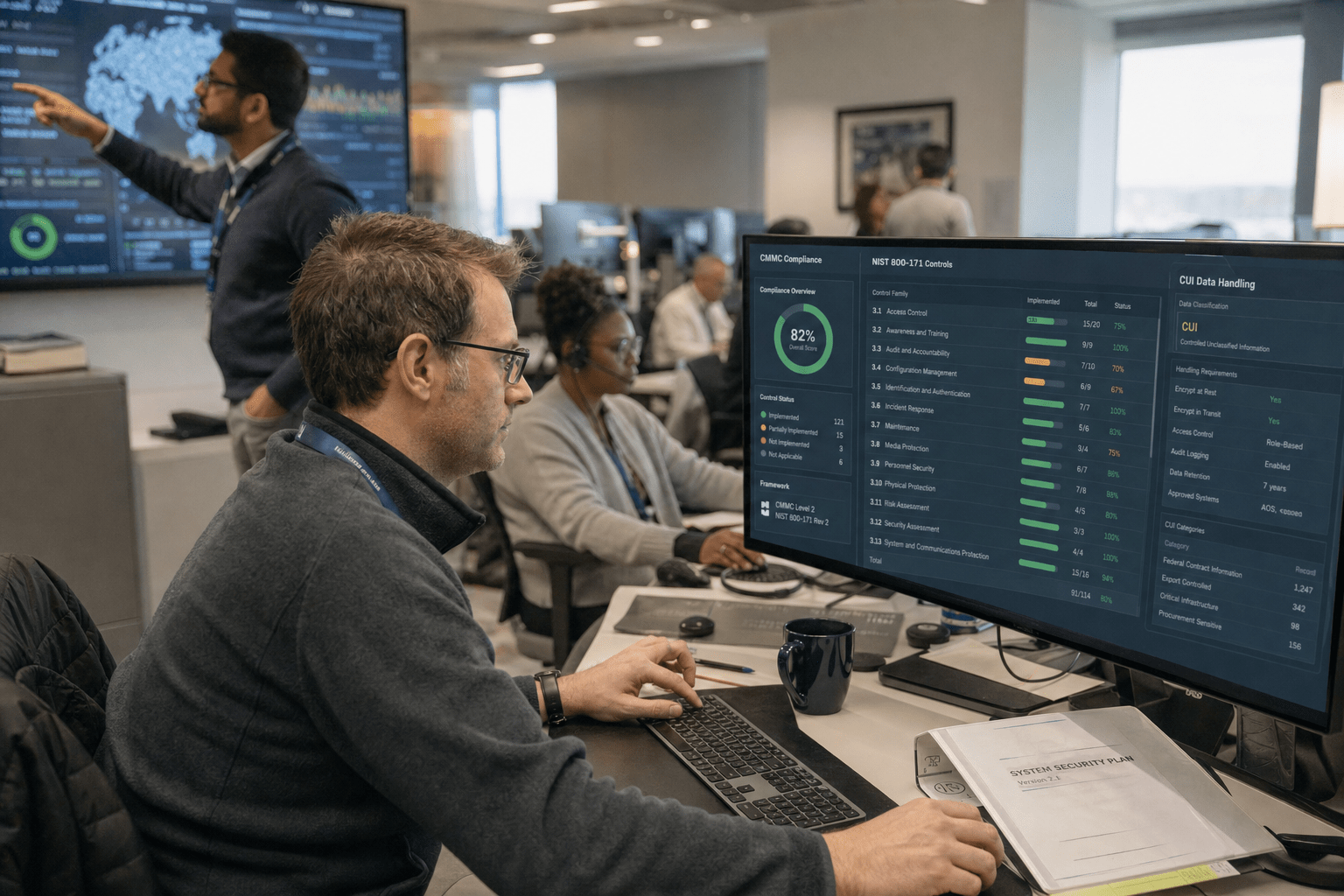
The Cybersecurity Maturity Model Certification program is now the gate for most DoD work. Level 1 covers basic safeguarding of Federal Contract Information. Level 2 aligns with the 110 controls in NIST SP 800-171 and applies to anyone handling Controlled Unclassified Information. Level 3 raises the bar further for the most sensitive programs.
A capable cybersecurity companies in Louisiana provider does not start by selling you tools. They start by mapping your contracts to the level you are actually required to hit, because over-engineering to Level 3 when you need Level 2 wastes money, and under-shooting fails the audit. Ask any candidate to walk you through how they determine your required level. If the answer is vague, keep looking. Mindcore’s CMMC certification support begins with exactly this scoping step.
Pillar 2: CUI Handling and Data-Flow Control
Controlled Unclassified Information is the heart of the requirement. The 800-171 controls exist to protect it. But you cannot protect data you cannot see, and most contractors have no clear picture of where CUI actually lives inside their environment.
A strong partner builds a data-flow map first. Where does CUI enter? Email, a prime’s portal, a shared drive? Where does it get stored, processed, and eventually deleted? Which employees and subcontractors touch it? Until that map exists, encryption and access controls are guesswork. The vendors who skip straight to deploying software without scoping your CUI boundary are the ones who leave you exposed at assessment time.
Pillar 3: ATO and Assessment Support
Winning the work often depends on an Authorization to Operate or a passing third-party assessment. This is paperwork-heavy, evidence-heavy, and unforgiving. A System Security Plan, a Plan of Action and Milestones, and a defensible self-assessment score in the Supplier Performance Risk System are not optional.
The right partner does not just harden your network and walk away. They help you assemble the body of evidence an assessor will demand, and they stay with you through the assessment itself. Ask candidates whether they have shepherded a client through a C3PAO assessment or a federal ATO, and what their role looked like when the assessor started asking hard questions.
Pillar 4: Incident Response and DFARS Reporting
DFARS clause 252.204-7012 requires contractors to report a cyber incident to the DoD within 72 hours of discovery. Seventy-two hours is not a lot of time to detect, scope, preserve evidence, and file a compliant report. If your partner cannot stand up that capability, the clause becomes a trap.
When assessing cybersecurity companies in Louisiana, evaluate every candidate on their incident response readiness. Do they offer monitoring that actually catches an intrusion early? Do they have a documented response runbook tuned to federal reporting timelines? A contractor who discovers a breach on day five and reports on day six has already failed the clause, regardless of how clean the rest of the program looked.

Local Presence Is a Practical Advantage, Not a Slogan
You can run a security program remotely, and plenty of it should be. But there are moments where being in the state matters. An on-site assessment, a sensitive incident that needs hands on hardware, a prime that wants a face-to-face before extending a subcontract. A partner with people in Louisiana can show up when showing up is the difference.
Mindcore maintains a Louisiana presence in New Orleans, which means assessment support and incident response are not a four-hour flight away. For contractors who need a partner that understands both the federal requirement and the local landscape, proximity removes friction at the exact moments it counts.
Red Flags When You Evaluate a Cybersecurity Partner
Knowing what to look for is half the job. Knowing what to avoid is the other half. Watch for these signals when you talk to candidates.
A vendor that quotes a flat monthly price before scoping your CUI boundary is selling a product, not a compliance outcome. A vendor that promises CMMC certification as if they issue it themselves does not understand the program, because certification comes from an authorized third-party assessor, not your IT provider. A vendor that has no answer for the 72-hour DFARS reporting window has never supported a defense contractor through a real incident. And a vendor that cannot show you a sample System Security Plan or describe the assessment evidence trail is going to leave you scrambling when an assessor arrives.
The pattern across all of these is the same: generic managed IT dressed up in defense language. The federal requirement is specific, and a partner who treats it generically will cost you the contract.
How the Evaluation Maps to a Decision
Once you have run candidates through the four pillars and screened for red flags, the decision usually clarifies itself. Score each candidate on whether they scope your CMMC level correctly, map your CUI before deploying anything, carry you through assessment evidence, and stand up a response capability that beats the 72-hour clock. The partner among cybersecurity companies in Louisiana who scores well on all four is the one who keeps you eligible to bid.
This is the same discipline that protects regulated firms in other industries. The criteria shift with the framework, but the rigor does not, and you can see a parallel version of this thinking in our breakdown of the best cybersecurity companies for insurance companies, where the governing standard differs but the evaluation logic holds.
Where Mindcore Fits
Mindcore works as a guide for Louisiana government contractors, not as a box of tools you have to figure out yourself. The starting point is your contracts and your data, not a product catalog. We scope the CMMC level your awards actually require, map where CUI flows through your environment, build the System Security Plan and evidence trail an assessor will demand, and stand up monitoring and response tuned to the DFARS reporting window.
Our broader cybersecurity services and cybersecurity compliance practice exist to keep your environment defensible long after the certificate is issued, because compliance is a posture you maintain, not a date you pass. The goal is simple. When the next contract depends on proof that your security holds up, you have the proof ready.
If you are a government contractor in Louisiana weighing your options, the next step is a short conversation about where you stand today. Book a free strategy call and we will walk through your readiness against the four pillars, no obligation.
Frequently Asked Questions
What cybersecurity standard do government contractors in Louisiana have to meet?
Most Louisiana contractors working on DoD or federal civilian contracts must meet CMMC requirements, which for anyone handling Controlled Unclassified Information align with the 110 controls in NIST SP 800-171. The exact level depends on the data your contracts involve, so the first step is mapping your contracts to a required level rather than assuming.
Do small subcontractors really have to comply, or just the prime?
Subcontractors are squarely in scope. Security obligations flow down from the prime contractor through every tier of the supply chain. If you touch Federal Contract Information or Controlled Unclassified Information, the prime above you is obligated to verify that you meet the same standard they do, usually on a deadline.
How fast do we have to report a cyber incident?
DFARS clause 252.204-7012 requires reporting a cyber incident to the DoD within 72 hours of discovery. That short window is why incident response and early detection are core evaluation criteria, not afterthoughts, when you choose a cybersecurity partner.
Can a cybersecurity company certify us for CMMC directly?
No. CMMC certification comes from an authorized third-party assessment organization, not your IT or security provider. A good partner prepares you for that assessment, assembles the evidence, and supports you through it, but any vendor claiming to issue the certification itself misunderstands the program.
Why does a Louisiana presence matter if security work is mostly remote?
Most of the program runs remotely, but on-site assessments, hands-on incident response, and face-to-face checks with a prime are easier when your partner has people in the state. A New Orleans presence means support arrives quickly at the moments that need a physical presence.
Louisiana Government Contractor Cybersecurity and CMMC Compliance Expertise from Matt Rosenthal
Matt Rosenthal, CEO of Mindcore Technologies, has over 30 years of experience helping Louisiana defense contractors across New Orleans, Baton Rouge, Shreveport, and the Gulf Coast shipbuilding and aerospace corridors navigate CMMC requirements, map CUI data flows before deploying any controls, and build the System Security Plan and assessment evidence that a C3PAO assessor will actually examine. He has seen firsthand how Louisiana subcontractors get caught off guard when a prime pushes compliance requirements down the supply chain on a 90-day deadline, and their existing IT provider has no answer for DFARS 72-hour incident reporting, no evidence trail, and no documented SSP. Matt leads a team with Louisiana presence that scopes CMMC levels from actual contract language, builds CUI boundaries before recommending a single tool, and stays through assessment so contractors arrive with proof rather than a promise.

