

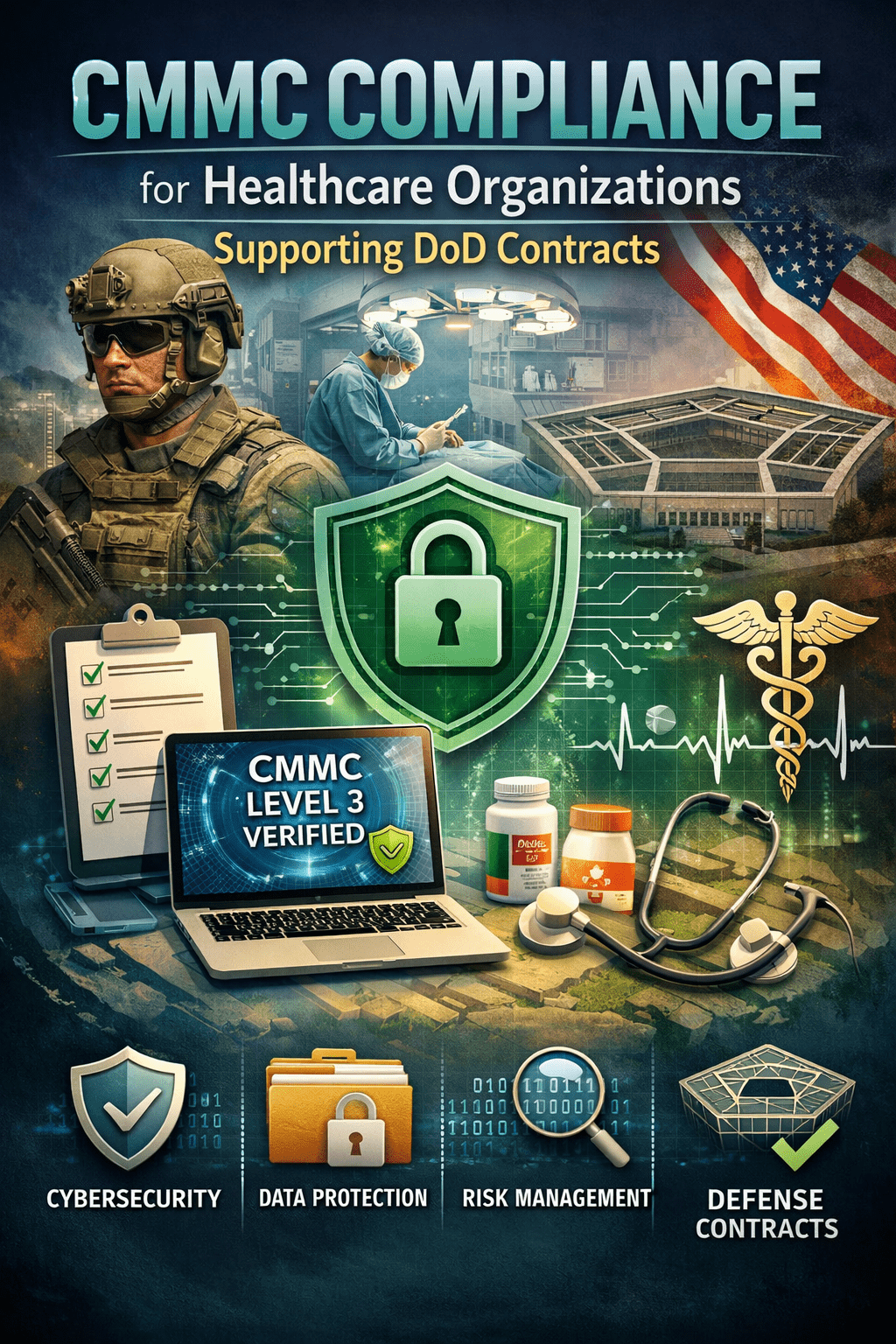
Healthcare organizations that support DoD contracts — military treatment facility contractors, defense health agency vendors, medical research organizations, clinical service providers — carry a compliance burden that most of the defense industrial base does not: HIPAA and CMMC simultaneously.
Those two frameworks are not the same. They have overlapping requirements in some domains and conflicting implementation assumptions in others. Organizations that try to satisfy CMMC by extending their HIPAA compliance program discover the gaps quickly. Those that try to build CMMC compliance without accounting for HIPAA operational constraints create controls that their clinical staff cannot follow.
The correct approach treats HIPAA and CMMC as parallel but distinct compliance obligations — identifying where they align, where they diverge, and designing an infrastructure that satisfies both without requiring parallel security programs that compete for resources and create operational confusion.
Overview
Healthcare organizations supporting DoD contracts handle two distinct categories of sensitive information: PHI governed by HIPAA and CUI governed by CMMC. Those categories may overlap in some clinical research contexts, but they typically require separate handling frameworks, separate access controls, and separate audit trail architectures. The compliance design challenge is building a single operational environment that satisfies both frameworks without creating segregated infrastructure that doubles the cost of compliance and creates operational barriers that undermine clinical workflows.
- PHI and CUI may coexist in healthcare organizations but require distinct handling frameworks
- HIPAA minimum necessary and CMMC least privilege align in principle but differ in implementation specifics
- CMMC boundary protection requirements are more prescriptive than HIPAA’s administrative safeguard equivalents
- Audit and accountability requirements under CMMC are more technically specific than HIPAA audit controls
- Clinical workflow continuity must be preserved — compliance architecture that breaks clinical operations will be bypassed
The 5 Why’s
- Why can’t healthcare organizations satisfy CMMC requirements through HIPAA compliance alone? HIPAA is a risk-based framework — it requires reasonable safeguards calibrated to the organization’s risk environment. CMMC is a prescriptive framework — it requires specific controls regardless of risk calibration. HIPAA compliance demonstrates that an organization has addressed healthcare data risks appropriately. CMMC compliance requires specific technical implementations that HIPAA does not mandate. The gap between them is the difference between risk management and control specification.
- Why do CMMC CUI handling requirements create specific challenges for clinical environments? Clinical workflows depend on rapid, unrestricted access to patient records for care delivery. CMMC access control requirements — least privilege, session-based authorization, explicit access approval — introduce access friction that clinical environments are designed to eliminate. Organizations that apply CMMC controls uniformly across clinical and CUI handling environments create operational barriers that result in workarounds rather than compliance. CUI must be isolated from clinical operations to apply CMMC controls appropriately.
- Why does the dual HIPAA/CMMC compliance burden require a unified infrastructure approach? Running separate HIPAA-compliant and CMMC-compliant infrastructure doubles the operational cost, creates integration complexity, and produces two separate security programs that compete for the same staff attention. A unified infrastructure approach — where security controls satisfy both frameworks in their shared domains and separate handling environments address the domain-specific requirements — produces compliance at sustainable cost.
- Why is CUI-PHI intersection a specific risk area that requires design attention? In defense health research and some clinical contracting contexts, information that qualifies as both PHI and CUI exists. That intersection creates compliance obligations under both frameworks simultaneously. CMMC CUI handling requirements apply. HIPAA safeguard requirements apply. Incident response, breach notification, and audit requirements from both frameworks apply. The design must account for both sets of obligations — not default to one framework and create gaps in the other.
- Why do healthcare organizations frequently underestimate CMMC system boundary scope? Healthcare organizations accustomed to HIPAA’s covered entity model tend to scope CUI handling to the systems that primarily handle defense data. CMMC system boundary requirements include any system that stores, processes, or transmits CUI — which may include email systems that receive DoD correspondence, file sharing platforms used for contract document exchange, and administrative systems that process contract-related financial data. Scope underestimation is the most common source of CMMC assessment failure in healthcare contractor environments.
Designing for Dual Compliance
Separating CUI from PHI Environments
The foundational design decision for healthcare organizations pursuing dual compliance is environmental separation:
- Clinical environment — HIPAA-governed; access optimized for care delivery; PHI handling under minimum necessary standard; HIPAA audit controls
- CUI environment — CMMC-governed; access enforced under least privilege; CUI handling under CMMC AC controls; CMMC AU audit infrastructure
Where personnel need to work in both environments, the access mechanisms and audit controls for each environment are distinct. CUI access does not use clinical workflow access tools. PHI access does not inherit CUI environment controls.
Shared Controls That Satisfy Both Frameworks
Several control areas satisfy both HIPAA and CMMC requirements with shared implementation:
- Multi-factor authentication — required under CMMC IA domain and strongly indicated under HIPAA; a single MFA implementation satisfies both
- Encryption — HIPAA encryption addressable risk and CMMC SC.3.177 encryption requirements are both satisfied by encryption at rest and in transit across both environments
- Workforce training — HIPAA workforce security and CMMC AT requirements both require security awareness training; unified training programs with framework-specific content satisfy both
- Incident response — HIPAA breach notification and CMMC IR domain requirements both require incident response programs; a unified IR plan with framework-specific notification procedures satisfies both
CMMC-Specific Requirements That HIPAA Does Not Address
Organizations must implement these CMMC controls as additions to their HIPAA compliance baseline:
- CMMC system and communications protection — managed interfaces, boundary protection, and traffic monitoring more prescriptive than HIPAA’s technical safeguard equivalents
- CMMC configuration management — baseline configurations, change control, and least functionality requirements not present in HIPAA
- CMMC risk management — CMMC RM domain requirements for periodic risk assessments and POAM management more structured than HIPAA’s general risk analysis obligation
- CMMC media protection — CUI media sanitization and disposal requirements more specific than HIPAA media disposal addressable safeguard
Clinical Workflow Continuity Considerations
CMMC compliance architecture for healthcare organizations must preserve clinical workflow continuity:
- CUI handling systems are isolated from clinical care systems — clinical staff do not encounter CMMC access friction during care delivery
- Clinical staff who work on defense contracts access CUI through defined pathways that are separate from clinical application access
- Security awareness training for clinical staff distinguishes between clinical data handling (HIPAA) and defense contract data handling (CMMC) — staff understand which framework governs which activity
A Simple Dual Compliance Gap Assessment
Healthcare organizations supporting DoD contracts have dual compliance gaps if:
- CUI is handled in the same systems and on the same networks as PHI without distinct access controls and audit trails
- CMMC system boundary scoping has not been performed — the full set of systems touching CUI has not been identified
- HIPAA compliance is assumed to satisfy CMMC configuration management, boundary protection, and continuous monitoring requirements
- Clinical staff who access CUI do not receive CMMC-specific security awareness training separate from their HIPAA training
Final Takeaway
Healthcare organizations supporting DoD contracts are not the same as general DIB contractors — and their CMMC compliance programs should not be. The dual HIPAA/CMMC compliance burden requires design that accounts for both frameworks simultaneously, separates the environments each governs, identifies the shared controls that satisfy both, and preserves the clinical workflow continuity that care delivery requires.
Organizations that design for both produce compliance programs that are sustainable operationally and defensible in assessment. Those that attempt to satisfy CMMC by extending their HIPAA program produce compliance gaps that assessors find and clinical workarounds that undermine the controls they find.
Implement Dual HIPAA/CMMC Compliance With Mindcore Technologies
Mindcore Technologies works with healthcare organizations supporting DoD contracts to design and implement dual-framework compliance programs — CUI environment isolation, shared control implementation, CMMC-specific control additions, and clinical workflow continuity design that produces sustainable compliance without operational disruption.
Talk to Mindcore Technologies About CMMC Compliance for Healthcare Organizations →
Contact our team to assess your current compliance posture against both HIPAA and CMMC requirements and design the unified infrastructure that satisfies both.

