

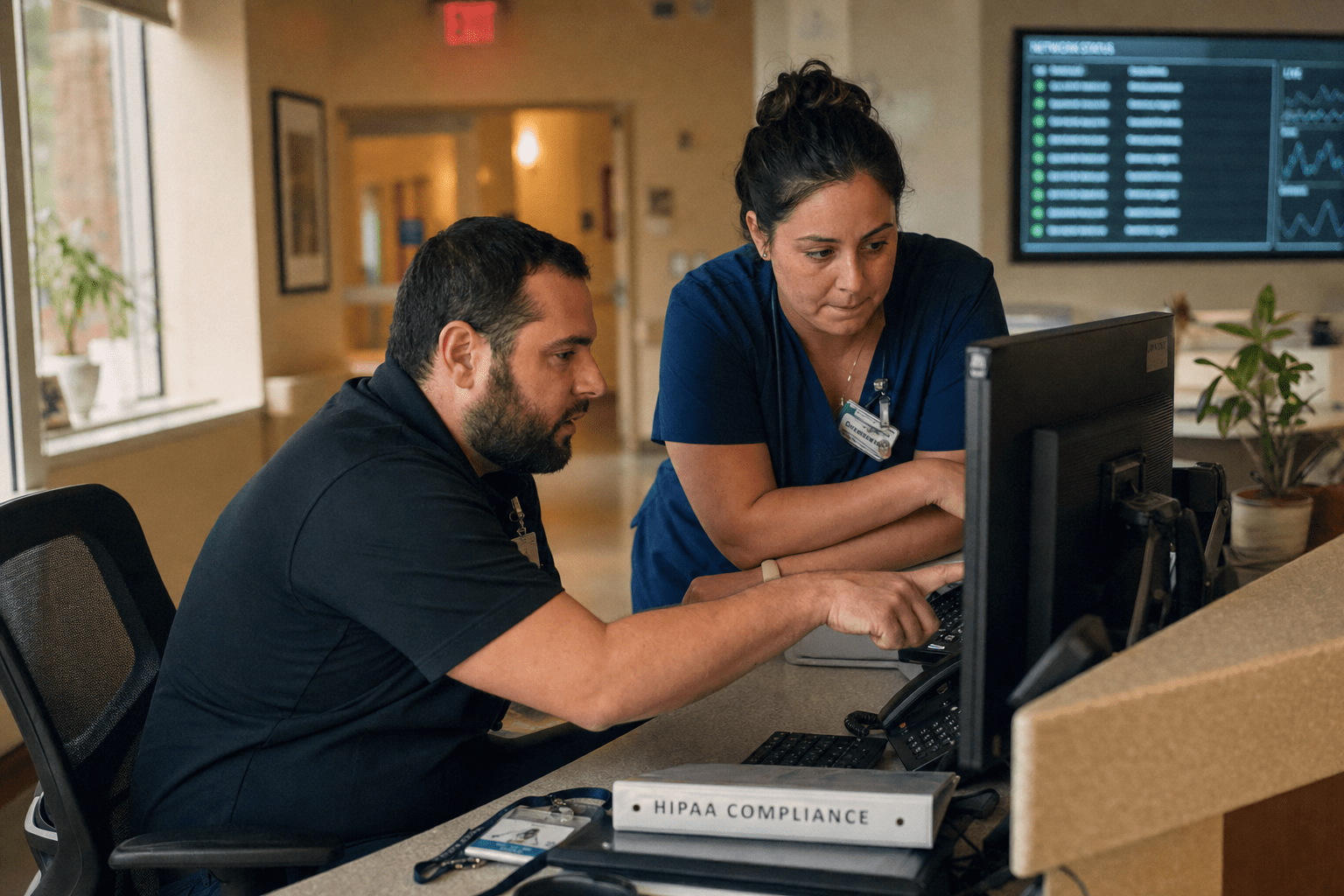
Choosing the best Cybersecurity Services in New Jersey for healthcare organizations means verifying whether the provider works in healthcare daily or treats your practice like a generic office. Patient data is highly valuable, and breaches can trigger HIPAA penalties along with New Jersey breach-notification requirements. The right Cybersecurity Services in New Jersey protects patient records, keeps connected medical devices safe, and gives your team a plan for the day something goes wrong. This guide walks through what separates a strong healthcare security firm from a generic vendor, and how to judge one before you sign.
Five things to look for before you shortlist a firm
Healthcare security is a specialty, and a short checklist keeps your search focused on what protects patients.
- Real HIPAA experience, including risk assessments and documented safeguards for electronic protected health information.
- Round-the-clock monitoring, because attacks on hospitals and practices rarely wait for business hours.
- A written incident response plan you can test before an emergency, not after one.
- Coverage for connected medical devices and the systems that talk to them.
- A local New Jersey presence so support arrives fast and understands state reporting timelines.
Why healthcare organizations in New Jersey are a top target
Attackers focus on healthcare because the payoff is high and the pressure to pay is even higher. A hospital that loses access to patient records cannot safely treat people, so the temptation to pay a ransom fast is real. New Jersey adds its own weight: the state has a dense mix of hospitals, specialty clinics, and independent practices, and each one holds records that combine identity data, insurance details, and medical history in one place.
The cost is more than the ransom
A breach rarely stops at the attacker demand for payment. You face forensic investigation, patient notification, credit monitoring, legal review, and often a period where scheduling and billing stall. For a mid-sized practice, the downtime alone can outrun the ransom figure. A good security partner measures success by how rarely you reach that point and how quickly you recover if you do.
Compliance is the floor, not the ceiling
HIPAA sets a baseline, and meeting it is required, but attackers do not stop at the compliance line. The best cybersecurity companies for healthcare organizations in New Jersey treat HIPAA as the starting point and then add active monitoring, staff training, and tested recovery on top. Compliance proves you did the paperwork; real defense proves you can withstand a live attack.
What the best healthcare Cybersecurity Services in New Jersey actually do
A strong healthcare security firm gives you a full program, not a single product. The pieces below work together, and a gap in any one of them is where trouble starts.
Continuous monitoring and fast response
Twenty-four-hour monitoring watches your network for the early signs of an intrusion, such as odd login patterns or a workstation reaching out to a server it has never contacted. When something looks wrong, a security team investigates and acts in minutes, not days. For a practice that runs on scheduling and electronic records, that speed is the difference between a contained event and a shutdown.
Risk assessments built for healthcare
A healthcare risk assessment maps where protected health information lives, who can reach it, and where the weak points are. It should cover your electronic health record system, your email, your backups, and every connected device from an infusion pump to a check-in tablet. The output is a prioritized plan you can act on, with the highest-risk gaps addressed first.
Staff training that sticks
Most breaches begin with a person, not a firewall. A convincing email that looks like it came from a supervisor can hand an attacker the keys. Ongoing training, paired with simulated phishing tests, turns your front-desk and clinical staff into a working line of defense. The best partners make this routine and report on it so you can see progress.
Backup and recovery you have tested
Backups only help if they work when you need them and if attackers cannot reach them. That means copies kept separate from your main network and a recovery plan your team has actually rehearsed. When ransomware hits a practice with tested, isolated backups, the answer is restore and move on rather than negotiate.
Access controls sized for a clinical team
Healthcare runs on a mix of full-time clinicians, part-time staff, and rotating contractors, and each of them touches patient data at some point. The right partner sets access by role so a front-desk hire cannot open records they never need, and it removes access the day someone leaves. Multi-factor login on every account that reaches protected health information closes one of the most common doors attackers walk through. These controls sound basic, yet they stop a large share of real breaches before they start, and a good firm makes them the default rather than an upsell. Ask any candidate how they handle new-hire setup and same-day offboarding, because a slow or manual process there is a warning sign about the rest of their work.
How to compare firms and pick the right fit
Once you have a shortlist, a few direct questions separate a genuine healthcare partner from a general IT shop.
Ask about healthcare depth first
Ask how many healthcare clients the firm serves and what those environments look like. A partner who works with practices and clinics every day already knows HIPAA, understands electronic health record systems, and speaks the language of your compliance officer. If most of their answers are about generic office networks, keep looking. You can compare this against a healthcare-focused view of managed IT service providers for healthcare organizations in New Jersey to see how depth changes the conversation.
Weigh local presence and response time
A partner with a New Jersey footprint can be on site quickly and already knows the state breach-notification expectations. Local matters when an incident is unfolding and every hour counts. Firms that serve regulated fields such as law and finance tend to bring the same rigor to healthcare, and a look at how they handle cybersecurity for law firms in New Jersey is a useful signal of that discipline.
Confirm the scope in writing
Get a clear statement of what is covered and what is not. Does the plan include connected medical devices? Does monitoring run every hour of every day, or only during business hours? Is incident response included or billed separately when you need it most? A firm confident in its healthcare work will put the scope in plain language, and you can check whether their broader New Jersey service coverage matches the locations you operate in.
Frequently Asked Questions
What should a healthcare organization look for in a Cybersecurity Services in New Jersey?
Look for documented HIPAA experience, round-the-clock monitoring, a tested incident response plan, and coverage for connected medical devices. A local New Jersey presence helps with fast on-site support and knowledge of state breach-notification timelines. Ask how many healthcare clients the firm serves before you sign.
How is healthcare cybersecurity different from general business IT security?
Healthcare adds HIPAA obligations, higher-value patient records, and connected medical devices that a standard office network does not carry. A general IT vendor may secure email and workstations well yet miss the device and compliance layers that regulators expect. Healthcare-focused firms build their programs around those extra requirements.
Does a small medical practice really need a cybersecurity partner?
Yes. Attackers target smaller practices precisely because they often have thinner defenses and cannot afford long downtime. A right-sized partner gives a small practice monitoring, training, and recovery without the cost of a full in-house team.
How much does healthcare Cybersecurity Services in New Jersey cost?
Cost depends on the number of users, the systems in use, and the depth of monitoring and response you need. Most partners price a managed program as a predictable monthly fee, which is far easier to plan around than the open-ended cost of a breach. A free strategy call is the fastest way to get a figure tied to your practice.
What happens if a healthcare organization suffers a breach?
You face forensic investigation, patient notification, possible HIPAA penalties, and downtime while systems are restored. A partner with a tested response plan and isolated backups shortens that timeline and helps you meet reporting deadlines. The goal is contained recovery instead of a prolonged shutdown.
Protect your patients and your practice today
The best Cybersecurity Services in New Jersey earn that title by living in healthcare every day, meeting HIPAA as a floor rather than a finish line, and standing ready the moment an attack begins. Mindcore is headquartered in Fairfield, New Jersey, and works with healthcare providers across the state to protect patient data, secure connected devices, and keep care running. Book a free strategy call and we will map your current risks and the fastest path to close them.

