

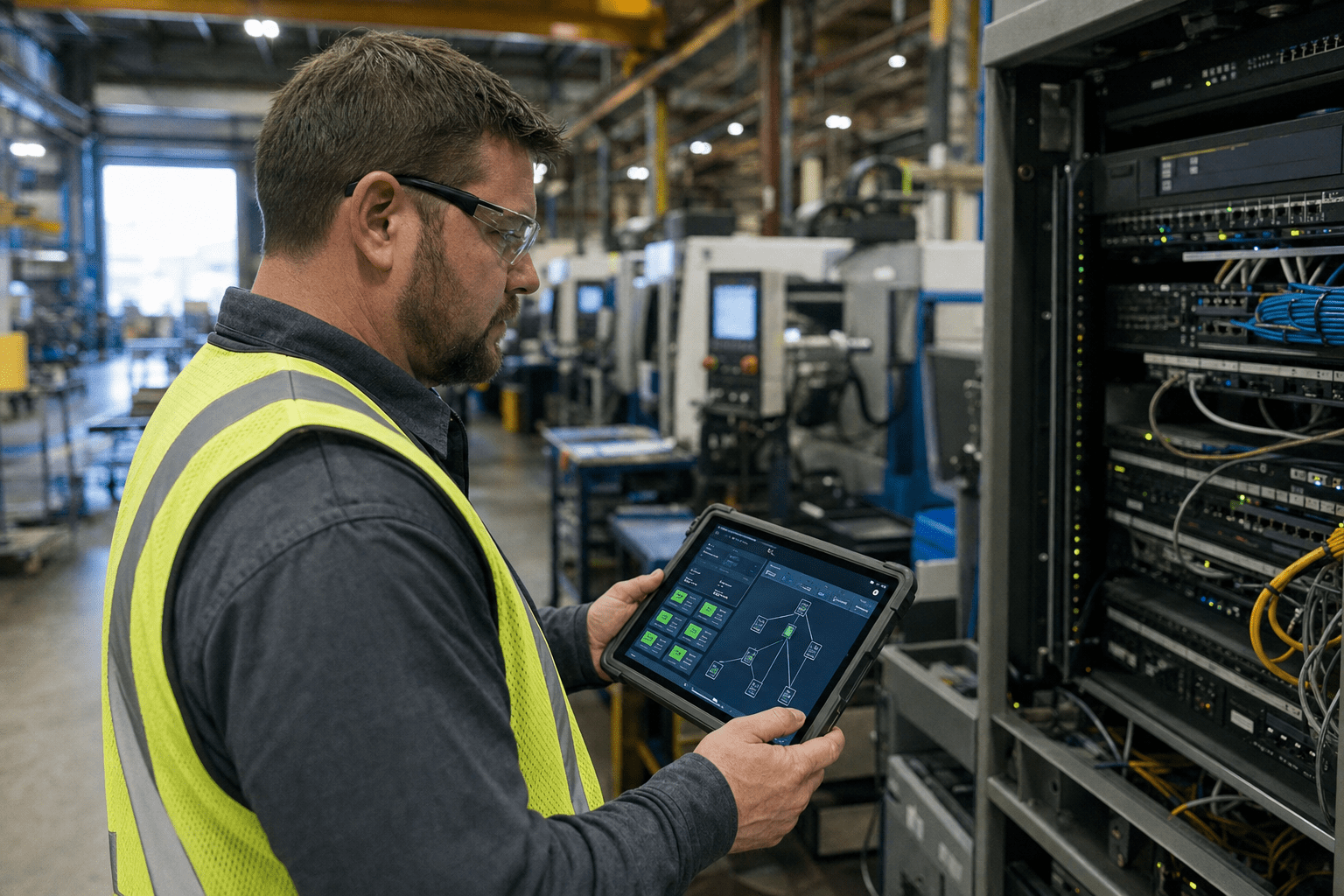
The best Managed IT Services in Alabama secure the plant floor, not just the front office, ensuring manufacturers have robust coverage for both OT and IT environments. That means a partner who treats your programmable logic controllers, HMIs, and SCADA systems as protected assets, carries documented OT and IT convergence security practices, and can prove NIST SP 800-171 and CMMC readiness when a prime contractor asks. Most generic break-fix shops cannot deliver the plant-floor security, compliance support, and response discipline expected from Managed IT Services in Alabama. They patch laptops and reset passwords, then leave a flat network where one phished email reaches a CNC machine. For an auto or aerospace supplier near Huntsville or Montgomery, that gap is the difference between winning the next contract and losing it.
Why Generic MSPs Fail Alabama Manufacturers
Most generic providers offering Managed IT Services in Alabama focus on office networks rather than the plant floor, which can put manufacturers at risk of losing critical contracts. We have walked into facilities where the same network carried payroll, email, and a line of injection-molding machines with no segmentation between them. The provider on record had been billing for years. They had never logged into a single piece of operational technology, the hardware that actually runs production. Operational technology, or OT, covers the controllers, sensors, and machines on the floor, and it follows rules that ordinary IT support never learns.
Manufacturing is the most attacked industry in the United States by ransomware, and the reason is simple economics. When a line stops, the clock runs on lost output, contract penalties, and idle labor, so attackers know the pressure to pay is high. A provider who only watches the office side of the house never sees the intrusion path that matters most. They also rarely understand why you cannot just reboot a controller during a shift or push a Windows update to a machine running validated firmware.
How OT and IT Convergence Changes the Risk
Managed IT Services in Alabama must address OT and IT convergence because factory equipment now shares networks, data, and attack surface with business systems. The upside is real. Connected machines feed production data into dashboards, predictive maintenance, and supply chain planning. The downside is that a controller designed in an era of physical isolation now sits one hop away from the internet.
The opposing view holds that air-gapping keeps OT safe, so convergence is optional. In practice, true air gaps are rare and shrinking. USB drives, vendor laptops, and remote support tools all bridge the gap, often without anyone noticing. The honest position sits in the middle. Convergence delivers efficiency you cannot ignore, and it introduces risk you cannot wish away. A provider offering Managed IT Services in Alabama understands OT and IT convergence and builds segmentation, monitoring, and access control to connect machines safely without exposing the network. The Cybersecurity and Infrastructure Security Agency publishes practical guidance on securing industrial control systems that any serious provider should already follow.
Why Break-Fix Pricing Hides the Real Cost
Unlike Managed IT Services in Alabama, break-fix pricing can appear cheaper initially but fails to prevent costly ransomware events that can wipe out a year’s savings in days. The appeal is understandable. You pay only when something breaks, and a small shop wants to protect cash flow. For manufacturers comparing break-fix support with Managed IT Services in Alabama, that pricing advantage often collapses once downtime, monitoring, and incident-response costs are considered.
The counterargument is that managed service retainers feel like paying for nothing during quiet months. That feeling is real, and we respect it. The resolution lies in what the retainer actually buys. A flat monthly model funds continuous monitoring, patching cadence, and incident readiness, the work that prevents the quiet months from ending badly. Break-fix funds none of that. It pays a technician to arrive after the damage is done. For a plant where downtime is measured in thousands of dollars per hour, prevention is the cheaper line item, even when the invoice looks larger.
How Plant Downtime Multiplies the Stakes
Plant downtime turns an IT incident into a P&L event, which is why manufacturers need providers who measure response in minutes, not business days. A law office can survive a slow morning. A stamping line that stops mid-run can scrap in-process material, miss a just-in-time delivery window, and trigger penalty clauses with a Tier 1 customer.
Some argue that downtime risk is overstated for smaller suppliers. There is a grain of truth here. A 40-person shop running one shift has less exposure than a three-shift operation feeding an OEM. The distinction does not eliminate the risk, it scales it. Either way, the question to ask a provider is the same. What is your guaranteed response time when a production system goes down, and how do you prioritize OT incidents over routine office tickets? A provider who cannot answer that clearly is not built for your environment.
What CMMC and NIST SP 800-171 Demand of Your IT Partner
CMMC and NIST SP 800-171 compliance is now a gate to defense and aerospace contracts, so your managed IT partner must be able to implement and document the controls, not just talk about them. Alabama sits at the center of this. Huntsville’s Redstone Arsenal corridor and the aerospace and defense supply chain across the state mean a large share of manufacturers either hold Controlled Unclassified Information today or will be asked to soon. When that request arrives, your IT posture either supports the contract or sinks it.
The Cybersecurity Maturity Model Certification, or CMMC, is the Department of Defense framework that verifies contractors protect sensitive information. It builds directly on NIST Special Publication 800-171, the 110-control standard for safeguarding Controlled Unclassified Information. A provider who has never produced a System Security Plan or a Plan of Action and Milestones will not get you through an assessment.
Why a System Security Plan Is the First Deliverable
A System Security Plan is the document that proves your controls exist, and a capable provider produces it as a standard deliverable rather than a special project. The System Security Plan, often shortened to SSP, describes how each required control is implemented across your environment. Without it, you have security that you cannot demonstrate, which under CMMC counts as no security at all.
One view treats the SSP as paperwork that slows real work down. We understand the frustration, because documentation does take time. The opposing reality is that assessors and prime contractors do not accept verbal assurances. They read the SSP. The balanced approach is to treat documentation as a byproduct of doing the work correctly, generated as controls go in rather than scrambled together before an audit. The full control set is published in NIST SP 800-171 Revision 3, and your provider should map your environment against it line by line.
How Maryland Manufacturers Approached the Same Problem
Manufacturers in defense-heavy states have already worked through this compliance curve, and their experience maps cleanly onto Alabama. We covered the parallel playbook in our guide for managed IT service providers for manufacturers in Maryland, where the Aberdeen and Fort Meade supply chains face the same Controlled Unclassified Information requirements.
A skeptic might say every state and every supply chain is different, so comparisons mislead. That caution is fair on the margins. Local primes, local talent pools, and local incentives do vary. The underlying compliance engine does not. NIST SP 800-171 reads the same in Mobile as it does in Baltimore, and the controls do not bend to geography. The lesson from other defense corridors is that the suppliers who treated compliance as an operational discipline, not a one-time scramble, kept their contracts. The ones who waited for an audit notice lost ground.
Why Self-Attestation Is Ending
Self-attestation, the era of checking a box and promising you are compliant, is closing, and Alabama manufacturers who relied on it face a harder bar. Under the phased CMMC rollout, more contracts will require third-party assessment rather than a contractor’s own word. The Department of Defense maintains current program details on the official CMMC site.
The hopeful interpretation is that enforcement always lags policy, so there is time to wait. There is some history behind that hope. Compliance deadlines do slip. The risk in waiting is that readiness cannot be bought overnight. Implementing 110 controls, documenting them, and proving them takes months, not weeks. A manufacturer who starts when the contract clause appears has already lost the timeline. The providers who serve manufacturers well start that work before the requirement becomes urgent, so the SSP and evidence are ready when a prime asks.

How to Evaluate Managed IT Providers for Your Plant
When considering Managed IT Services in Alabama, evaluate providers based on their plant-floor competence, compliance capabilities, and response discipline rather than simply comparing hourly rates. The directory listings and ranking sites that fill search results sort providers by review volume and marketing spend. They do not tell you whether a provider can segment an OT network or write an SSP. When evaluating Managed IT Services in Alabama, manufacturers must directly test each provider’s OT expertise, compliance capabilities, and production-response procedures.
We recommend you treat provider selection like a supplier qualification, because that is what it is. You would not onboard a parts vendor without auditing their process. Your IT partner touches every contract you hope to win, so the bar should be at least as high.
What Questions Separate Real Manufacturing MSPs
The questions that separate a real manufacturing MSP from an office shop center on operational technology and compliance evidence. Ask each candidate directly, and listen for specifics rather than reassurance.
- Can you segment our OT network from our business network, and show us a reference architecture you have deployed?
- Have you produced a NIST SP 800-171 System Security Plan, and can you walk us through one with a client name redacted?
- What is your guaranteed response time for a production-down OT incident versus a routine office ticket?
- How do you patch validated machinery without violating firmware or warranty constraints?
- Do you carry cyber insurance, and have you helped a manufacturing client through an actual incident?
A provider who answers these with concrete examples is built for your environment. One who pivots to talking about help desk satisfaction scores is not.
How Co-Managed IT Fits Manufacturers With Internal Staff
Co-managed IT lets a manufacturer with an internal technician or small team add specialized OT and compliance depth without replacing the people who know the plant. Many Alabama shops already employ someone who keeps the network running day to day. The gap is rarely day-to-day support. It is the specialized work, OT segmentation, CMMC documentation, and 24-hour monitoring, that a one-person internal team cannot cover alone.
The objection is that two cooks spoil the kitchen, and overlapping responsibilities create confusion. That risk is real when roles are vague. The fix is a clear division of labor written into the engagement, internal staff owns what they know best, the provider owns the specialized layer. We broke down how to structure this in our piece on how SMBs pick the best co-managed IT service providers. For a manufacturer, co-managed often delivers the most capability per dollar, because you keep institutional knowledge and add the depth you lack.
Why Local Presence Still Matters in a Remote World
Local presence still matters for manufacturers because a controller failure, a network drop on the floor, or a hardware swap sometimes needs hands on site within the hour. Remote monitoring covers most of the work, and a good provider resolves the majority of issues without a truck roll.
The counterpoint is that cloud tooling and remote access have made geography irrelevant. For office IT, that is largely true. For a plant, it is only partly true. When a switch in the production network fails, no remote session brings the line back. A provider with technicians who can reach Huntsville, Birmingham, Montgomery, or Mobile within a reasonable drive gives you a floor under your downtime risk. The strongest Managed IT Services in Alabama combine remote technical depth with local support for plant-floor incidents that require hands-on assistance.
Frequently Asked Questions
What makes a managed IT provider right for manufacturers in Alabama?
The right provider secures both your office network and your plant floor, including operational technology like controllers and SCADA systems. They should also demonstrate NIST SP 800-171 and CMMC readiness, since Alabama’s aerospace and defense supply chains increasingly require it. Generic providers who only support office hardware leave your production environment exposed.
Do Alabama manufacturers really need CMMC compliance?
Manufacturers in defense and aerospace supply chains need CMMC compliance to keep and win Department of Defense contracts. Alabama’s concentration around Redstone Arsenal and the broader aerospace sector means many local suppliers handle Controlled Unclassified Information. Even manufacturers not yet asked for compliance should prepare early, because implementing the controls takes months.
How is managed IT for manufacturers different from regular business IT?
Manufacturing IT must protect operational technology, the machines and controllers that run production, in addition to standard business systems. It requires network segmentation, careful patching of validated equipment, and response times measured in minutes because downtime stops production. Regular business IT focuses on office support and rarely touches the plant floor.
What is OT and IT convergence and why does it matter?
OT and IT convergence is the merging of factory operational technology with business information systems onto shared networks. It matters because it delivers production efficiency while exposing once-isolated machines to cyber threats. A capable managed IT provider uses segmentation and monitoring to capture the efficiency without opening the plant floor to attack.
Should we choose a fully managed or co-managed IT provider?
Choose fully managed if you have no internal IT staff, and co-managed if you employ a technician or small team you want to keep. Co-managed lets your internal staff handle daily support while the provider adds specialized OT security and CMMC documentation. The right model depends on your existing capacity, not on a one-size-fits-all rule.
Secure the Plant Floor, Not Just the Office
Choosing a managed IT provider for an Alabama manufacturing operation comes down to one principle: the partner must protect production, prove compliance, and respond fast enough to keep your lines running. The ranking sites and directories that dominate search will sort vendors by review count and ad spend, but those signals say nothing about whether a provider can segment your OT network, write a System Security Plan, or get a technician to your floor when a controller fails. The manufacturers who win defense and aerospace contracts in Huntsville, Montgomery, Mobile, and Birmingham are the ones who treated IT and security as an operational discipline, built into how the plant runs rather than bolted on before an audit. Our team works with manufacturers across the Southeast to secure operational technology, build NIST SP 800-171 and CMMC readiness, and keep production protected around the clock. If you want a clear read on where your plant stands and what a real manufacturing-grade partner looks like, book a free strategy call and we will walk your environment with you.
Alabama Manufacturing IT and OT Security and CMMC Compliance Expertise from Matt Rosenthal
Matt Rosenthal, CEO of Mindcore Technologies, has over 30 years of experience helping Alabama manufacturers in the Huntsville aerospace and defense corridor, Birmingham, Montgomery, and Mobile find managed IT partners who secure the plant floor alongside the front office rather than billing for years without ever logging into a single piece of operational technology. He has seen firsthand how facilities run flat networks where one phished email in the office reaches a CNC machine on the floor, and how manufacturers relying on self-attestation discover when a prime contractor asks for a System Security Plan that they have controls they cannot demonstrate, which under CMMC counts as no controls at all. Matt leads a team that segments OT from IT networks with documented reference architectures, produces NIST SP 800-171 System Security Plans and Plans of Action and Milestones as standard deliverables rather than special projects, and measures OT incident response in minutes because a stamping line that stops mid-run costs money that no uptime percentage on a sales sheet can recover.

