

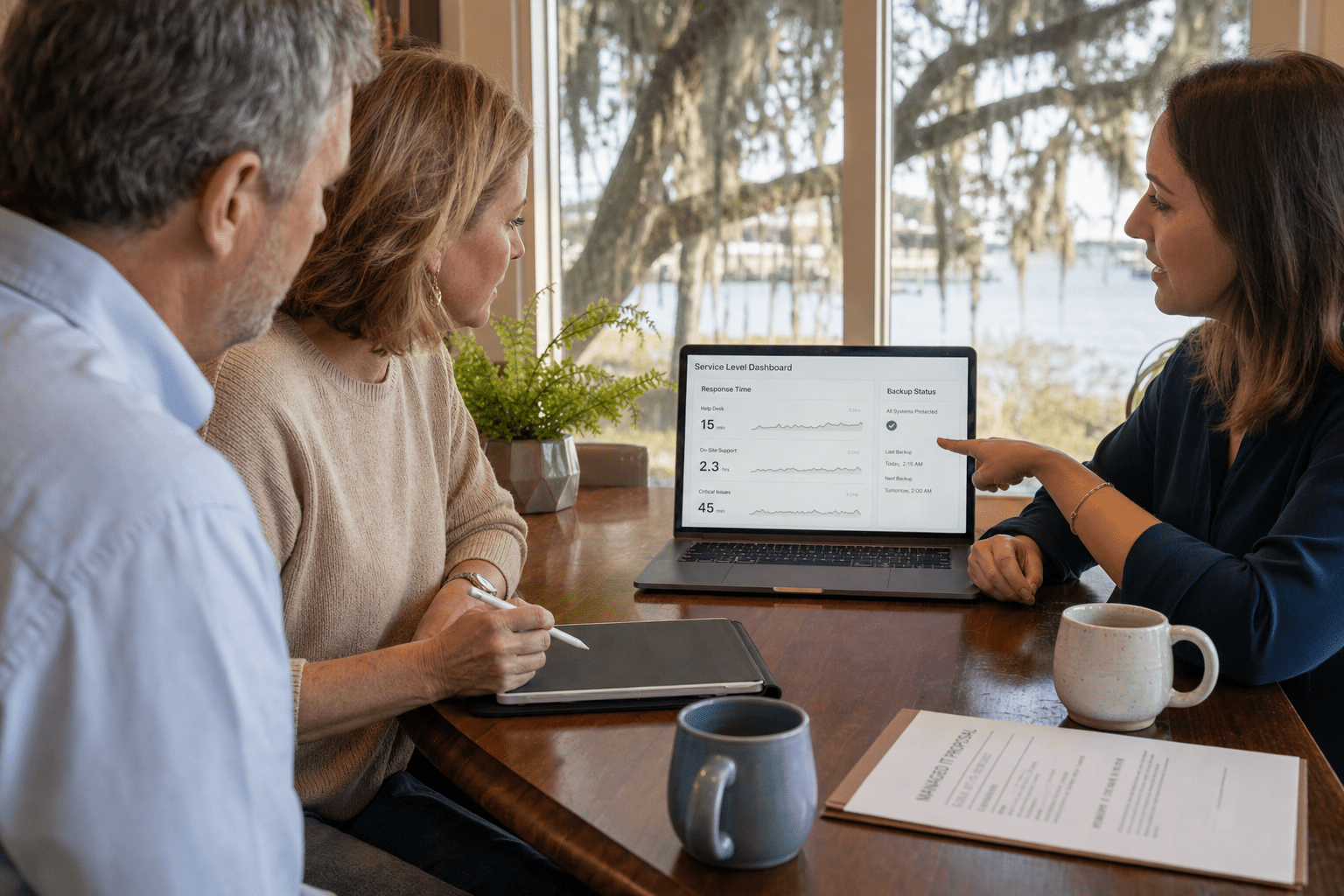
Choosing Savannah IT Consultants in 2026 comes down to three verifiable factors: guaranteed response times, a tested continuity plan for hurricane season, and security measures tailored to your business operations. A local address feels reassuring, and proximity has value, but it is not the factor that decides whether your systems stay up when a storm rolls in off the Atlantic or when ransomware hits at 2 a.m. This guide walks through what to test for, where a local presence genuinely matters, and where a regional firm serving coastal Georgia can serve you better than a one-person shop down the street.
I have watched SMBs in the Southeast pick IT partners on the wrong criteria for years. The pattern is predictable: they hire the nearest name, then discover during the first outage that “we will get to it” was the whole service level. Let us fix that before you sign.
The 5 Factors That Decide a Savannah IT Consultant Hire
When selecting Savannah IT Consultants, consider these five critical factors: response time guarantees, hurricane-season continuity, tailored security, proven experience, and scalability with your business growth:
- Response time in writing. A guaranteed response window in the contract beats a friendly promise. If it is not written down, it does not exist.
- Hurricane-season continuity. Coastal Georgia loses power and connectivity to storms. Your consultant needs a tested plan for keeping you running through it.
- Security that fits your operation. The controls should match your data, your industry, and your team, not a generic template.
- Proof they have done it before. Ask for references from businesses your size in your region, not logos on a website.
- A path that scales with you. The right partner supports the company you are becoming, not just the one you are today.
Why “Local” Matters Less Than Buyers Think
The instinct to hire local is reasonable, and there are real benefits: a consultant who can drive to your office for hardware work, who knows the regional internet providers, and who understands coastal Georgia’s storm risk firsthand. Those things count. The mistake is treating a local address as the whole decision.
Most IT work in 2026 happens remotely. Patching, monitoring, security response, cloud administration, and help-desk support all run over the network, not from a chair in your building. A one-person local shop can be physically close and still leave you waiting, because one person cannot monitor your systems overnight, cover a help desk during business hours, and drive to a client site all at once. A regional firm with a team and written service levels often delivers faster real-world response than the closer name, while still sending someone when hands-on work is genuinely needed. Our Savannah IT guide for SMBs goes deeper on how coastal-Georgia businesses weigh this tradeoff.
Hold the other side honestly. If your operation depends on frequent on-site hardware changes, a heavy lab, or equipment that cannot move to the cloud, physical proximity climbs the priority list. The right answer depends on how much of your IT actually needs a body in the room.
What to Test Before You Hire a Savannah IT Consultant
How fast will they respond, and is it in writing?
Before engaging Savannah IT Consultants, test their responsiveness, documented service guarantees, continuity planning for storms, security alignment, and evidence of prior successful implementations. A consultant who answers “usually pretty quick” is telling you there is no commitment. Pair the response guarantee with a question about coverage: who answers at 9 p.m., who covers a Saturday outage, and what happens when your one contact is on vacation. A team-based managed IT service answers those questions structurally, where a solo consultant answers them with optimism.
Do they have a continuity plan for hurricane season?
Coastal Georgia carries a risk most regions do not: every storm season threatens power and connectivity for days. A serious IT consultant treats business continuity as a planned capability, not an improvisation. Ask what happens to your data, your phones, and your access to systems when your office loses power for three days. The answer should reference offsite backups, cloud failover, and a tested recovery process, in line with the planning guidance at Ready.gov for business. If the consultant has never run a recovery drill, you will find out during the actual emergency, which is the worst possible time.
Does their security match your business?
Security is where generic IT consultants quietly underdeliver. The right controls depend on what you handle: a medical practice, a law firm, and a logistics company on the Savannah port all face different obligations and threats. Ask the consultant to walk through how they would secure your identity logins, your email, and your backups, and listen for whether they tailor the answer to you or recite a checklist. A baseline like the NIST Cybersecurity Framework and the free scanning from CISA’s cyber hygiene services are reasonable reference points, but the test is whether they reason about your specific exposure.

Local Shop, Regional Firm, or National Vendor
Deciding between a local provider, a regional team, or a national vendor is a key choice when evaluating Savannah IT Consultants. Regional firms often offer round-the-clock monitoring and written service levels that outperform solo local shops, while national vendors provide scale but may lack local insight.
A local one-person shop offers personal attention and physical closeness, and for a very small office with simple needs, that can be enough. The risk is single-person coverage: no overnight monitoring, no backup when they are sick, and limited depth when a problem exceeds their experience.
A regional firm serving coastal Georgia and the Southeast brings a team, written service levels, and round-the-clock monitoring, while still being close enough to send someone for on-site work and to understand regional storm risk. For most growing SMBs, this is the balance that holds up. Our IT consulting practice is built on this model.
A large national vendor offers scale and resources, but smaller accounts often get junior staff and slow queues, and the vendor rarely understands your local conditions. The fit depends on your size and how much you value being a priority versus a ticket number.
How do you check a consultant’s track record?
When vetting Savannah IT Consultants, always verify references. Contact two or three clients of similar size in your region to confirm response times, effectiveness during outages, and reliability in supporting business continuity. The questions that matter: how fast does the consultant really respond, how did they handle the last emergency, and would the client hire them again. A consultant proud of their work will hand over references without hesitation. One who stalls is telling you something.
Frequently Asked Questions
How much does a Savannah IT consultant cost?
Pricing usually runs as a flat monthly fee per user or per device for managed support, plus project rates for larger work like migrations. The right way to compare is against the written scope and service levels, since a low monthly price with no response guarantee can cost far more during a single extended outage. Get the coverage and response terms in the quote, not just the number.
Should I hire a local consultant or a regional IT firm?
Hire local if your operation needs frequent on-site hardware work or a body in the room. Choose a regional firm if you want a team, written service levels, and around-the-clock monitoring with on-site support available when needed. For most coastal-Georgia SMBs, the regional model delivers faster real-world response than a single local contact.
What should a Savannah IT consultant include for hurricane season?
Look for offsite or cloud backups, failover that keeps you running when the office loses power, and a recovery process the consultant has actually tested. Ask when they last ran a recovery drill. Continuity planning that has never been rehearsed tends to fail in the real storm, so a tested plan is the signal that matters.
Can an IT consultant handle our compliance needs?
Many can, but confirm they have worked with your specific obligations, whether that is healthcare privacy rules, financial regulations, or contractual security requirements. Ask for examples from clients in your industry. A consultant experienced with general IT but new to your regulatory world can leave gaps you only discover during an audit.
How long does it take to switch IT consultants?
A clean transition usually takes a few weeks, covering documentation handover, access transfer, and a review of your systems. A good incoming consultant runs a structured onboarding that maps your environment before taking over, rather than learning it during the first outage. Ask the candidate to describe their onboarding process, since a rushed handover is where switches go wrong.
Talk Through Your Savannah IT Options With Us
If you are weighing a Savannah IT consultant in 2026, the decision is easier once you separate what truly needs to be local from what just needs to be done well. We work with SMBs across the Southeast and can help you set the response guarantees, continuity plan, and security baseline your business actually needs, then judge any candidate against them. Book a free strategy call and we will walk through your current setup, your storm-season exposure, and what the right IT partner looks like for a company your size on the coast.
Savannah IT Consulting and Southeast Regional IT Strategy Expertise from Matt Rosenthal
Matt Rosenthal, CEO of Mindcore Technologies, has over 30 years of experience helping coastal Georgia and Southeast SMBs select IT partners based on the criteria that decide real-world outcomes: written response guarantees, tested hurricane-season continuity plans, and security controls matched to their specific industry obligations rather than a generic template applied to every client. He has seen firsthand how Savannah businesses hire the nearest name, then discover during the first extended outage or storm event that a friendly promise was the entire service level and nobody had rehearsed a recovery. Matt leads a team that serves growing SMBs across the Southeast with the on-site availability of a regional presence and the team-based coverage, monitoring depth, and written accountability that a solo local shop structurally cannot provide.

