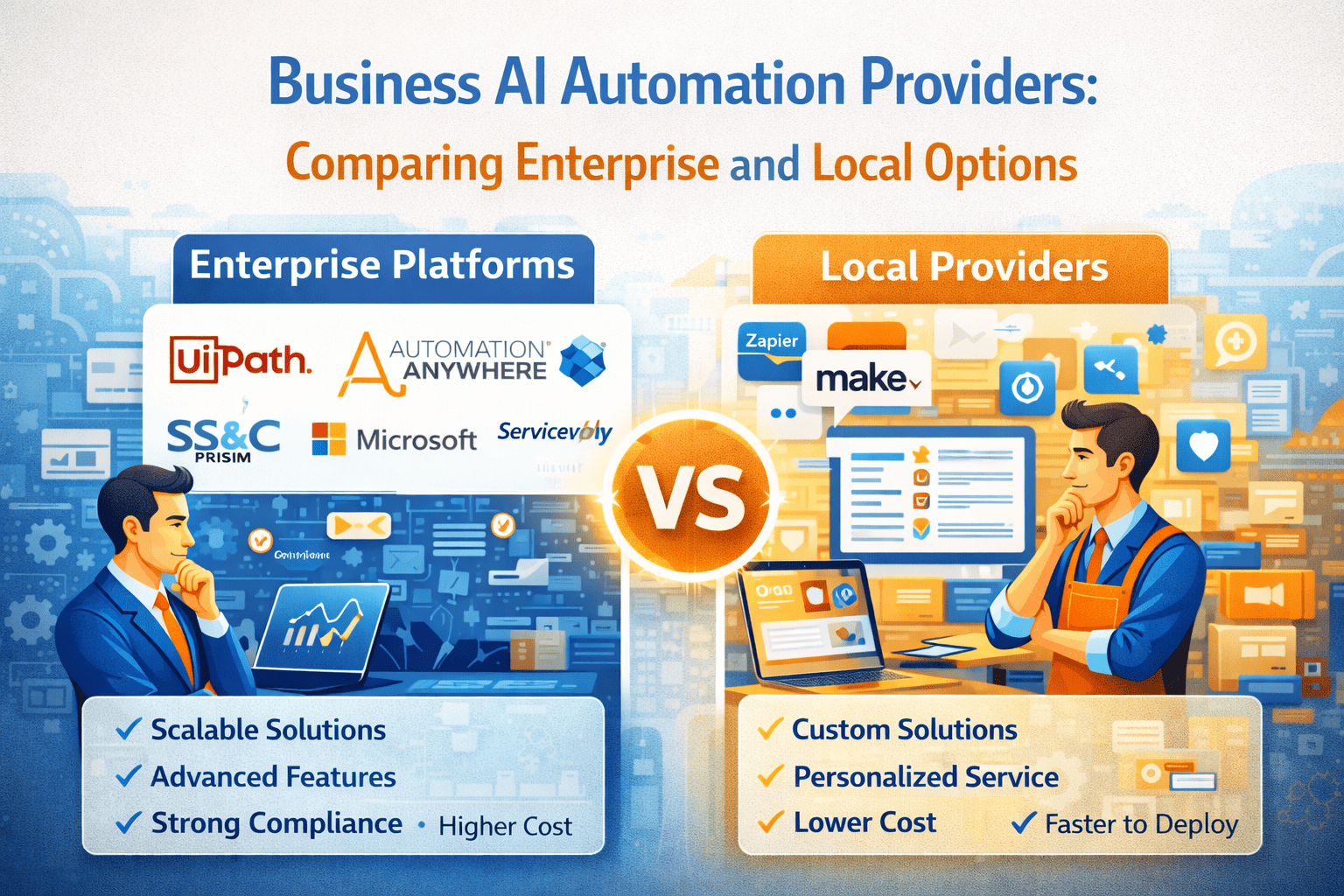
Choosing the right AI automation provider is not about features. It is about fit. Enterprise organizations and local businesses operate at different scales, with different budgets, governance requirements, and integration complexity. Selecting the wrong provider can create unnecessary cost, integration friction, and scalability limitations.
The broader operational architecture is outlined in AI Process Automation for Business: Complete Guide to Operational Excellence, where automation is positioned as long-term infrastructure rather than short-term experimentation.
Provider alignment determines sustainability.
Enterprise AI Automation Providers
Enterprise-focused providers are designed for scale and governance.
Typical characteristics include:
• Multi-department workflow orchestration
Support cross-functional automation.
• Advanced API integrations
Connect ERP, CRM, HR, and financial systems.
• Centralized monitoring dashboards
Improve oversight visibility.
• Compliance and documentation logging
Strengthen audit defensibility.
• Custom implementation support
Handle complex environments.
Enterprise solutions align closely with requirements outlined in How to Choose AI Process Automation for Your Business Operations.
Local and Small Business AI Providers
Small business providers prioritize simplicity and affordability.
Common features include:
• Plug-and-play workflow templates
Fast onboarding.
• Limited but practical integrations
Focus on accounting, CRM, scheduling tools.
• Transparent pricing tiers
Predictable budgeting.
• Minimal technical configuration
Reduce learning curve.
Small business selection discipline is reinforced in AI Automation Challenges in Business: Executive and Small Business Solutions.
Comparing Key Evaluation Factors
When comparing providers, assess:
Integration Capability
• Enterprise systems compatibility
Required for complex organizations.
• Small business tool alignment
Important for local operations.
Pricing Structure
• Tiered enterprise licensing
Scales with usage.
• Flat subscription models
Ideal for limited budgets.
Governance and Monitoring
• Centralized audit logging
Necessary for regulated industries.
• Basic reporting dashboards
Sufficient for smaller operations.
Comparison clarity is expanded in Business Process Automation: AI Agents vs. Traditional Solutions.
Cost vs Complexity Alignment
Enterprise organizations may require:
• Structured implementation support
• Advanced workflow customization
• Long-term scalability planning
Local businesses may require:
• Rapid ROI
• Limited setup time
• Clear operational simplicity
Implementation sequencing considerations are detailed in AI Agent Implementation: Reducing Business Operational Overhead.
Avoiding Common Provider Selection Mistakes
• Selecting enterprise tools for simple workflows
• Choosing small business tools for multi-system orchestration
• Ignoring integration documentation
• Overlooking long-term scalability
• Evaluating price without considering efficiency gains
Operational elimination strategies are discussed in How to Eliminate Manual Business Processes with AI Agents.
Workforce and Training Considerations
Providers should also support employee enablement.
Look for:
• Clear user dashboards
Reduce staff confusion.
• Built-in workflow transparency
Improve accountability.
• Knowledge support integration
Assist training.
Workforce automation support is detailed in Employee Training AI: Automating Staff Support and Guidance.
Key Takeaways
Business AI automation providers must be evaluated based on operational scale, integration complexity, pricing structure, governance requirements, and workforce readiness. Enterprise providers deliver advanced orchestration and compliance capabilities suited for multi-department environments, while local business providers prioritize affordability and simplicity for lean teams. Selecting the right provider requires aligning automation complexity with business size and long-term growth strategy to ensure sustainable efficiency and measurable ROI.