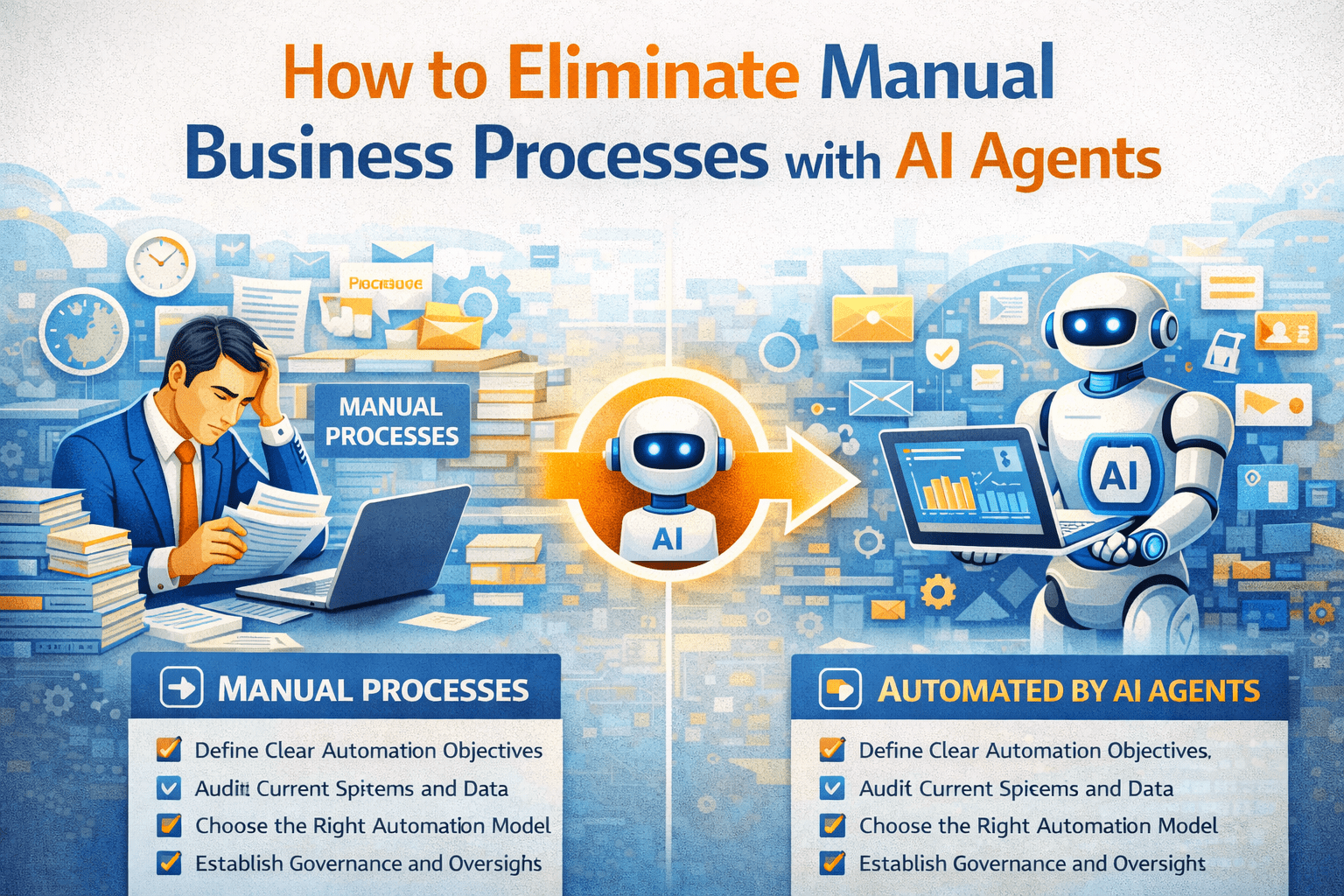
Manual processes are silent profit killers. Spreadsheet tracking, repetitive CRM updates, email-based approvals, manual invoice chasing, and fragmented reporting workflows consume time without adding strategic value. Businesses often normalize these inefficiencies because “it’s how we’ve always done it.”
AI agents eliminate manual business processes by orchestrating workflows across systems, triggering actions automatically, and maintaining documentation without constant oversight.
The broader automation architecture is introduced in AI Process Automation for Business: Complete Guide to Operational Excellence, where operational efficiency is framed as structured process design.
Elimination begins with clarity.
Step 1: Identify Repetitive Manual Tasks
Start by auditing daily operational friction.
Common examples include:
• Manual invoice follow-ups
Staff chasing late payments through email.
• Duplicate CRM data entry
Re-entering customer information across tools.
• Spreadsheet-based KPI tracking
Consolidating reports manually each week.
• Email approval chains
Delayed decisions due to fragmented communication.
Process mapping discipline is reinforced in The Business AI Automation Checklist for Leaders and Owners.
Step 2: Redesign Before Automating
Automation should not digitize inefficiency.
Before deploying AI:
• Remove unnecessary approval layers
Simplify workflows first.
• Consolidate overlapping tools
Reduce integration complexity.
• Standardize data formats
Improve automation accuracy.
Challenge mitigation strategies are expanded in AI Automation Challenges in Business: Executive and Small Business Solutions.
Step 3: Deploy AI Agents for Cross-System Orchestration
AI agents excel in connecting platforms.
Elimination examples:
• Invoice automation
Trigger reminders based on payment status.
• CRM synchronization
Automatically update records after customer interaction.
• Approval routing
Assign tasks based on predefined thresholds.
• Reporting aggregation
Compile KPIs from multiple systems instantly.
Model comparison is detailed in Business Process Automation: AI Agents vs. Traditional Solutions.
Step 4: Replace Email-Based Workflows
Email-based processes create confusion.
AI can:
• Route approvals through workflow dashboards
Improve visibility.
• Send automated status updates
Reduce follow-up messages.
• Track escalation thresholds
Prevent stalled decisions.
Implementation sequencing is outlined in AI Agent Implementation: Reducing Business Operational Overhead.
Step 5: Eliminate Spreadsheet Dependency
Spreadsheets often act as temporary operational tools that become permanent.
AI agents can:
• Pull real-time system data
Eliminate manual report consolidation.
• Generate automated dashboards
Improve executive clarity.
• Trigger alerts for threshold deviations
Reduce monitoring burden.
Provider evaluation for scalable dashboards is discussed in Business AI Automation Providers: Comparing Enterprise and Local Options.
Step 6: Maintain Workforce Clarity
Automation must not create confusion.
Ensure:
• Transparent workflow visibility
Employees understand automation triggers.
• Built-in knowledge support
Staff can access guidance easily.
• Training reinforcement
Improve adoption confidence.
Workforce enablement is detailed in Employee Training AI: Automating Staff Support and Guidance.
Common Mistakes in Process Elimination
• Automating without mapping dependencies
• Eliminating human oversight entirely
• Ignoring integration testing
• Failing to measure improvement
• Scaling before validating first workflow
Intentional elimination prevents operational disruption.
Key Takeaways
Eliminating manual business processes with AI agents requires identifying repetitive tasks, redesigning inefficient workflows before automation, deploying AI for cross-system orchestration, replacing email-based approvals, reducing spreadsheet dependency, and maintaining workforce clarity. When implemented strategically, AI agents remove administrative friction, accelerate execution cycles, and reduce operational overhead without disrupting business continuity.