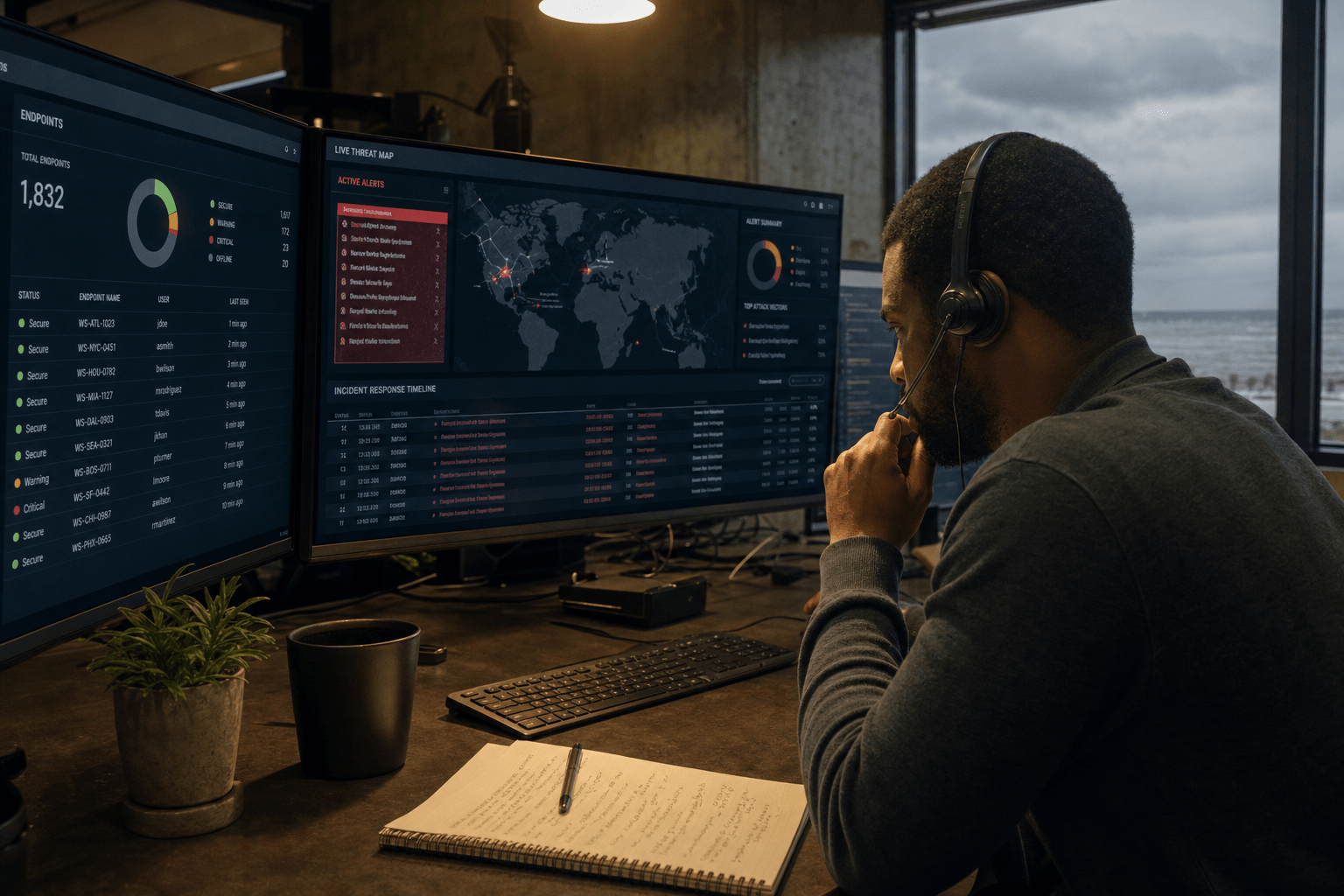
Choosing a Cybersecurity Baton Rouge partner in 2026 means evaluating both hurricane-season continuity and a threat model tailored to Louisiana’s industrial and healthcare sectors to ensure real protection beyond generic tools. The tool list every provider recites, firewalls, monitoring, endpoint protection, is table stakes. What separates a partner who keeps you running from one who sells you software is whether they have planned for the specific ways businesses around Baton Rouge actually get hit. This guide walks through what to verify, where regional knowledge matters, and how to tell real security operations from a reseller with a logo.
I have helped Louisiana businesses sort through this for years, and the costly mistakes cluster in the same place: companies buy a stack of tools, assume they are covered, and discover during a storm or a ransomware event that nobody was actually watching or planning. Let us close that gap before it costs you.
The 5 Factors That Decide a Baton Rouge Cybersecurity Hire
When selecting Cybersecurity Baton Rouge services, focus on five key factors: staffed 24/7 monitoring, tested hurricane-season continuity, an industry-specific threat model, actionable incident response, and documented proof of operational effectiveness:
- 24/7 monitoring with a real response. Tools that alert into an empty room are worthless. Someone has to be watching and ready to act at any hour.
- Hurricane-season continuity. Louisiana loses power and connectivity to storms. Your security plan has to assume that and keep working through it.
- A threat model fit for Louisiana. Industrial, petrochemical, healthcare, and port-linked businesses draw specific attention. The plan should reflect your real exposure.
- Incident response you can name. Ask exactly what happens in the first hour of a breach, and who does it.
- Proof, not promises. References from Louisiana businesses your size beat a wall of vendor badges.
Why a Tool List Is Not a Security Program
The most common way Baton Rouge businesses get cybersecurity wrong is buying products and mistaking them for protection. A provider rattles off a stack of brand names, the client feels covered, and the actual question goes unasked: who is watching these tools, and what happens when one of them fires an alert at 3 a.m.? For true Cybersecurity Baton Rouge, it’s critical to remember that a stack of tools alone does not equal protection; only monitored, well-orchestrated operations provide meaningful security.
Real security is an operation, not a shopping list. It needs people watching for threats around the clock, a defined process for responding when something breaks through, and a plan for the regional realities that generic vendors ignore. Threats evolve constantly, as the advisories from CISA make plain, and a static tool stack bought two years ago does not keep pace on its own. When you evaluate cybersecurity services, look past the product names to the operation behind them.
There is a fair counterpoint worth holding. For a very small office with simple needs and low-value data, a well-configured baseline of tools plus basic monitoring may genuinely be enough, and paying for a full security operations center would be overspending. The point is not that everyone needs the maximum. It is that you should know whether you are buying tools or buying an operation, and match that to what you actually have to protect.
The way to tell the two apart is to ask what happens between the alerts. A tool stack sold as protection goes quiet once it is installed, and nobody reviews it until something breaks. An operation produces evidence of activity: weekly reviews, tuned alerts, and a record of what was investigated and closed. When a provider walks you through their service, ask to see that ongoing record from a current client, with the names removed. A provider running a real operation can show it without hesitation, while a reseller has nothing to show because nothing is happening between installs.
What to Verify Before Hiring a Baton Rouge Cybersecurity Provider
Who is watching, and when?
Round-the-clock monitoring is the spine of real security, because attacks do not wait for business hours. Ask the provider directly: who watches your systems overnight, on weekends, and during holidays, and what do they do when an alert fires? A strong answer describes a staffed security operations capability with a defined escalation path. A weak answer is some version of “the system notifies us.” A staffed managed security service answers this structurally, where a part-time IT shop answers it with hope.
Does the plan survive a hurricane?
Baton Rouge sits in a region where storm season threatens power and connectivity every year, and a security plan that assumes the lights stay on is not a plan for Louisiana. Ask what happens to your monitoring, your backups, and your ability to respond when the office loses power for days. The answer should reference offsite and cloud-based backups, failover that keeps protection running, and a tested recovery process. A provider who has never thought about storm continuity will improvise during the actual emergency, which is exactly when improvisation fails.
Is the threat model built for your industry?
Louisiana’s economy draws specific attention. Petrochemical, industrial, healthcare, and port-connected businesses sit in supply chains that ransomware crews and other attackers actively target, and a generic security template does not account for that. Ask the provider how they would adjust your defenses based on what your business does and who might come after it. The free resources at CISA’s StopRansomware and a baseline like the NIST Cybersecurity Framework are reasonable reference points, but the signal you want is a provider who reasons about your specific exposure rather than reciting a checklist.

Local Knowledge Versus National Scale
Businesses seeking Cybersecurity Baton Rouge expertise must weigh local providers with regional knowledge against national firms, ensuring hurricane-season readiness, industrial exposure understanding, and responsive support.
A regional provider who understands Louisiana brings firsthand knowledge of storm risk, local connectivity, and the industries that define the area, plus a team close enough to send help. For most SMBs around Baton Rouge, that combination of regional fluency and real operational depth is the strongest fit, and it is the model we built our Louisiana practice around.
A large national vendor offers scale and deep resources, which matters for very large or highly regulated organizations. The tradeoff is that smaller accounts often get junior staff, slow queues, and a provider with no feel for local conditions like hurricane season.
A small local IT shop offers personal attention and closeness, which suits a tiny office with simple needs. The risk is thin coverage: a part-time team rarely sustains true 24/7 monitoring or a tested incident-response process.
What does the first hour of a breach look like?
This is the question that exposes whether a provider has a real plan. Ask them to walk through the first hour after they detect a breach: who they call, how they contain it, how they communicate with you, and how they preserve evidence. A provider with a rehearsed plan answers in concrete steps. One without freezes or speaks in generalities. Where regulations apply, that response plan also feeds your cybersecurity compliance obligations, since how you handle a breach often determines your legal exposure afterward.
Frequently Asked Questions
How much does Baton Rouge cybersecurity cost for an SMB?
Cost usually runs as a monthly fee scaled to your number of users or devices and the depth of monitoring, plus project work for assessments or remediation. The right comparison is against the written scope and response commitments, since a low monthly price with no staffed monitoring can cost far more in a single breach or extended outage. Get the coverage terms in the quote.
Do small businesses in Baton Rouge really get targeted?
Yes. Attackers frequently target smaller businesses precisely because they assume weaker defenses, and Louisiana’s industrial and supply-chain connections make the region attractive. Ransomware crews often hit SMBs that sit in the supply chains of larger targets. Size is not protection, and assuming you are too small to notice is how many breaches begin.
What is the difference between IT support and cybersecurity?
IT support keeps your systems running and fixes what breaks, while cybersecurity focuses on detecting, preventing, and responding to threats. Some providers do both, but confirm the security work is staffed and active rather than a side feature of general support. A help desk that also “handles security” is often watching nothing in particular.
How fast should a provider respond to a security incident?
Look for a written commitment to begin response within a defined window, often measured in minutes to a small number of hours for critical incidents, backed by staffed monitoring. The speed of containment in the first hour heavily shapes the damage, so a vague response promise is a real risk. Ask for the commitment in the agreement, not as a verbal assurance.
Can a cybersecurity provider help with compliance?
Many can map your security program to the regulations your industry faces, prioritize the gaps, and prepare audit evidence. Confirm they have worked with your specific obligations, whether that is healthcare privacy, financial rules, or contractual security requirements, since experience with one regulatory world does not automatically transfer to another.
Talk Through Your Baton Rouge Security With Us
Selecting Cybersecurity Baton Rouge services should prioritize operational depth, 24/7 monitoring, and tested continuity plans over mere software lists to protect your business effectively during storms, ransomware events, or cyber incidents. We work with Louisiana businesses and can help you set the monitoring, continuity, and incident-response standards your operation actually needs, then judge any provider against them. Book a free strategy call and we will walk through your current defenses, your storm-season exposure, and what real protection looks like for a business your size in this region.
Baton Rouge Cybersecurity Partnership and Louisiana Regional Security Expertise from Matt Rosenthal
Matt Rosenthal, CEO of Mindcore Technologies, has over 30 years of experience helping Louisiana SMBs in petrochemical, healthcare, industrial, and port-connected industries move past tool-stack purchases toward security operations that include staffed 24/7 monitoring, tested hurricane-season continuity plans, and threat models built around what those industries actually attract. He has seen firsthand how Baton Rouge businesses buy a stack of branded products, assume they are covered, then discover during a storm or a ransomware event that nobody was watching the alerts and nobody had planned for three days without power. Matt leads a team with deep Louisiana regional knowledge that builds security programs around what clients have to protect and what they are realistically up against, not a checklist recited the same way to every industry.