

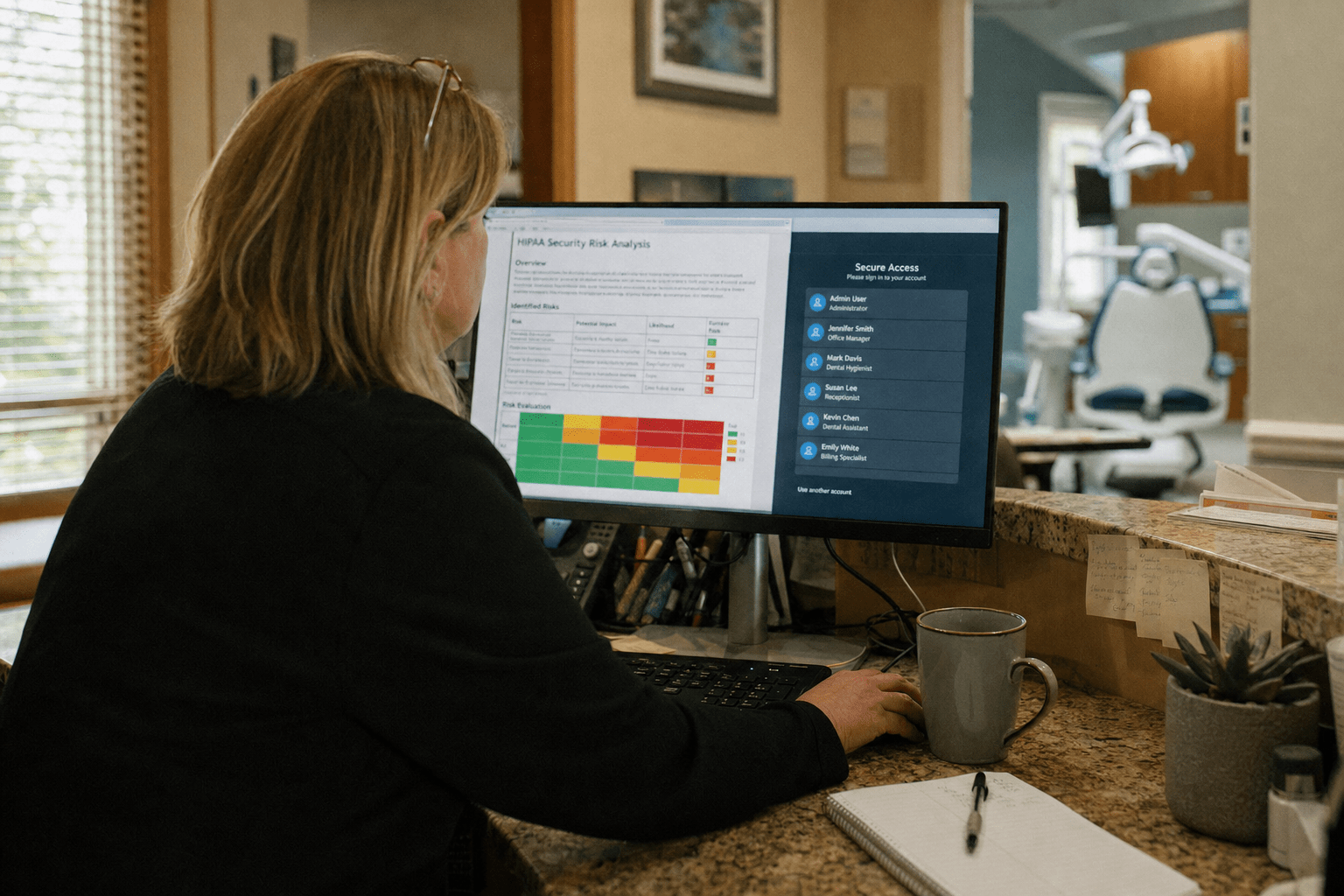
IT Compliance for Dentists comes down to one document more often than any other, and it is the document most dental offices never finish. When the Office for Civil Rights investigates a dental practice after a breach or a complaint, the first thing they ask for is the Security Risk Analysis. The absence of a current one is the most common finding in HIPAA enforcement, and it is the gap that turns a manageable incident into a penalty. What surprises most dentists is that their IT vendor sold them firewalls, antivirus, and backups but never produced this document, because it is compliance work, not a product. We have helped practices close that gap before it cost them, and the pattern holds: the offices that treat the risk analysis as the foundation stay defensible, and the ones that treat security as a shopping list stay exposed.
Why the Security Risk Analysis Comes First
The Security Risk Analysis comes first in IT Compliance for Dentists because HIPAA requires it and every other security control depends on it. The HHS risk analysis guidance describes it as an accurate assessment of the risks to all electronic protected health data a practice creates, receives, maintains, or transmits. Without it, a practice is buying security controls blind, with no record of what it was protecting or why. The reason it is skipped so often is that it produces no visible product. A firewall is a box on the wall. A risk analysis is a document in a drawer, which makes it easy to defer until an auditor asks. That deferral is exactly the risk.
- It is legally required. The HIPAA Security Rule mandates a risk analysis for every covered dental practice.
- It is the top OCR finding. Missing or stale analyses drive a large share of enforcement actions.
- It scopes everything else. You cannot right-size encryption, access controls, or backups without knowing your risks.
- It must be current. A one-time analysis from three years ago does not cover the systems you added since.
- It is documentation, not hardware. No security product satisfies it, which is why vendor-led practices miss it.
The IT Compliance Gaps That Get Dental Offices Fined
The most common gaps in IT Compliance for Dentists are rarely exotic attacks; they are basic security controls left undone. Enforcement data points at the same handful of failures year after year: no current risk analysis, shared logins, unencrypted data, and missing agreements with vendors who touch patient records. Each is fixable with attention rather than a large budget. The trouble is that a busy practice assumes its IT provider handled all of it, and the provider assumes anything labeled compliance was the practice’s job. That seam is where the exposure lives.
Why Shared Logins Break HIPAA Audit Trails
Shared logins break HIPAA compliance because they destroy the audit trail the rule requires, and they remain common in dental offices for the sake of speed. When the whole front desk uses one account, no one can prove who viewed a given patient record or when, which fails the access-control and audit requirements outright. The counterargument is practical: unique logins slow a fast-moving clinical team, and staff resist the extra step. That friction is real, but it does not survive contact with an investigation, because the practice cannot answer the basic question of who accessed what. The workable path is unique logins with role-based permissions and multi-factor authentication, tuned so the clinical workflow stays fast. Our managed security services implement this in a way that respects how a dental team actually works chairside.
How Encryption Requirements Apply to Patient Data
Encryption requirements apply to dental patient data both at rest and in transit, and getting them wrong is a frequent and avoidable finding. HIPAA treats encryption as an addressable specification, which some practices misread as optional. The honest reading is that if you decline to encrypt, you must document a defensible reason and an equivalent alternative, and few dental offices can. In practice this means encrypting stored records and backups, and sending images and referrals through an encrypted channel or a secure portal rather than ordinary email. The opposing view that encryption is overkill for a small office ignores how a lost laptop or a misdirected email becomes a reportable breach without it. The ADA’s HIPAA resources are direct that encryption is the practical safeguard that turns a lost device from a breach into a non-event.
Why Business Associate Agreements Cannot Be Skipped
Business Associate Agreements cannot be skipped because every outside vendor that touches patient data has to be under contract, and dental practices sign up new vendors constantly. Cloud imaging, practice-management software, billing services, and IT contractors all handle protected health data, and each needs a signed agreement that binds them to HIPAA. The counterpoint that a trusted local vendor does not need paperwork is exactly the assumption that creates liability, because trust is not a legal safeguard and a vendor breach still lands on the practice. There is a reasonable limit: a vendor who genuinely never accesses patient data may not need an agreement, and over-papering every relationship wastes effort. The discipline is knowing which vendors touch the data and confirming an agreement exists for each. Practices in our medical and dental practice work often discover several missing agreements the first time anyone maps the vendor list.
What an IT Compliance Program Costs a Dental Practice
A well-designed IT Compliance for Dentists program costs far less than a breach, with expenses scaling according to practice size and current security posture. The recurring pieces are the risk analysis and its updates, security controls like encryption and multi-factor authentication, staff training, and periodic testing. A single-location office starting from a reasonable baseline invests modestly, mostly in documentation and a few control upgrades. A practice starting from shared logins and no risk analysis invests more because it is building the foundation. Against those numbers sits the cost of a breach: mandatory notification under the HHS breach notification rule, potential penalties, and the patient trust a small practice cannot easily rebuild. Framed that way, compliance is the cheaper line item, and the practices that see it clearly treat it as routine overhead rather than an emergency.
Who Should Own HIPAA Compliance in a Dental Office
HIPAA compliance in a dental office should be owned by a named Security Officer, even in a small practice where that person wears other hats. The rule expects a designated individual responsible for the security program, and leaving the role unassigned is how practices drift into the gaps above. That owner does not need deep technical skill if the practice pairs them with the right outside help. Many offices are too small to justify a full-time security role, which is where fractional CISO consulting fits, supplying the accountable security leadership the rule expects at a cost a single practice can absorb. What does not work is assuming the IT vendor owns compliance by default, because most vendor contracts cover systems, not the practice’s legal obligations. Our cybersecurity compliance team often serves as that named owner for practices that need the role filled properly.
Frequently Asked Questions
What is the most important HIPAA requirement for a dental practice?
The most important HIPAA requirement for a dental practice is a current Security Risk Analysis, because it is legally mandated and it is the top finding in OCR enforcement. Every other control depends on it, since you cannot size encryption, access rules, or backups without knowing your risks. It must be kept current as the practice adds systems.
Do dental practices really get audited for HIPAA?
Dental practices face HIPAA scrutiny most often after a breach or a patient complaint rather than a random audit, but the outcome is the same when OCR investigates. The first request is usually the Security Risk Analysis, and its absence drives penalties. A practice that keeps its compliance documentation current is defensible regardless of what triggers the review.
Does my IT company handle HIPAA compliance automatically?
Most IT companies handle the technical security systems but not the practice’s full HIPAA compliance obligations, which is a common and costly misunderstanding. Firewalls and backups are products, while the risk analysis, policies, and business associate agreements are compliance work. Confirm in writing who owns each piece so nothing falls through the seam between practice and vendor.
How much does HIPAA IT compliance cost for a dental office?
HIPAA IT compliance cost for a dental office depends on practice size and starting posture, covering the risk analysis, security controls, training, and testing. An office with a reasonable baseline invests modestly in documentation and upgrades, while one starting from scratch invests more to build the foundation. In every case the cost is far below the price of a reportable breach.
Build Your Dental IT Compliance on the Right Foundation
IT Compliance for Dentists is not a shopping list of security products; it is a documented program built on a current risk analysis that helps practices remain defensible and protected. The gaps that draw penalties are consistent and fixable: a missing risk analysis, shared logins, unencrypted data, and vendors handling patient records without an agreement. None of them requires a large budget, only ownership and attention. Assign a named Security Officer, get outside help sized to a single practice, and treat compliance as routine overhead rather than a fire drill after a breach. That posture keeps your patients’ trust intact and keeps an investigation from turning into a fine. If you want to know exactly where your practice stands against the HIPAA Security Rule, our team will run the assessment, close the gaps in priority order, and keep the program current. Book a free strategy call and we will start with the risk analysis that everything else depends on.

