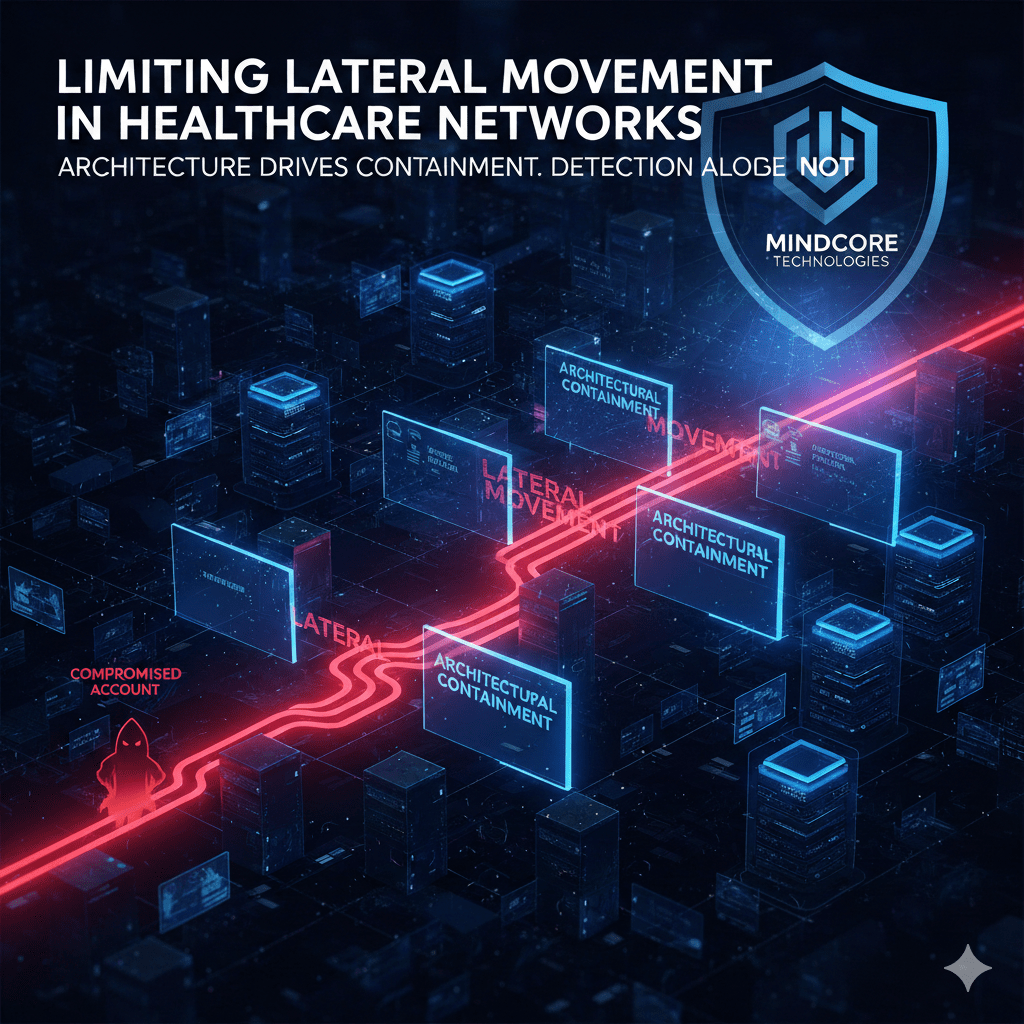
Most healthcare breaches do not fail at the perimeter. They fail after access is already granted. Lateral movement is how attackers turn a single compromised account into a full-scale incident affecting EHR systems, file shares, and patient data.
If an attacker can move freely once inside, the breach is no longer a question of if damage occurs, but how far it spreads.
At Mindcore Technologies, healthcare incident reviews consistently show that lateral movement, not initial compromise, is what drives ransomware impact, operational downtime, and HIPAA exposure.
What Lateral Movement Actually Means in Healthcare
Lateral movement is the ability for an attacker to move from one system to another after gaining initial access.
In healthcare environments, this often includes:
- Moving from a compromised user account to servers
Attackers pivot from workstations into EHR, imaging, or billing systems. - Reusing credentials across systems
Shared or poorly segmented credentials accelerate spread. - Scanning flat networks for reachable systems
Internal visibility enables rapid discovery of high-value targets. - Escalating privileges quietly
Attackers blend into normal administrative activity.
The initial entry point is rarely the problem. The lack of containment is.
Why Healthcare Networks Are Especially Vulnerable
Healthcare environments are uniquely exposed to lateral movement because:
- Availability is prioritized over isolation
Systems are kept broadly accessible to avoid disrupting care. - Legacy systems coexist with modern platforms
Older systems often lack segmentation or modern access controls. - Third-party access is widespread
Vendors, MSPs, and partners often retain standing access. - VPNs extend trust across the network
Remote access frequently grants internal visibility.
These conditions create ideal conditions for attackers to move undetected.
How Attackers Exploit Lateral Movement
Once inside a healthcare network, attackers typically:
- Enumerate accessible systems
Flat networks allow easy discovery of file servers and databases. - Harvest additional credentials
Memory scraping and credential reuse expand access. - Disable backups and security tools
Preparation happens before ransomware deployment. - Encrypt or exfiltrate data simultaneously
Lateral reach increases impact and leverage.
By the time ransomware triggers, containment is already impossible.
Why Traditional Defenses Fail to Stop Lateral Movement
Many healthcare organizations rely on controls that detect too late.
Common failures include:
- Perimeter-focused security models
Firewalls stop entry but do nothing once access is gained. - Flat internal networks
Minimal segmentation allows unrestricted movement. - Persistent VPN connections
Network trust remains active long after login. - Monitoring without enforcement
Alerts occur after attackers already moved.
Detection alone does not stop lateral movement.
Limiting Lateral Movement Through Architecture
Stopping lateral movement requires reducing what is reachable, not just watching what happens.
Effective strategies include:
1. Segmentation That Reflects Risk, Not Convenience
Segmentation must be intentional.
This means:
- Separating clinical, administrative, and infrastructure systems
Compromise in one area should not expose others. - Restricting east-west traffic explicitly
Systems communicate only when required. - Limiting administrative access paths
Privileged systems are isolated from user environments.
Segmentation limits blast radius immediately.
2. Eliminating Network Trust from Remote Access
VPNs are one of the biggest lateral movement enablers.
Reducing risk requires:
- Removing VPN-based network access
Users should not join internal networks. - Delivering access at the application level
Users connect only to approved systems. - Using session-based access instead of standing connections
Access expires automatically.
When the network is not reachable, movement stops.
3. Enforcing Least-Privilege Identity Access
Lateral movement thrives on excessive permissions.
Healthcare organizations must:
- Align access strictly to job roles
No generic or inherited access. - Review privileged accounts frequently
Admin access should be rare and temporary. - Remove shared credentials entirely
Accountability depends on unique identity.
Identity control limits what attackers can reach.
4. Containing Access with Secure Workspace Models
Secure workspaces dramatically reduce lateral movement by design.
They work by:
- Isolating applications inside controlled environments
Users never connect directly to infrastructure. - Preventing network discovery
Systems are invisible to unauthorized users. - Keeping PHI off endpoints
Even compromised devices cannot reach data stores. - Allowing instant session termination
Access can be revoked without network changes.
Containment replaces reaction.
5. Centralizing Visibility Across Access Paths
You cannot stop movement you cannot see.
Healthcare organizations need:
- Unified visibility across users, sessions, and applications
Not siloed logs. - Clear audit trails of access and activity
Especially for PHI systems. - Correlation between identity and system access
Not just network events.
Visibility supports enforcement, not just investigation.
How Limiting Lateral Movement Reduces Ransomware Impact
When lateral movement is restricted:
- Ransomware cannot spread across systems
Encryption impact is limited. - Data exfiltration paths are reduced
Attackers cannot freely access repositories. - Response time increases dramatically
Security teams can act before damage escalates. - HIPAA exposure is minimized
Fewer systems and records are affected.
Containment turns catastrophic incidents into manageable events.
HIPAA Alignment Through Lateral Movement Control
HIPAA expects healthcare organizations to minimize exposure and enforce access intentionally.
Limiting lateral movement supports this by:
- Enforcing minimum necessary access
Users cannot reach unrelated systems. - Improving audit clarity
Access paths are explicit and reviewable. - Reducing breach scope
Fewer systems fall within notification requirements.
HIPAA compliance improves when architecture limits reach.
How Mindcore Technologies Helps Healthcare Organizations Limit Lateral Movement
Mindcore helps healthcare organizations reduce lateral movement by:
- Mapping real-world access paths
Identifying where movement is currently possible. - Reducing network trust through architectural changes
Not just policy updates. - Replacing VPN access with secure workspace models
Eliminating network exposure. - Enforcing identity-driven, session-based access
Limiting scope and duration. - Improving visibility and audit readiness
Making access defensible.
The focus is stopping spread, not chasing alerts.
A Simple Lateral Movement Reality Check
Your healthcare environment remains high-risk if:
- VPNs provide broad internal access
- Networks are flat or minimally segmented
- Users can access systems outside their role
- PHI systems are reachable from endpoints
- Incident response depends on cleanup
These conditions enable attackers to move freely.
Final Takeaway
Lateral movement is what turns small compromises into healthcare crises. Limiting it requires architectural containment, not better detection alone.
Healthcare organizations that design access to prevent movement reduce ransomware impact, protect patient data, and strengthen HIPAA alignment. Those that do not discover the cost only after attackers have already moved too far.