

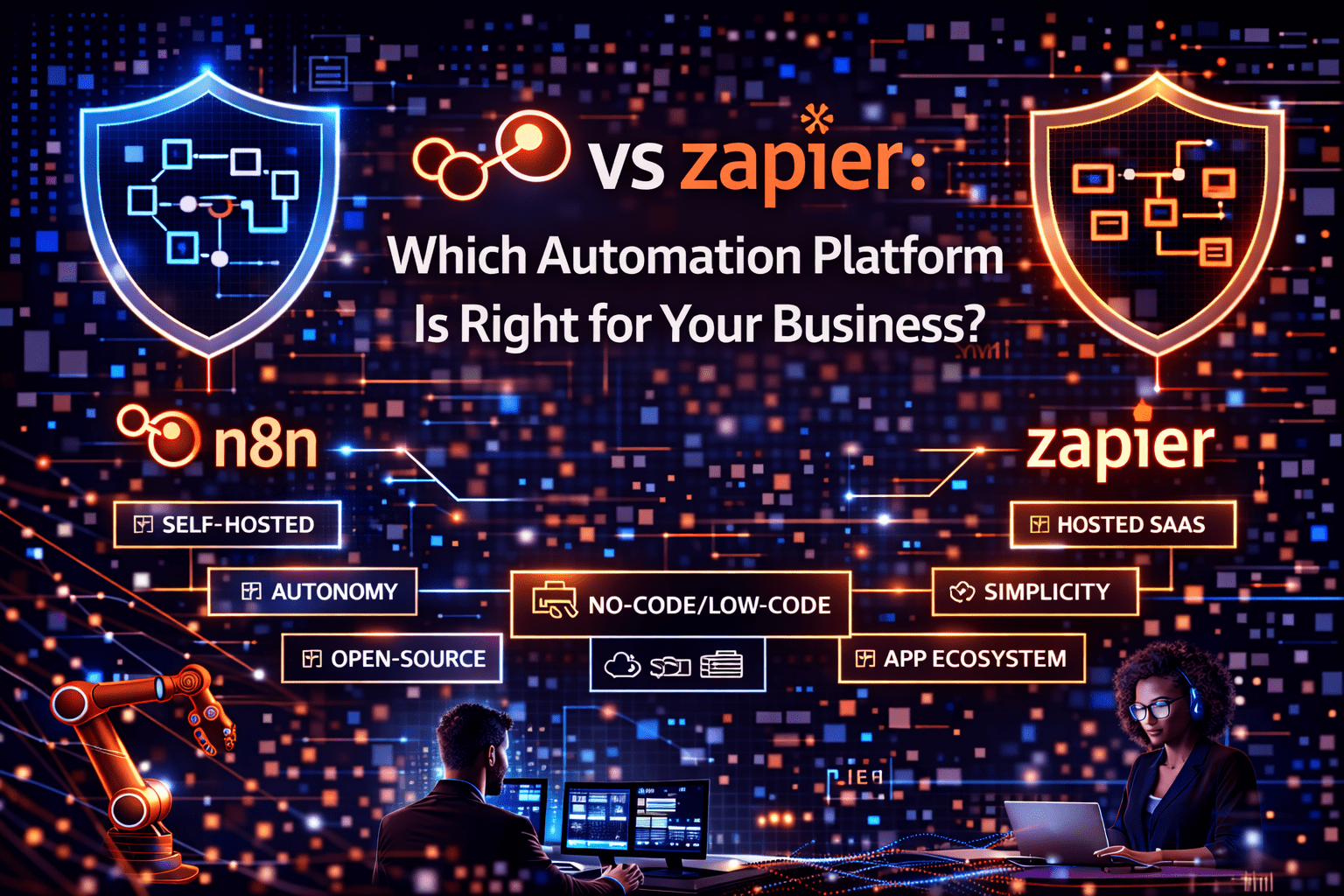
Zapier and n8n are both workflow automation platforms. Beyond that, the comparison requires specificity — because they were built for different use cases, operate on different architectural models, and produce different outcomes at different price points.
Zapier is optimized for simplicity and speed. Two-step workflows between popular applications, set up in minutes without technical knowledge. For non-technical users automating simple repetitive tasks, that optimization produces genuine value quickly.
n8n is optimized for flexibility, depth, and data control. Multi-step workflows with complex logic, self-hosted on your own infrastructure, with native AI support and code execution capability for advanced use cases. For organizations with complex automation requirements, regulated data handling, or high automation volume, that optimization produces outcomes Zapier cannot match.
The right answer depends on what you are building — and this comparison provides the framework to determine that.
Overview
The n8n vs Zapier decision is not primarily about features — it is about use case complexity, data handling requirements, cost structure at scale, and the technical capability of the team building the automation. Zapier wins on initial setup speed and simplicity for basic use cases. n8n wins on workflow complexity, data control, cost at scale, and AI integration capability. Organizations that are outgrowing Zapier — running into workflow complexity limits, hitting cost walls on high-volume automation, or facing data compliance requirements — are the natural n8n migration candidates.
- Zapier: optimized for simple, fast, non-technical automation between popular apps
- n8n: optimized for complex, flexible, self-hosted automation across the full technology stack
- Cost structure: Zapier charges per task; n8n self-hosted has no per-task cost
- Data control: Zapier processes data on Zapier’s infrastructure; n8n self-hosted processes data on yours
- Workflow complexity: Zapier handles linear two-step workflows well; n8n handles branching, looping, and multi-system orchestration
This aligns with modern AI automation strategies and enterprise workflow optimization.
The 5 Why’s
Why does workflow complexity specifically favor n8n over Zapier as automation requirements grow?
Zapier’s trigger-action model is optimized for two-step automation: when X happens in App A, do Y in App B. Real business workflows involve more complexity: conditional branching (if the contact already exists, update it; if not, create it), loops (process each item in a list), error handling (if the API call fails, retry or notify), and multi-system orchestration (trigger a sequence across four systems based on a single event). n8n’s node architecture handles all of those patterns natively. Zapier handles them partially, through workarounds, or not at all.
Why does Zapier’s per-task pricing model become a cost problem at enterprise automation scale?
Zapier charges based on the number of tasks (workflow step executions) per month. For businesses running high-volume automation — thousands or tens of thousands of workflow executions daily — per-task pricing produces monthly costs that scale with volume rather than remaining fixed. n8n self-hosted eliminates per-task costs; the cost is infrastructure and, if applicable, Mindcore management — both of which are fixed regardless of execution volume. For high-volume automation, n8n’s cost structure is significantly more favorable.
Why is data handling the non-negotiable differentiator for regulated industry businesses?
Zapier is a SaaS platform — workflow data passes through Zapier’s infrastructure. For businesses handling PHI, financial records, legal documents, or other regulated data, that means regulated data is processed by a third-party system that requires its own compliance assessment. n8n self-hosted keeps data within enterprise infrastructure — the automation platform itself is under the same data governance as the systems it connects. For healthcare, financial services, and legal organizations, that is often a binary requirement.
Why is Zapier still the right choice for some businesses even after considering n8n’s advantages?
Zapier’s onboarding experience is faster for non-technical users. If the primary automation use cases are simple two-step workflows between popular consumer and business applications (Gmail to Google Sheets, Slack to Asana, etc.), and the team building automation has no technical background, Zapier’s simplicity advantage produces faster time-to-value. n8n’s capability advantage matters when workflow complexity increases or data control becomes a requirement. For businesses at the simpler end of the automation spectrum, Zapier may remain the right choice.
Why do businesses that have invested in Zapier eventually migrate to n8n rather than the reverse?
Businesses grow into n8n from Zapier — they outgrow Zapier’s workflow complexity limits, hit cost walls at high volume, face data compliance requirements, or discover that their use cases require AI integration or custom code. They do not typically migrate from n8n to Zapier because n8n’s capabilities are a superset — everything Zapier can do, n8n can do, plus the advanced capabilities. The migration direction is consistently from simpler tools toward n8n as requirements mature.
Side-by-Side Comparison
| Dimension | Zapier | n8n |
|---|---|---|
| Workflow model | Trigger-action (2 steps) | Node-based (unlimited steps) |
| Branching and logic | Limited | Full conditional, switch, loop support |
| Error handling | Basic | Explicit error handling nodes |
| Code execution | No | JavaScript and Python nodes |
| AI integration | Via HTTP requests | Native LangChain and LLM nodes |
| Self-hosting | No | Yes (open-source) |
| Data control | Zapier infrastructure | Your infrastructure (self-hosted) |
| Pricing model | Per task | Fixed (self-hosted) or per execution (cloud) |
| Setup complexity | Low | Moderate (self-hosted requires infrastructure) |
| Custom API support | Limited | Full HTTP request node |
| Community integrations | Zapier-controlled | Open-source community |
Who Should Choose n8n
- Organizations with automation volume that makes per-task pricing cost-prohibitive
- Regulated industries where data must stay on enterprise infrastructure
- Organizations building complex multi-step or multi-system workflows
- Teams that need AI-augmented automation within their workflow platform
- Organizations that have hit Zapier’s workflow complexity limits
- IT-led automation programs that need code execution capability for advanced logic
Who Should Choose Zapier
- Non-technical users who need simple two-step automation between popular apps quickly
- Small businesses with low automation volume where per-task pricing is not a cost concern
- Organizations where speed of initial setup is the primary priority
- Use cases that do not involve regulated data and do not require complex workflow logic
Final Takeaway
n8n is not universally better than Zapier — it is the right choice for a specific profile of automation requirements. Organizations with complex workflows, high automation volume, regulated data, or AI automation needs will consistently find n8n produces better outcomes at lower long-term cost. Organizations with simple use cases and non-technical teams may find Zapier’s simplicity advantage compelling for their current needs. The decision point is where your organization sits on that spectrum today — and where it is heading as automation requirements mature.
Make the Right Automation Platform Decision With Mindcore Technologies
Mindcore Technologies works with businesses evaluating n8n versus other automation platforms — requirements assessment, platform selection guidance, and n8n implementation for organizations that are ready for the platform that grows with their automation ambitions.
Schedule your free strategy call to assess your automation needs and determine the right platform.

