

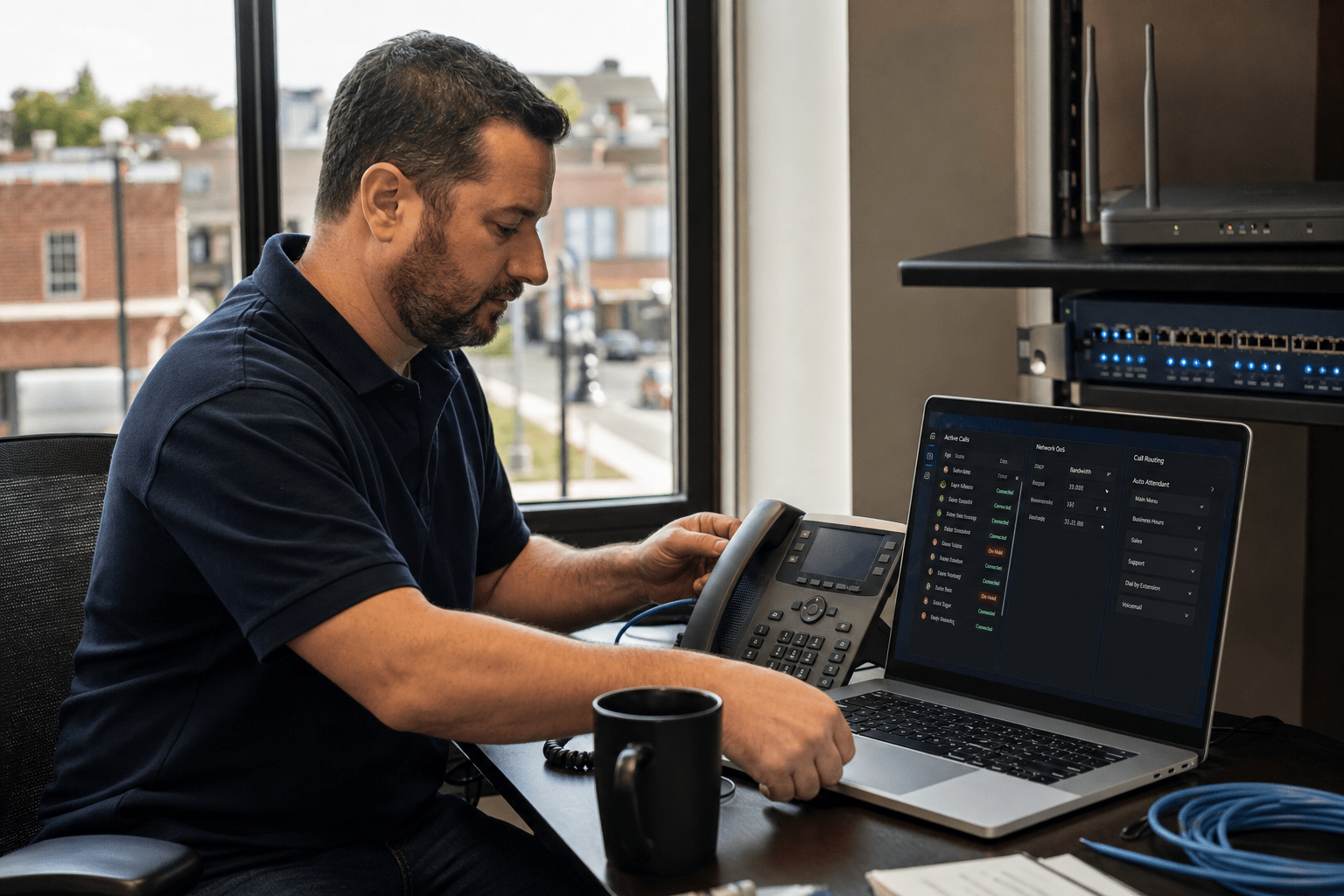
VoIP and unified communications in Fairfield NJ succeed or fail on the network underneath them, not on the phone brand or the feature list a vendor sells. Voice over internet protocol turns your calls into data that rides your internet connection, so a great phone system on a weak or unmanaged network delivers dropped calls and garbled audio. We set up voice and unified communications for New Jersey businesses, and the pattern holds every time. The firms that get clear, reliable calls prepared the network first. The ones that switched on price and plugged phones into whatever connection they had spent the next month troubleshooting call quality.
What Fairfield NJ SMBs Should Check Before Switching to VoIP
VoIP and unified communications in Fairfield NJ depend on network readiness and a few details most vendors gloss over, and these are the checks we run before moving any New Jersey business to voice over IP. Use them as a pre-switch checklist.
- Network readiness. Your internet connection and internal network have to carry voice with priority, or call quality suffers no matter how good the phones are.
- Quality of Service settings. Voice traffic needs to be prioritized over ordinary data on your network so a large download does not break a call.
- Bandwidth headroom. Each concurrent call uses bandwidth, and a connection sized only for browsing will not hold up during busy call periods.
- Outage behavior. VoIP acts differently in a power or internet outage than an old copper line did, including how it handles 911, so a continuity plan matters.
- Unified communications fit. Video, messaging, and file sharing add real value only if your team will actually use them, so match the platform to how you work.
Why the Network Decides VoIP Call Quality
The network decides VoIP call quality in Fairfield NJ because voice over internet protocol converts your calls into data packets that compete with everything else on your connection. Unlike a traditional phone line that carried voice on its own dedicated path, VoIP shares your internet link with email, cloud apps, and downloads. When that traffic is not managed, a heavy file transfer can starve a live call of the bandwidth it needs, and the caller hears choppy or dropped audio. This is why we assess and prepare the network as the first step, not the last. A phone system is only as reliable as the network management that carries it.
How Quality of Service Protects Your Calls
Quality of Service protects your calls by telling the network to move voice traffic ahead of ordinary data. Without it, every packet is treated equally, so a backup job or a video stream can crowd out a call happening at the same moment. The reasonable objection is that modern connections are fast enough that prioritization should not matter, and on a lightly used connection it often does not. The moment your network gets busy, though, equal treatment means voice competes and loses, because voice is far less tolerant of delay than a download. Configuring Quality of Service costs nothing in hardware and prevents the most common VoIP complaint. We set it as part of every deployment so a busy Tuesday does not degrade your calls.
How Bandwidth Planning Prevents Dropped Calls
Bandwidth planning prevents dropped calls by making sure your connection can carry every simultaneous call plus your normal business traffic. Each active VoIP call uses a modest but real slice of bandwidth, and a business with many phones ringing at once needs enough headroom for all of them together. Some argue that any broadband connection today has plenty of capacity, and for a small team that can be true. A growing Fairfield business, or one with a call-heavy sales or support function, can outgrow a connection sized for browsing without realizing it until calls start failing at peak. We size the connection to concurrent call load, not just headcount, so the system holds up when the phones are busiest.
How a Business-Grade Connection Changes Reliability
A business-grade connection changes VoIP reliability because consumer internet is not built for the consistency voice demands. Residential-tier service prioritizes download speed and tolerates brief interruptions that a web page shrugs off but a phone call does not. The counterpoint is that business connections cost more, and they do. That cost buys the symmetrical bandwidth, lower latency, and reliability guarantees that keep voice clear, which a consumer plan does not promise. For a business that runs on its phones, the difference shows up directly in call quality and uptime. We help Fairfield firms match the connection to the role their phones play, rather than discovering the gap during a bad call with a customer.
Why VoIP Outage Behavior and Unified Communications Need Planning
VoIP outage behavior and unified communications both need deliberate planning in Fairfield NJ, because a switch to voice over IP changes how calls behave when the power or internet goes down. An old copper line often kept working in a blackout because it drew power from the phone company. VoIP depends on your internet and your local power, so an outage can take your phones with it unless you plan around that. The FCC guidance on VoIP and 911 is direct that internet-based phone service handles emergency calling differently, and every business should understand exactly how its system behaves in an outage.
How to Keep Calls Running During an Outage
Keeping calls running during an outage means planning for the scenario before it happens, because VoIP will not survive a blackout on its own the way copper sometimes did. Continuity options include automatic call forwarding to mobile phones, backup internet connections, and battery or generator power for network gear. The Ready.gov business continuity guidance frames this as planning for the disruptions your area actually faces, and New Jersey storms take out power often enough to matter. Some argue that outages are rare enough to ignore, and for a low-call business that gamble might hold. For a firm that loses real money when customers cannot reach it, a continuity plan is not optional. We build call-forwarding and failover into deployments so an outage reroutes calls instead of silencing them.
How to Adopt Unified Communications Without Overbuying
Adopting unified communications without overbuying means matching the platform to how your team actually communicates, not to the longest feature list. Unified communications brings voice, video, messaging, and file sharing into one platform, and that consolidation genuinely helps teams that use it. The opposing reality is that many businesses pay for a full collaboration suite and use only the phone and a fraction of the rest. Neither extreme serves you, since underusing a rich platform wastes money and underbuying leaves teams stitching together separate tools. The honest path is to look at how your people already work before choosing. For teams already living in Microsoft, a Microsoft Teams phone system often folds voice into tools they use daily, and the right setup depends on your internet and VoIP compatibility as much as the features.
Frequently Asked Questions
Does VoIP work well for small businesses in Fairfield NJ?
VoIP works well for Fairfield NJ small businesses when the network is prepared to carry voice with priority and enough bandwidth. On a managed, business-grade connection, call quality matches or beats traditional lines while costing less and adding features. On an unmanaged consumer connection, quality suffers, which is why network readiness comes first.
What happens to VoIP phones during a power outage?
VoIP phones depend on your internet and local power, so a power or internet outage can take them offline unless you plan for it, unlike some old copper lines that drew power from the phone company. Continuity options include call forwarding to mobiles, backup internet, and battery power for network gear. Understanding your system’s 911 behavior in an outage is also important.
How much bandwidth does VoIP need for a business?
VoIP needs enough bandwidth to carry every simultaneous call plus your normal business traffic, so the right amount depends on how many calls happen at once, not just headcount. Each active call uses a modest slice, and busy sales or support teams need more headroom. Sizing the connection to concurrent call load prevents dropped calls at peak times.
Is unified communications worth it for a small business?
Unified communications is worth it for a small business when the team will actually use the video, messaging, and file sharing it bundles with voice, not just the phone. Consolidating tools into one platform helps teams that adopt it and wastes money for those who do not. Matching the platform to how your people already work is the deciding factor.
Talk to a Fairfield NJ Team That Preps the Network First
VoIP and unified communications in Fairfield NJ deliver clear, reliable calls when the network underneath is ready: voice prioritized, bandwidth sized to real call load, a business-grade connection, and a plan for what happens when the power goes out. The phone brand and feature list matter far less than most vendors imply. The New Jersey businesses that get this right prepared the network before they switched and planned for outages and adoption up front. Our team assesses your network, sizes it for voice, and builds the continuity so a storm reroutes your calls instead of ending them. If you want a clear read on whether your network is ready for VoIP, book a free strategy call and we will review it with you.

