

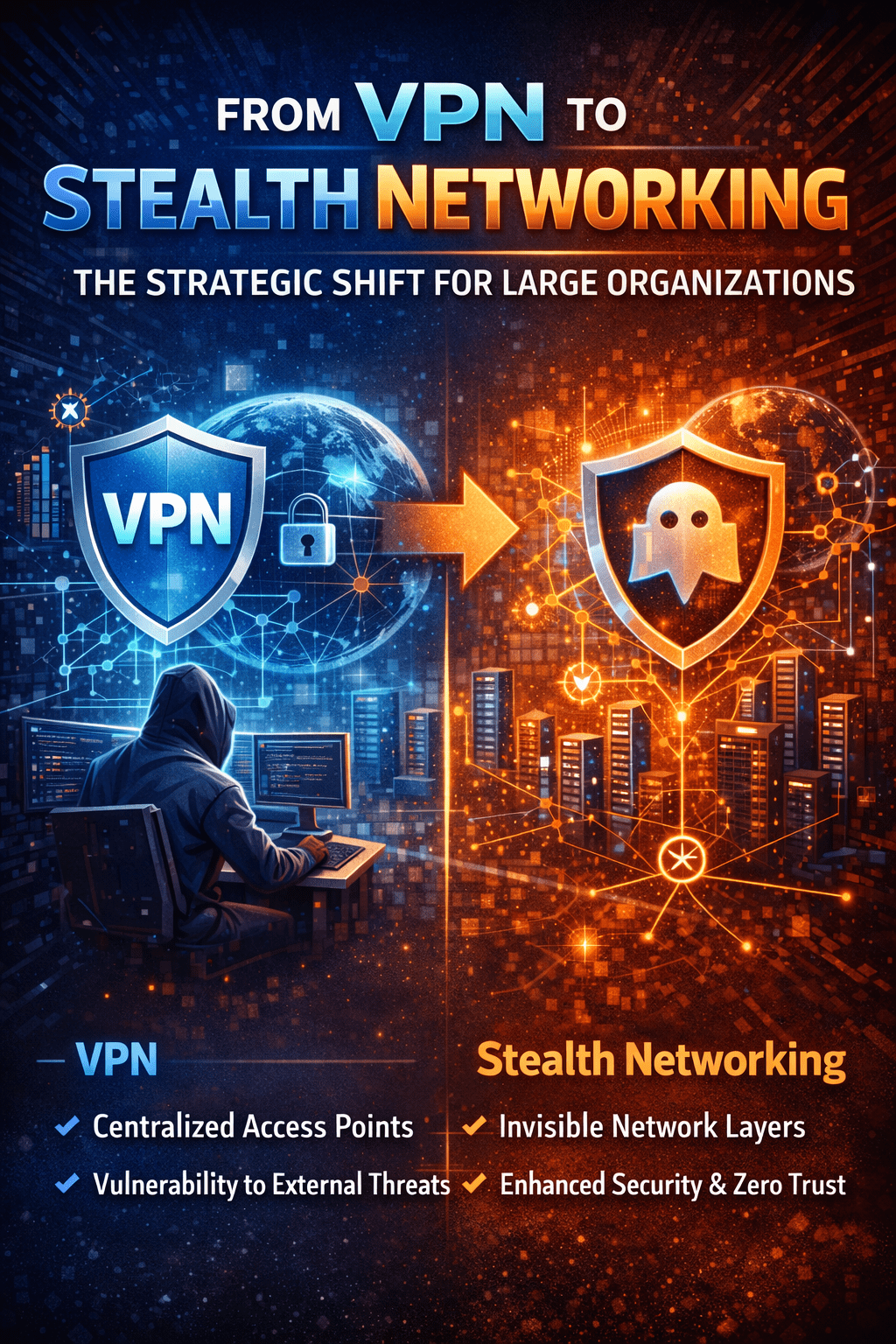
VPNs were the right solution for a security problem that no longer defines the threat landscape. They were designed to extend the corporate network to remote users — to make a remote laptop behave as if it were physically on the office network. That design solved the problem of geographic separation. It also created the problem of universal internal network access for any entity that authenticates successfully.
In 2005, that trade-off was acceptable. Remote users were a small percentage of the workforce, the systems on the internal network were relatively contained, and the primary threat was external actors trying to breach the perimeter. In 2025, the trade-off has reversed: remote and hybrid work is the operational baseline, cloud infrastructure has dissolved the network perimeter, and the primary threat actors specifically target VPN credentials because they know those credentials produce broad internal network access.
The strategic shift from VPN to stealth networking is not a technology upgrade. It is a recognition that the architecture designed for the old operational model creates the conditions the new threat model exploits.
Overview
Stealth networking replaces the network extension model with application-level access delivery — users reach specific applications they are authorized to use, not internal network infrastructure. Systems behind stealth networking are invisible to discovery and unreachable by default. Access paths exist only after explicit authorization, only for the duration of the session, and only to the specific applications authorized for the requesting identity. The result is an access model that eliminates the network visibility, lateral movement paths, and inherited trust that VPN architecture creates — while delivering the same operational connectivity that remote and hybrid workforces require.
- VPNs extend network access; stealth networking delivers application access — a fundamentally different trust model
- Systems are invisible by default in stealth networking — no reconnaissance, no target discovery, no attack surface exposure
- Lateral movement requires network visibility; stealth networking eliminates the visibility that lateral movement depends on
- Vendor and third-party access under stealth networking is scoped, time-bound, and auditable — not persistent and network-wide
- The operational experience for authorized users is equivalent or superior to VPN — security without productivity friction
The 5 Why’s
- Why is VPN architecture specifically targeted by the threat actors that large organizations face? Nation-state actors and advanced persistent threat groups specifically prioritize VPN credential compromise because the return on a single compromised VPN credential is an authenticated connection to internal network infrastructure with broad lateral movement capability. VPN exploits appear in CISA advisories repeatedly because attackers have priced the value of VPN access into their targeting decisions. Stealth networking does not create the prize that VPN compromise offers — because there is no network to access.
- Why does the scale of large organizations amplify VPN security risk rather than contain it? Large organizations have more VPN users, more vendors with VPN access, more legacy systems on the internal network, and more credential surface area than small organizations. Each of those factors multiplies the probability of a successful VPN credential compromise. And each VPN credential compromise in a large organization with a flat internal network reaches proportionally more systems. Scale under VPN architecture is a risk multiplier.
- Why is the operational cost of VPN at enterprise scale underestimated? VPN operational cost compounds with user count, device diversity, and geographic distribution. Help desk tickets for VPN connectivity issues, IT staff time managing VPN infrastructure and certificates, performance degradation for users in high-latency regions, and the capacity planning required for peak concurrent VPN sessions — these costs are significant and continuous. Stealth networking eliminates most of them because users access applications directly rather than through a network tunnel that requires infrastructure management.
- Why do large organizations face specific challenges with VPN architecture that smaller ones do not? Large organizations have vendor ecosystems that require external access management, geographic footprints that VPN performance degrades across, regulatory compliance requirements that VPN broad-access models make harder to satisfy, and security operations teams that cannot monitor the alert volume that compromised VPN infrastructure generates. Each of these challenges is directly addressed by stealth networking’s application-level, identity-verified access model.
- Why does the transition from VPN to stealth networking require a strategic decision rather than a technical one? VPN replacement affects every remote user, every vendor with remote access, and every network architecture assumption the organization has made. It requires stakeholder alignment, phased migration planning, and organizational change management that a technology deployment alone does not address. Organizations that approach it as a strategic shift — with executive sponsorship, a defined transition roadmap, and operational continuity planning — succeed. Those that approach it as an IT project discover the organizational barriers that IT authority alone cannot overcome.
What the Transition Looks Like
Assessment Phase
- Inventory all VPN use cases — remote employee access, vendor access, administrative access, legacy system access
- Identify the access requirements each use case actually needs (application access, not network access)
- Map current VPN users, vendors, and third parties to stealth networking access profiles
Architecture Phase
- Define the application access profiles that replace network access grants
- Design the identity and authentication integration that will govern stealth networking access
- Establish the secure workspace environments for data classification requiring endpoint protection
Migration Phase
- Migrate low-risk user populations first — validates stealth networking operational model before high-volume migration
- Migrate vendor and third-party access — typically the highest-value security improvement from the transition
- Migrate legacy system access last — these often require the most careful integration planning
Decommission Phase
- Remove VPN access for migrated populations — do not maintain dual access during extended transition periods
- Decommission VPN infrastructure as user populations migrate — the security benefit requires actual removal, not parallel operation
What Large Organizations Gain From the Transition
- Eliminated VPN attack surface — the most commonly exploited enterprise remote access vector is removed
- Vendor access management — vendor connections are scoped, time-bound, and auditable; VPN-inherited network access is eliminated
- Reduced lateral movement capability — attackers who compromise credentials reach application scope, not network infrastructure
- Operational simplification — VPN infrastructure management, certificate management, and connectivity support load is reduced or eliminated
- Compliance positioning — least-privilege access is enforced architecturally rather than through policies that require manual verification
Final Takeaway
The strategic shift from VPN to stealth networking is not about replacing a technology. It is about replacing an architectural model that was designed for a threat landscape that no longer exists with one designed for the threat landscape that does. Large organizations that make this shift eliminate the VPN attack surface that advanced threat actors specifically target, remove the lateral movement paths that make credential compromise catastrophic, and gain the operational simplicity that enterprise-scale VPN infrastructure has never been able to provide.
Execute the VPN-to-Stealth Transition With Mindcore Technologies
Mindcore Technologies works with large organizations to design and execute the strategic shift from VPN to stealth networking — use case assessment, architecture design, phased migration planning, and ShieldHQ Powered by Dispersive® Stealth Networking deployment that eliminates VPN risk without disrupting the operational connectivity that distributed workforces require.
Talk to Mindcore Technologies About Your VPN-to-Stealth Transition →
Contact our team to assess your current VPN architecture and design the transition roadmap that eliminates the attack surface while preserving operational continuity.

