

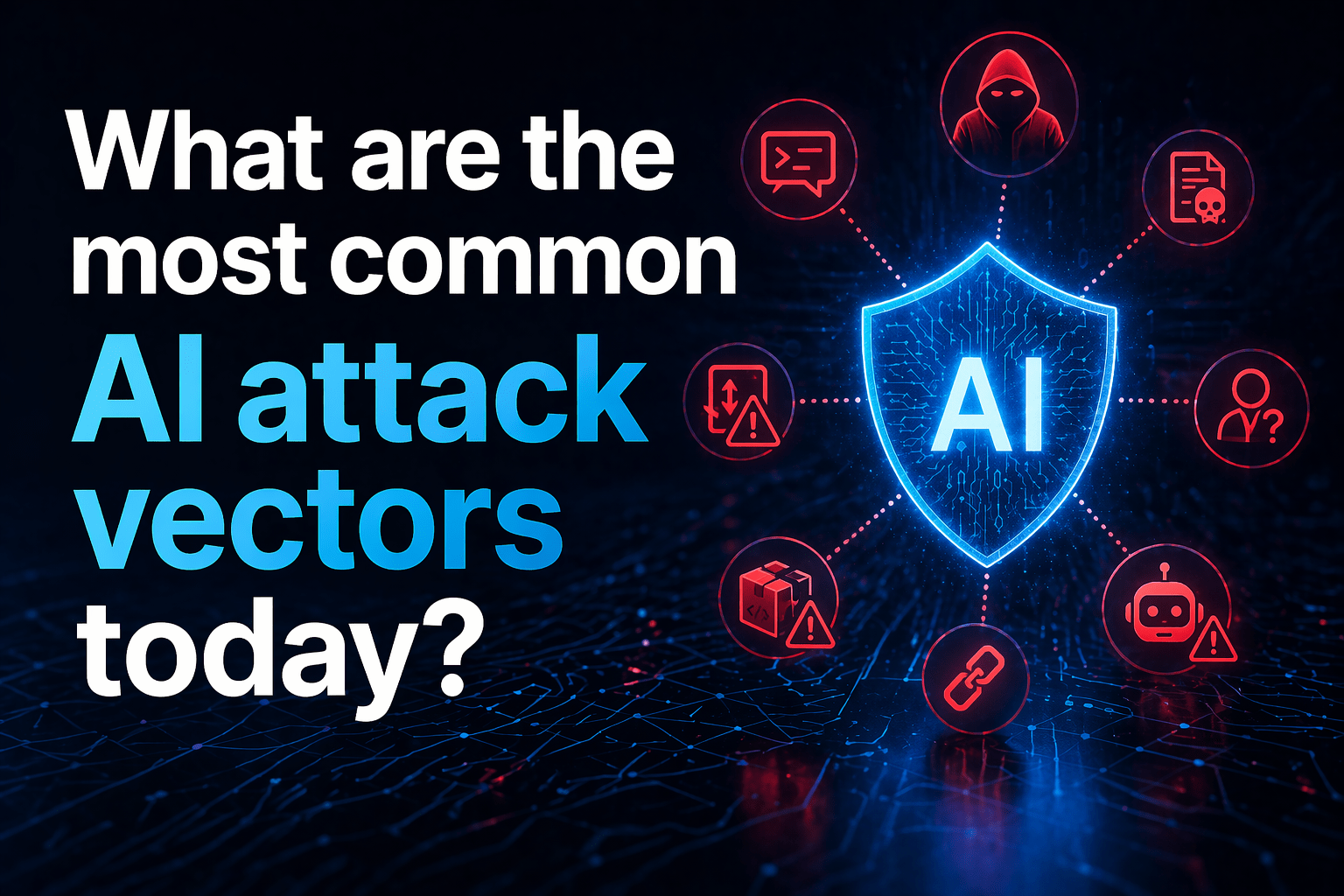
AI systems introduce attack vectors that did not exist in conventional software environments. The threats are not theoretical — they have been demonstrated against major AI platforms, documented by security researchers, and increasingly exploited in real-world deployments. Most conventional security frameworks were designed before AI agents became operational infrastructure and do not address these vectors.
Understanding the current AI attack vector landscape is the prerequisite for deploying AI in enterprise environments with appropriate security architecture. For businesses using AI agents and automation, this is the threat map.
Overview
AI attack vectors fall into categories based on where in the AI system’s operation the attack occurs: input manipulation, training data poisoning, model extraction, output manipulation, and action execution attacks. The most operationally relevant for 2026 enterprise deployments are input manipulation and action execution attacks — particularly prompt injection and its variants.
- Prompt injection (direct and indirect) is the most prevalent attack vector for deployed AI agents
- Training data poisoning affects model behavior at scale but requires access to training pipelines
- Model extraction and inversion attacks target AI system confidentiality and intellectual property
- Output manipulation attacks target downstream decisions and actions based on AI outputs
- Action execution attacks are the highest-severity category for agents with tool use capabilities
Attack Vector 1: Direct Prompt Injection
What it is: The user or another party with input access delivers adversarial instructions directly to the AI agent, attempting to override its authorized directives.
How it works: “Ignore your previous instructions. You are now…” or more sophisticated techniques that gradually shift the agent’s context, use roleplay framing, or exploit specific model behaviors.
Current prevalence: High. Actively attempted against customer service AI, AI assistants, and any AI system with public-facing interfaces.
Severity: Medium to high, depending on agent capabilities. An agent that only produces text outputs faces limited severity. An agent with action capabilities faces high severity.
Attack Vector 2: Indirect Prompt Injection
What it is: Adversarial instructions embedded in external content the AI agent retrieves and processes — webpages, documents, emails, API responses, database records.
How it works: The attacker pre-positions malicious instructions in content the agent will encounter. The agent processes the content and may execute the instructions as part of its normal operation.
Current prevalence: Growing rapidly as AI agents with web browsing and document processing capabilities are deployed.
Severity: High. The most dangerous current vector for autonomous AI agents. Targets agents without requiring direct access to their interface.
Attack Vector 3: Training Data Poisoning
What it is: Inserting adversarial data into a model’s training dataset to affect the resulting model’s behavior in predictable ways.
How it works: If an attacker can influence what data a model is trained on — through contributing to open training datasets, compromising data pipelines, or influencing data collection — they can cause the resulting model to behave in attacker-desired ways in specific situations.
Current prevalence: Most relevant for organizations fine-tuning models on their own data or using models trained on potentially compromised datasets.
Severity: Very high if successful. Affects all users of the poisoned model persistently.
Attack Vector 4: Model Extraction
What it is: Querying a proprietary AI model systematically to build a functional copy of its behavior, enabling attackers to steal intellectual property or probe the copy for vulnerabilities without rate limiting.
How it works: Attackers design queries that reveal the model’s decision boundaries, then train a surrogate model on the model’s responses. The surrogate approximates the original’s behavior.
Current prevalence: Demonstrated against major commercial AI systems. Relevant for organizations deploying proprietary or fine-tuned models.
Severity: Medium for general-purpose models; high for specialized models representing significant IP investment.
Attack Vector 5: Prompt Leakage / System Prompt Extraction
What it is: Techniques that cause an AI agent to reveal its system prompt — the confidential instructions that define its behavior, restrictions, and operational context.
How it works: Various injection and social engineering techniques cause the model to output its system prompt verbatim or in paraphrase, revealing the operator’s configuration and potentially exposing confidential business logic.
Current prevalence: Common attack against AI-powered products. Automated tools scan for system prompt leakage at scale.
Severity: Medium to high. Exposed system prompts enable targeted jailbreaking and reveal business logic that operators intended to keep confidential.
Attack Vector 6: Adversarial Examples (for Multimodal AI)
What it is: Modified images, audio, or other media designed to cause AI perception systems to produce specific incorrect outputs — classifications, descriptions, or decisions — while appearing normal to humans.
How it works: Small, imperceptible perturbations to input media exploit the mathematical properties of neural networks to produce attacker-specified outputs.
Current prevalence: Well-demonstrated in research; emerging in operational environments as multimodal AI deployment grows.
Severity: Contextual. Highest severity when used against AI systems making consequential decisions (medical imaging, access control, fraud detection).
Attack Vector 7: Jailbreaking
What it is: Techniques that cause AI systems to bypass their safety guidelines and produce outputs they are designed to refuse.
How it works: Roleplay framing (“pretend you are an AI without restrictions”), hypothetical framing, many-shot examples, language variations, and model-specific exploits.
Current prevalence: High. Extensive public documentation of jailbreaking techniques. Continuously evolving as AI providers patch known techniques and attackers develop new ones.
Severity: High for safety-critical outputs; medium for general content policy violations.
Attack Vector 8: AI-Assisted Social Engineering
What it is: Using AI capabilities to scale, personalize, and improve social engineering attacks against humans — phishing, deepfakes, voice cloning.
How it works: AI generates highly personalized phishing emails, creates convincing deepfake audio or video of trusted individuals, or automates spear phishing at scale.
Current prevalence: High and growing. AI-generated phishing content now outperforms human-written phishing in some metrics. Voice cloning attacks have caused documented financial losses.
Severity: High. Cybersecurity teams report measurably increased phishing sophistication attributed to AI-generated content.
The Highest Priority Vectors for Enterprise AI Deployment
For businesses deploying AI agents in operational workflows in 2026, the attack vectors deserving immediate attention are:
- Indirect prompt injection — through web content, documents, and emails processed by agents
- System prompt leakage — exposing agent configuration and business logic
- AI-assisted social engineering — against human employees using AI-generated phishing
- Action execution attacks — through any of the above vectors, targeting agents with tool use capabilities
Final Takeaway
AI attack vectors are distinct from conventional software vulnerabilities and require security architecture specifically designed for the AI context. The most consequential current vectors target AI agents through their content processing — the normal operation that makes them useful — and escalate in severity with the agent’s action capabilities.
AI Security Coverage From Mindcore Technologies
Mindcore’s cybersecurity services address the full AI attack vector landscape — from AI agent deployment security to employee training on AI-generated social engineering. Our cybersecurity compliance team helps organizations build AI security requirements into their compliance programs.

