

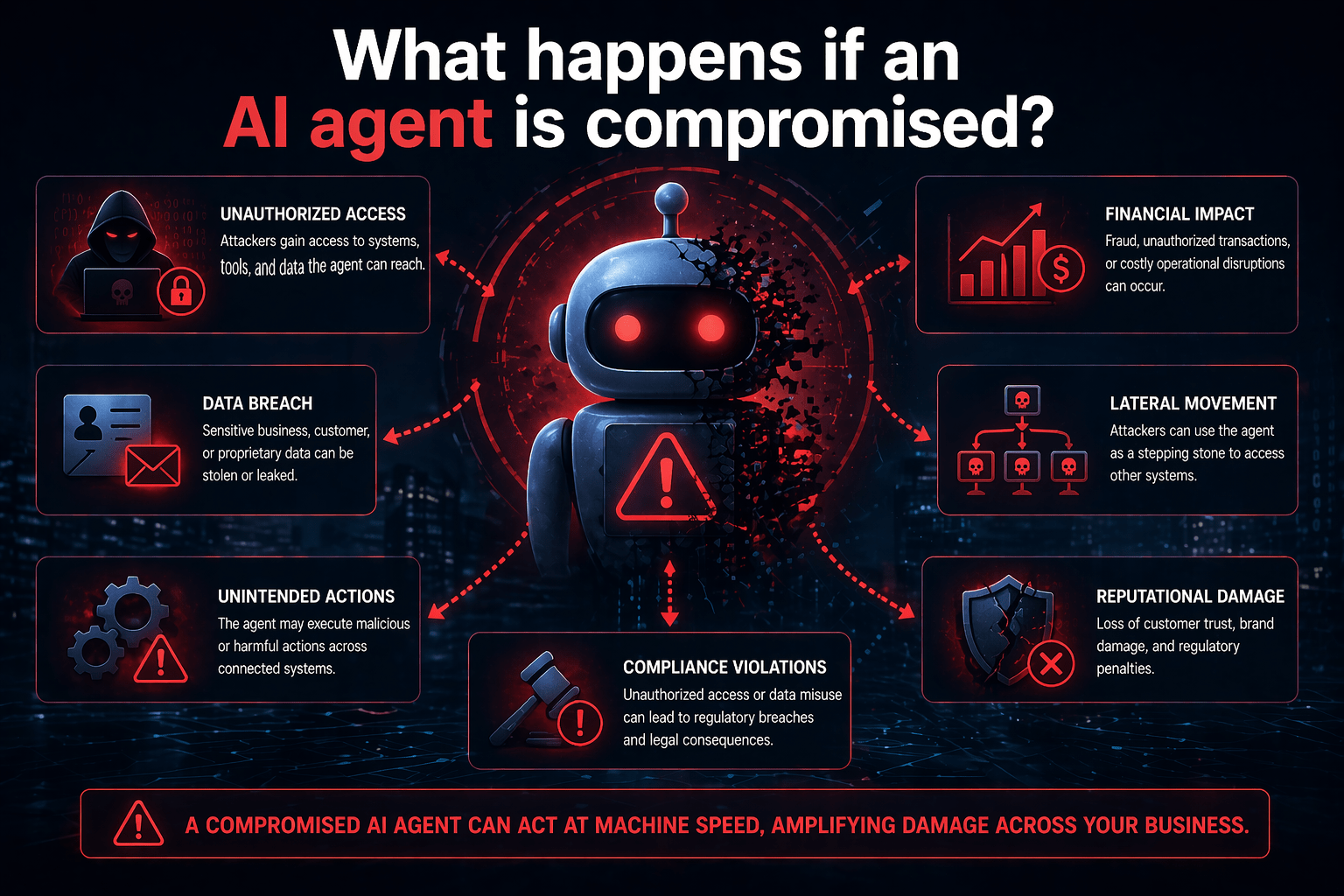
When an AI agent is compromised — through prompt injection, indirect injection, or another manipulation technique — it does not crash, generate error messages, or produce outputs that obviously indicate compromise. It continues operating, appearing functional to the user, while potentially executing attacker-directed actions, producing manipulated outputs, or transmitting data it should not.
The insidious quality of AI agent compromise is that normal-looking behavior is not evidence of normal operation. A compromised agent can summarize a document accurately while also executing an exfiltration action. It can answer questions helpfully while its context has been corrupted to produce biased recommendations. The user’s experience may be indistinguishable from an uncompromised session.
Understanding what happens when an AI agent is compromised — and how to detect and respond — is essential for businesses deploying AI agents in operational workflows.
What a Compromised Agent Can Do
The consequences of AI agent compromise depend entirely on what the agent is authorized to do. The attack amplifies existing capabilities — it does not grant new ones.
Data Exfiltration
An agent compromised through injection may be directed to transmit data it has access to: conversation history, retrieved documents, user queries, environment variables, API keys visible in its context, or data from connected systems. The transmission may look like normal API calls to external services.
Unauthorized Action Execution
An agent with action capabilities — email, API calls, file operations, code execution — can be directed to take specific unauthorized actions: sending emails with attacker-specified content, calling external APIs, modifying or deleting files, creating new user accounts, or executing attacker-provided code.
Output Manipulation
An agent processing documents or web content can be manipulated to produce outputs that misrepresent the source material: summarizing a contract inaccurately, reporting financial data incorrectly, providing biased analysis, or omitting specific information from a research report.
Context Poisoning for Subsequent Sessions
Some attacks corrupt the agent’s context in ways that affect its behavior across an extended session — gradually shifting its outputs, eroding its content restrictions, or building a corrupted context that produces attacker-desired behavior in subsequent interactions.
Reconnaissance for Further Attacks
A compromised agent may be directed to gather information about its environment: what systems it has access to, what credentials are in its context, what the organizational structure is, what security controls are visible — intelligence that supports more targeted subsequent attacks.
What Compromise Looks Like (And Why It Is Hard to Detect)
Normal indicators of system compromise — error messages, performance degradation, access anomalies — typically do not appear when an AI agent is compromised through injection. The agent continues to operate within its authorized parameters; the attacker’s instructions are being executed alongside or within those parameters.
Indicators that may suggest compromise:
- Outputs that seem inconsistent with the content the agent was processing
- Agent actions that were not explicitly requested by the user
- External network calls that cannot be explained by the agent’s authorized tasks
- Agent behavior that changes after processing content from a specific source
- System prompt content appearing in agent outputs (indicating leakage)
- Agent responses that reference information it should not have access to
These indicators require AI-specific monitoring to detect — they do not appear in conventional security log formats.
Immediate Response Steps
If AI agent compromise is suspected:
- Terminate the agent session immediately — do not continue interacting with a potentially compromised agent
- Preserve logs — capture all interaction logs, action logs, and network logs from the session before they expire
- Assess scope — determine what the agent had access to and what actions it could have taken
- Review outputs — examine the agent’s outputs for evidence of manipulation
- Review actions — review all actions the agent took during the suspected compromise window
- Notify IT and security — escalate to your IT support and cybersecurity team with session logs
- Assess downstream impact — if the agent took actions (sent emails, made API calls, modified files), assess and where possible reverse the impact
Final Takeaway
A compromised AI agent can cause significant harm while appearing to function normally. The response requires AI-specific detection capability, preserved logs, and incident response procedures designed for AI events. Organizations that build these capabilities before an incident occurs are in a meaningfully better position than those who discover the gap after one.
AI Incident Response Support From Mindcore
Mindcore’s cybersecurity services include incident response planning and support for AI agent deployments. We help organizations build detection, logging, and response procedures specific to AI security events.

