

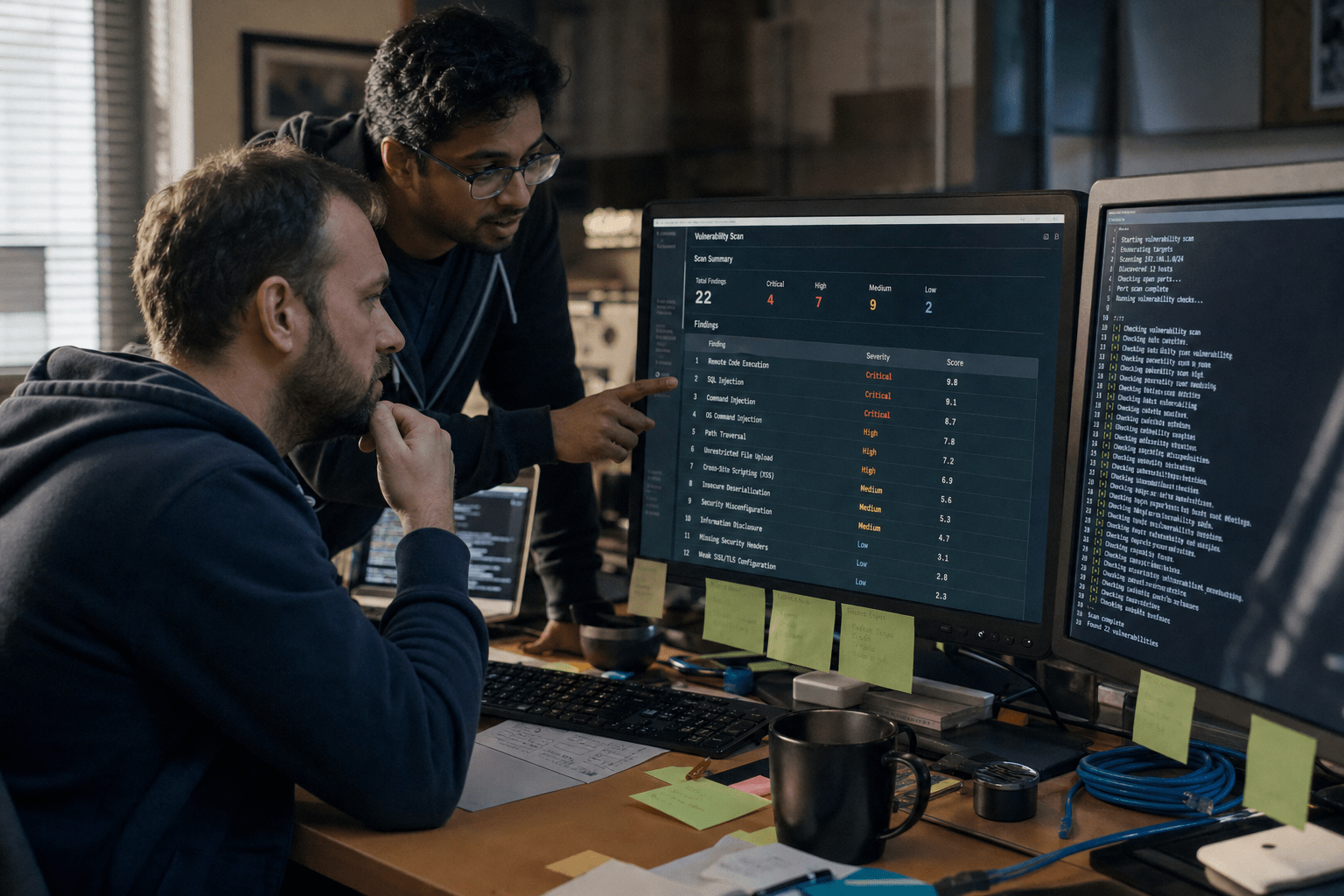
A Vulnerability Assessment Services approach helps organizations understand the difference between a vulnerability scan and a penetration test: the scan is an automated sweep of known weaknesses, while a penetration test uses human expertise to simulate real-world attacks for actionable insights A scan answers “what could be wrong here?” and runs in hours. A pen test answers “what would a real attacker do with this, and what would they reach?” and runs over days or weeks. Most SMBs need both at different times, and the costly mistake we see is buying one when the situation called for the other. The right call depends on what triggered the question in the first place.
The 5 Things That Separate a Scan From a Test
Before you spend a dollar, here are the five principles that decide which assessment fits your situation. We have walked dozens of SMB IT managers through this exact decision, and these are the points that matter once the sales pitches fade.
- When using Vulnerability Assessment Services, organizations benefit from both automated scans and human-led testing. Automation covers a wide range of issues quickly, while expert testers identify chained vulnerabilities that software alone might miss.
- Breadth versus depth. A scan covers everything fast and shallow. A test goes narrow and deep, proving real impact on a few high-value targets.
- Frequency. Scans are cheap enough to run weekly or monthly as ongoing hygiene. Tests are expensive and run quarterly, annually, or after a major change.
- The deliverable. A scan hands you a prioritized list of findings. A test hands you a narrative of how the breach happened, with proof.
- The trigger. This is the one almost nobody weighs correctly. What forced the question (a compliance deadline, a recent incident, or routine maintenance) should drive the choice more than the price tag.
These five together explain why two firms the same size buy completely different assessments and both make the right call.
How a Vulnerability Scan Actually Works
Vulnerability Assessment Services employ automated tools to probe networks, servers, and applications, comparing findings against updated vulnerability databases to maintain continuous risk awareness. The scanner checks software versions, open ports, misconfigurations, and missing patches, then ranks each finding by severity, usually with a CVSS score. According to NIST, vulnerability scanning is the process of identifying and reporting known weaknesses, and that word “known” is the whole story. A scanner cannot find a flaw that nobody has catalogued yet.
We run scans constantly for clients because they are the cheapest way to keep a moving inventory of risk. The trade-off is that a scan tells you a door is unlocked, but it never walks through to see what is on the other side.
What a Scan Is Good At
A vulnerability scan excels at fast, repeatable coverage of your entire environment at a low cost. It catches the unglamorous problems that cause most real breaches: an unpatched Exchange server, a forgotten admin account, an exposed database port. For an SMB without a dedicated security team, that visibility alone closes the gaps attackers hit most often.
The counterpoint is fair. A scan can lull a team into a false sense of safety. A clean scan report does not mean you are secure. It means the automated tool found nothing it already knew to look for. We have seen firms treat a green scan as a clean bill of health, then get breached through a logic flaw no scanner was ever going to flag. The honest position holds both: scanning is necessary and high-value, and a scan alone is incomplete proof of security.
What a Scan Misses
Even with Vulnerability Assessment Services, organizations must understand that scans alone cannot detect issues requiring complex reasoning or contextual analysis—human expertise remains essential for discovering high-impact combined vulnerabilities. Scanners do not understand business logic, so they miss flaws like a checkout flow that lets a user change a price, or a password reset that leaks another user’s token.
Some argue this gap is shrinking as scanners get smarter, and there is truth to that. Modern tools now do limited credential testing and basic web-app checks. Even so, the core limit stands: a tool matching signatures cannot replicate an adversary’s intuition. Treating a scanner as a substitute for a human tester is where the false confidence starts.
False Positives and the Noise Problem
A vulnerability scan often reports findings that are not exploitable in your specific setup, and learning to triage that noise is a real skill. A scanner might flag a “critical” issue on a service that is firewalled off from the internet and poses no practical risk. Without context, an unstaffed team chases ghosts and burns hours patching things that were never reachable.
The other side deserves weight too. Dismissing findings as false positives is exactly how genuine risk gets ignored. The disciplined approach is to validate, not assume, and that validation effort is the hidden cost teams forget to budget. This is also where our vulnerability management process earns its keep, because the scan is only the first step in a loop that ends with verified remediation.
How a Penetration Test Goes Deeper
A penetration test is a controlled, authorized attack run by a skilled human who attempts to breach your systems the way a real adversary would, then documents exactly how far they got. The NIST SP 800-115 technical guide frames it as security testing that actively exploits weaknesses to determine real impact, not just their presence. The tester starts where a scan stops: with a list of issues, they decide which ones to weaponize, chain together, and push until they reach something that matters, like customer data or financial controls.
This is where the value lives for higher-stakes environments. We had a tester on one engagement turn a low-severity information leak, the kind a scan ranks near the bottom, into full network compromise in under a day. No scanner connects those dots.
Why Human Judgment Changes the Result
A penetration test produces different findings than a scan because a human attacker improvises in ways automation cannot. The tester sees that a harmless-looking misconfiguration becomes dangerous next to a second weak setting, and pursues that path. That creativity is the entire point, and it is also why two competent testers can return different reports on the same network.
The opposing view is worth stating plainly: human testing is inconsistent and depends heavily on who you hired. A mediocre tester running automated tools and relabeling the output as a pen test is a real and common rip-off. So a penetration test is more powerful and less standardized, and the quality gap between testers is wide. Vetting the firm matters as much as buying the service. Our penetration testing methodologies walk through how a structured engagement avoids that trap.
The Cost and Time Reality
A penetration test costs far more and takes far longer than a scan because skilled human hours are the expensive ingredient. A meaningful test runs days to weeks and carries a price that makes monthly testing impractical for most SMBs. That cost is exactly why frequency has to be matched to actual risk rather than to a calendar habit.
There is a reasonable pushback here. For a small firm with a simple environment, an annual external pen test can feel like overkill against the bill. Sometimes it is. The judgment call is honest risk: a 30-person firm holding patient records or processing card payments faces a different threat profile than a local services shop, and the testing budget should reflect that.
What the Report Should Tell You
A penetration test report should read as a story of how a breach would unfold, with reproducible steps, evidence, and business-impact framing, not a raw list of CVEs. A strong report tells your leadership “here is the path an attacker takes to your customer database, and here is what closes it.” That narrative is what justifies the spend.
The counterargument is that some buyers only want a checkbox for an auditor and do not read the report. That happens, and it wastes the engagement. A test only pays off when someone acts on the findings, which loops back to the trigger question: if you are testing purely to satisfy a form, you may have bought the wrong assessment for your real need.

The Decision Framework: Which to Run, and When
Understanding Vulnerability Scanning vs Penetration Testing is crucial for organizations to balance automated detection with expert-led evaluation: scans quickly identify known weaknesses, while penetration tests simulate real-world attacks to uncover actionable security risks. This is the framework we walk every client through, and it cuts through the price-shopping confusion almost immediately. Match the assessment to the trigger, not to the brochure.
Trigger 1: A Compliance Deadline
If a compliance deadline is forcing the question, read the exact requirement before you buy anything, because many standards prescribe scans, not tests. PCI DSS, for example, requires regular vulnerability scans (often quarterly external scans by an approved vendor) and a penetration test on a defined cadence. The mistake we see most is a firm spending heavily on a full pen test when the auditor only asked for documented quarterly scans, or worse, running cheap scans when the standard explicitly required a test.
The nuance is real. Some frameworks are vague, and an over-cautious reading buys more than you need while an under-cautious one fails the audit. When the language is ambiguous, confirm scope with the auditor in writing first. Compliance is the one trigger where the requirement document, not your gut, decides the assessment.
Trigger 2: After an Incident or a Major Change
If you just had a security incident, a near miss, or a major infrastructure change, a penetration test is usually the right call because you need proof of real exposure, not a list of theoretical flaws. After a breach scare, leadership wants to know “could this happen again and how,” and only a test that simulates the attacker answers that with evidence. A scan after an incident tells you what is unpatched, which is useful but does not validate whether your fix actually holds against a determined intruder.
The other side holds in narrow cases. If the change was small and well understood, a targeted scan of the affected systems may be enough and far cheaper. The deciding factor is uncertainty: the less confident you are about your real exposure, the more a human test earns its cost. High uncertainty after an incident almost always points to a test.
Trigger 3: Routine Security Hygiene
If nothing is on fire and you simply want to stay ahead of risk, continuous vulnerability scanning is the right backbone, with periodic penetration testing layered on top. CISA’s cyber hygiene guidance treats regular scanning as foundational, and we agree: frequent scans keep your risk inventory current between the bigger, less frequent tests. For routine hygiene, scanning is the daily discipline and testing is the periodic deep audit.
A counterpoint deserves space. A firm that only ever scans and never tests is building on an unproven foundation, since it never validates that its defenses survive a real attack. So routine hygiene is not “scan instead of test.” It is “scan often, test occasionally,” with the testing cadence set by your risk profile rather than by the cheapest option on the menu.
Frequently Asked Questions
Is a vulnerability scan the same as a penetration test?
No, a vulnerability scan and a penetration test are different assessments with different goals. When comparing Vulnerability Scanning vs Penetration Testing, it is clear that automated scans provide broad coverage, but human expertise is necessary to connect vulnerabilities and discover attack paths that software alone cannot identify. They complement each other rather than replace one another, and mature security programs run both on different schedules.
Which is more expensive, a vulnerability scan or a penetration test?
A penetration test is substantially more expensive than a vulnerability scan because it depends on skilled human hours rather than automated software. Scans are cheap enough to run weekly or monthly as ongoing hygiene, while a meaningful pen test runs days to weeks and is typically performed quarterly or annually. The price difference is the reason matching the assessment to the trigger matters so much. Vulnerability Scanning vs Penetration Testing relies on automated scans to probe networks, servers, and applications against up-to-date vulnerability databases, offering a foundation for identifying potential entry points for attackers.
How often should an SMB run a vulnerability scan?
Most SMBs should run vulnerability scans at least monthly, and weekly for internet-facing systems or regulated environments. Frequent scanning keeps your risk inventory current as new flaws are disclosed and as your systems change. Many compliance standards also set a minimum scan cadence, so check your specific requirement, since it may mandate quarterly external scans by an approved vendor.
Does compliance require a penetration test or just a scan?
It depends on the standard, which is exactly why you should read the requirement before buying. Some frameworks such as PCI DSS mandate both regular vulnerability scans and periodic penetration tests, while others ask only for documented scanning. Confirm the exact language with your auditor in writing before you spend, because buying the wrong assessment can mean paying twice or failing the audit.
Can a vulnerability scan replace a penetration test?
No, a vulnerability scan cannot replace a penetration test because it only finds known, catalogued weaknesses and never validates whether an attacker could actually exploit them. A scan misses chained attacks, business-logic flaws, and anything requiring human reasoning. Scanning is necessary for ongoing visibility, but a test is what proves your defenses hold under a real, creative attack.
Get the Right Assessment for Your Situation
While Vulnerability Scanning vs Penetration Testing shows the strengths of scans, it also highlights their limitations: scans cannot detect complex, context-dependent vulnerabilities without human analysis to interpret and chain findings. They answer different questions at different moments, and the firms that get security right run both, matched to the trigger driving the decision rather than to whichever quote came in lowest. Organizations should evaluate Vulnerability Scanning vs Penetration Testing based on risk, compliance needs, and recent incidents to decide whether automated scanning, expert penetration testing, or a combination provides the most effective security posture.The expensive errors we see, buying a pen test when an auditor wanted scans, or trusting a clean scan as proof of security, both come from skipping that trigger question. Our team helps SMBs sort exactly this, from vulnerability assessment through full penetration testing, so you buy the assessment your risk actually needs. Book a free strategy call and we will help you map the right next step.
Vulnerability Assessment and Penetration Testing Expertise from Matt Rosenthal
Matt Rosenthal, CEO of Mindcore Technologies, has over 30 years of experience helping SMBs choose the right security assessment for the specific trigger driving the question, whether a compliance deadline, a recent incident, or routine hygiene, rather than buying whichever assessment the last vendor quoted. He has seen firsthand how firms treat a clean vulnerability scan as a clean bill of health, then get breached through a logic flaw no scanner was ever built to find, and how others spend on full penetration tests when an auditor required only documented quarterly scans. Matt leads a team that walks clients through the trigger-based decision framework before any assessment engagement begins, runs vulnerability scans as ongoing hygiene, and executes penetration tests that deliver a narrative of how a real breach would unfold rather than a rebranded list of CVEs.

