

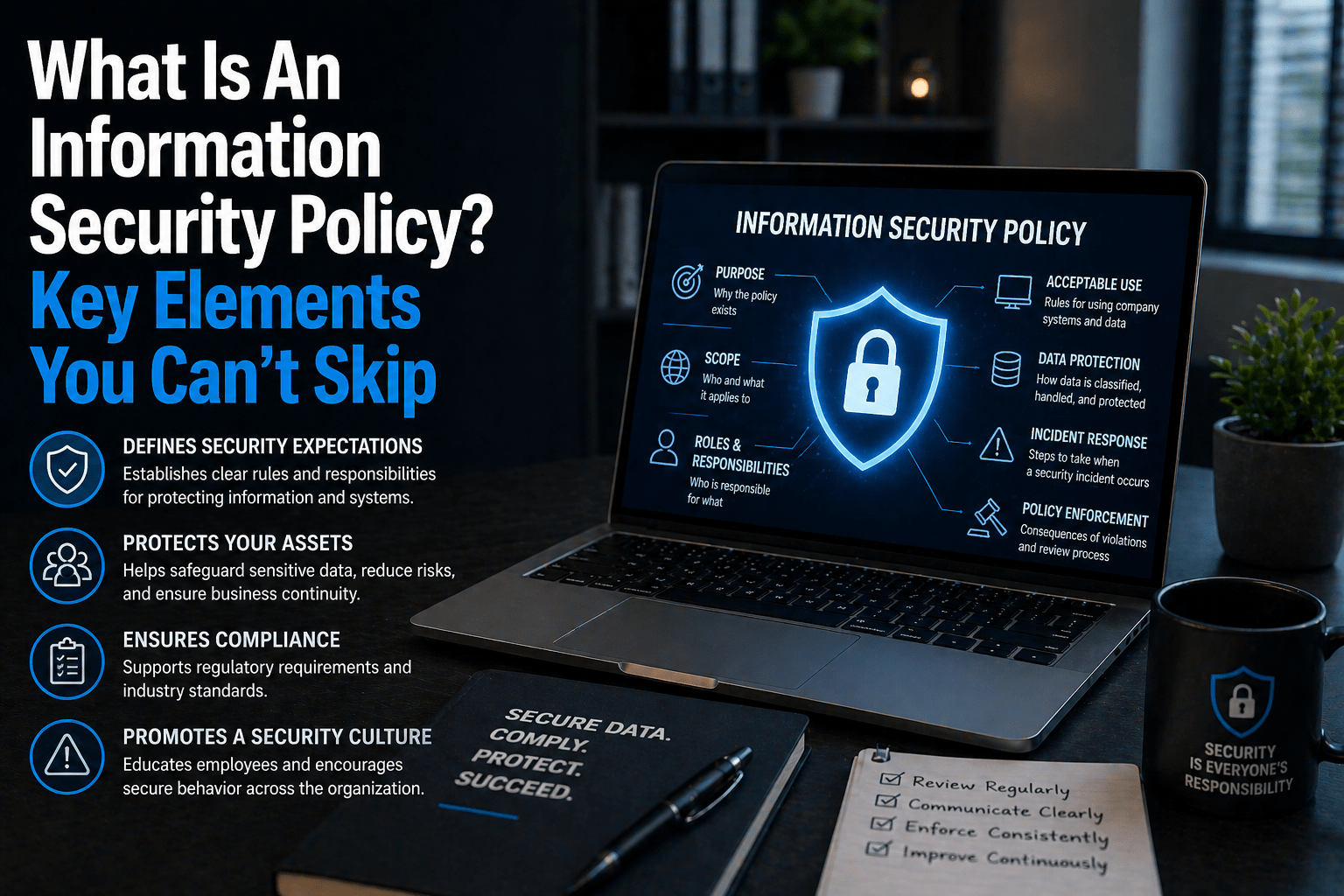
An information security policy is a formal document that defines how an organization manages, protects, and controls access to its information assets. It establishes the rules, responsibilities, and expectations that govern every aspect of how information is handled — from who can access which systems to how incidents are reported to what happens when an employee leaves.
The policy is not a technical document. It is a governance document. It translates the organization’s security objectives into defined rules that apply to everyone in the organization and sets the accountability framework for maintaining security over time.
Many organizations have security tools without security policies. The tools address specific threats; the policy addresses the human behaviors, processes, and responsibilities that determine whether those tools are used correctly, maintained appropriately, and supplemented by the practices that technology alone cannot enforce.
For businesses working on cybersecurity compliance requirements, an information security policy is a required deliverable under virtually every compliance framework.
Overview
An information security policy provides the governance framework that holds the security program together. Without it, individual security controls exist in isolation without the accountability, enforcement, and consistency that a policy provides. With it, the organization has a documented basis for security decisions, a defined standard against which behavior can be measured, and a foundation for compliance with regulatory requirements.
- Information security policies apply to all employees, contractors, and vendors with system access
- They address data handling, access control, incident reporting, acceptable use, and more
- They require executive sponsorship to be enforceable
- They require regular review and update to remain current
- They are required by HIPAA, PCI-DSS, SOC 2, and most other compliance frameworks
Key Elements Every Information Security Policy Must Include
1. Purpose and Scope
Clear statement of why the policy exists, what it is designed to protect, and who it applies to. The scope should be explicit: all employees, contractors, temporary staff, and vendors with access to the organization’s systems and data. A policy that is vague about scope is unenforceable because it is unclear who is bound by it.
2. Data Classification
A framework that categorizes the organization’s data by sensitivity and defines how each category must be handled, stored, and transmitted. Typical categories: confidential (customer PII, financial data, health records), internal (operational information not for public release), and public (marketing content, public-facing information). Classification is the foundation of proportionate data protection — you cannot apply appropriate controls without knowing what you are protecting.
3. Acceptable Use
Rules governing how organizational systems, devices, email, internet access, and cloud platforms may be used. This section defines what is permitted, what is prohibited, and what constitutes a policy violation. It should address personal use of business devices, social media use on business systems, remote access from personal devices, and any other patterns relevant to the organization’s environment.
4. Access Control
Requirements for who can access which systems and data, how access is provisioned and reviewed, and what the standards are for authentication. This section should address multi-factor authentication requirements, password standards, least-privilege principles, privileged account management, and access review procedures. Access control policy is the governance document behind identity and access management technical controls.
5. Data Handling and Storage
Requirements for how sensitive data is stored, transmitted, and disposed of. This includes encryption requirements for data at rest and in transit, rules about where sensitive data may be stored (approved cloud platforms vs. unauthorized personal storage), and secure disposal procedures for devices and documents containing sensitive information.
6. Incident Reporting and Response
Clear instructions for how employees recognize and report suspected security incidents. Who to contact, what information to provide, and what the expected response process looks like. The policy should address what constitutes a reportable incident broadly — not just obvious breaches, but suspicious emails, lost devices, accidental data exposure, and any other event that could indicate a security issue.
7. Third-Party and Vendor Management
Requirements for assessing the security posture of vendors with access to organizational systems or data, the contractual security requirements those vendors must satisfy, and the process for managing access granted to third parties.
8. Remote Work and Mobile Device Security
Requirements for how remote access is conducted, what devices may be used for work purposes, how mobile devices are managed and protected, and what happens when a device is lost or stolen. Remote work security policy has become one of the most important sections of any information security policy as remote and hybrid work have become standard.
9. Enforcement and Consequences
Explicit statement that policy violations have consequences, and the range of consequences — from coaching to termination — that apply based on severity and intent. An information security policy without enforcement provisions is a suggestion rather than a policy.
10. Review and Update Schedule
Documentation of how frequently the policy is reviewed and updated, who is responsible for the review, and what triggers an out-of-cycle review (regulatory change, significant incident, major environment change). A policy that is written once and never updated becomes increasingly inaccurate and less enforceable over time.
The 5 Why’s
- Why does an information security policy require executive sponsorship to be effective? Because policies that lack management backing are not enforced. Employees follow the behavior modeled and reinforced by leadership. A policy signed by the CEO and visibly adhered to by management has a fundamentally different organizational standing than one produced by IT without executive engagement.
- Why is data classification so foundational to everything else in the policy? Because every other security control depends on knowing what you are protecting. Encryption requirements, access controls, retention schedules, and incident reporting thresholds all depend on data sensitivity. Without classification, controls are applied uniformly rather than proportionately, which means either under-protecting sensitive data or over-protecting everything at unsustainable cost.
- Why must acceptable use policies specifically address cloud and mobile environments? Because the most common data security violations in modern organizations involve unsanctioned cloud storage (employees uploading sensitive files to personal Dropbox or Google Drive) and mobile device misuse. If the policy does not explicitly address these scenarios, employees in those situations have no clear guidance and the organization has no clear enforcement basis.
- Why does an information security policy need to be reviewed regularly rather than once? Because the regulatory landscape, threat environment, and organizational technology environment all change. HIPAA guidance is updated. New compliance requirements emerge. New tools are deployed. New attack techniques create new policy needs. A policy that has not been reviewed in two years is likely to be missing sections that are now required and to contain references to systems or procedures that no longer exist.
- Why is enforcement language necessary even in a policy that will mostly be followed voluntarily? Because the absence of enforcement language eliminates the organization’s ability to take action when the policy is violated. Without documented consequences, discipline for policy violations is inconsistent and legally exposed. The enforcement section is rarely invoked — but it must exist for the policy to function as a governance instrument.
Final Takeaway
An information security policy is the governance document that makes the security program coherent, enforceable, and compliant. The elements above — purpose and scope, classification, acceptable use, access control, data handling, incident reporting, vendor management, remote work, enforcement, and review schedule — are the components that cannot be skipped without producing a policy that looks complete but does not function as one.
Information Security Policy Development — Mindcore Technologies
Mindcore’s cybersecurity compliance and IT consulting services include information security policy development and review for businesses that need documentation that satisfies both security and compliance requirements. Our team ensures policies address your specific regulatory obligations alongside your operational environment.
Talk to Mindcore Technologies About Information Security Policy Development

