

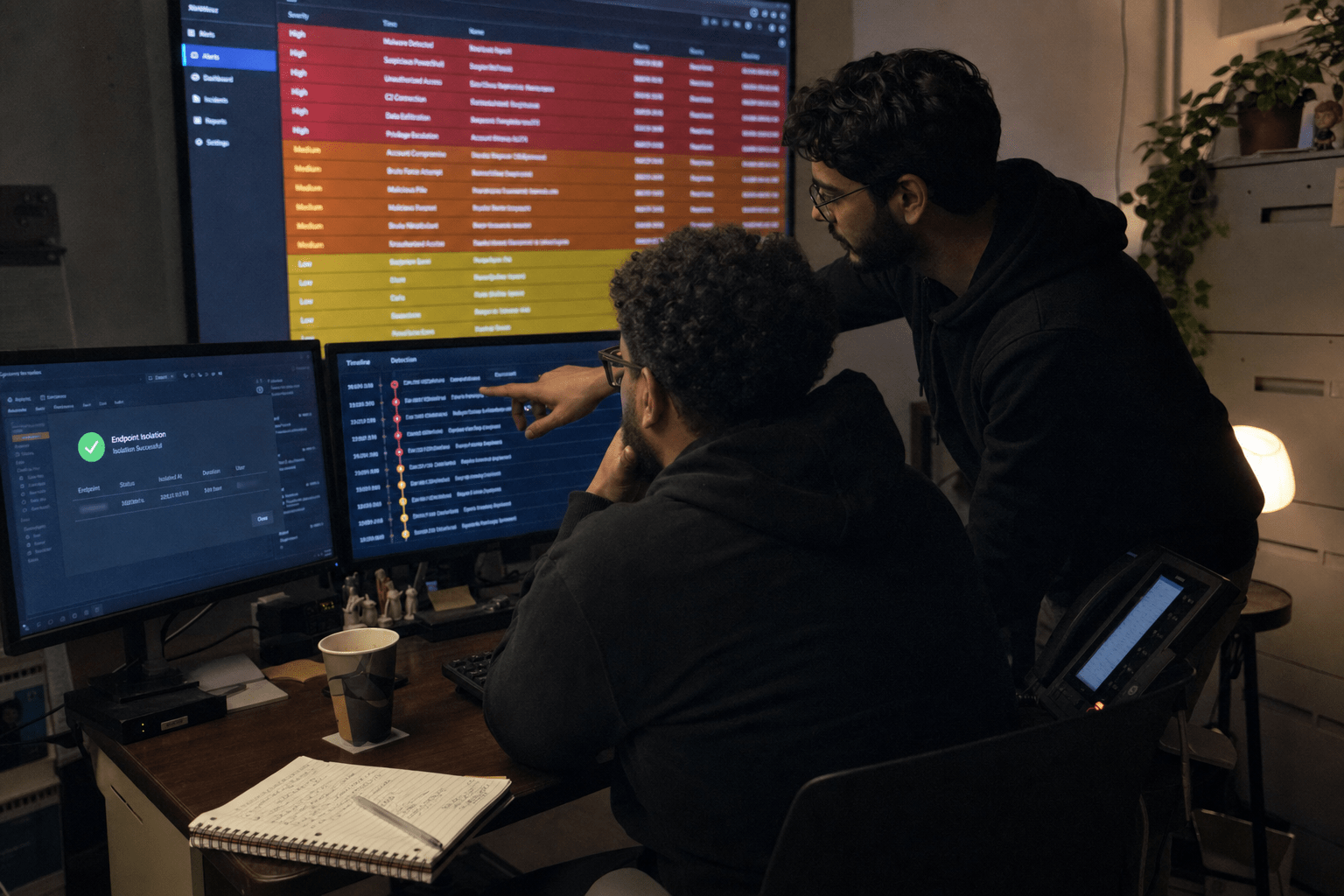
A 24/7 threat monitoring guide is only worth reading if it answers one question: at 3am on a Sunday, who is awake, what are they allowed to do without your permission, and how long does it take them to stop an attack rather than simply notice it. Most vendor pages describe sensors, dashboards, and coverage windows. Almost none publish the escalation path or the containment authority behind them. Our team reviews monitoring contracts for small and mid-sized businesses every month, and the gap between an alert that lands in a queue and an analyst who isolates an infected laptop is where nearly every after-hours incident turns expensive. This guide walks the six risks that sit inside that gap.
Overview: The 5 Why’s Behind After-Hours Coverage
Five principles carry the rest of this guide, written for the IT manager or operations lead at a 25 to 500 person company who already has endpoint protection and now has to judge whether a monitoring contract is staffed or automated.
- “24/7” describes the sensor uptime, not the roster. Software watches continuously by default. People do not. Ask which is being sold.
- Alert time and containment time are separate metrics. A provider can detect in four minutes and still take nine hours to act, because acting requires a human with permission.
- Containment authority is the whole negotiation. If nobody may isolate a host without your written approval, your monitoring is capped by how fast you answer your phone at 2am.
- In-house rotation math is brutal. Covering 168 hours a week with no single point of failure needs four to five trained analysts, not one senior hire with an on-call phone.
- Escalation paths decay silently. Contact lists, phone numbers, and named approvers go stale within months, and nobody notices until the night it matters.
Risk One: The Roster Nobody Asked About
The first after-hours risk is that continuous monitoring is being sold as continuous staffing, and the two are priced very differently. Detection tooling runs unattended by design, so any provider can truthfully say their platform watches your environment around the clock. That claim survives a sales call intact even when the overnight roster is empty and the queue is triaged at 8am. We have read contracts where the service description said “continuous monitoring” and the service level agreement quietly promised a first human response within one business day.
Does the provider staff nights, or queue them?
A staffed overnight shift means a named analyst is on duty, watching a live console, with a colleague available for escalation. A queued model means detections accumulate and get worked when the day shift arrives. Both are legitimate products at different prices, and a queued model paired with strong automated blocking can outperform a thinly staffed human shift that is asleep at the console. The opposing view has real weight: an automated response engine acts in seconds where a human takes minutes, and a tired analyst at 4am makes worse calls than a well-tuned rule. What matters is that you know which one you bought. Ask for the shift pattern, the headcount per shift, and whether the overnight team sits in your time zone or another one. Our managed security services team publishes the roster shape rather than the marketing phrase, because the shape is what you are actually paying for.
What does an automated-only night actually catch?
Automated overnight coverage reliably catches the loud things: known malware signatures, credential stuffing bursts, impossible-travel logins, and mass file encryption patterns. It handles those faster than any person. Where it struggles is the quiet intrusion that looks like ordinary administration, because a rule cannot weigh business context it was never told about. A finance director logging in from a hotel at midnight before a quarterly close is either normal or the end of your week, and only a person who knows the calendar can tell. Holding both sides honestly: automation wins on speed and consistency, humans win on judgement, and a night with neither is the configuration to avoid.
How do you verify the claim before signing?
Verification is simpler than most buyers expect. Request the last three overnight incident timelines with client details removed, showing the detection timestamp, the first human action timestamp, and the containment timestamp. A provider running a real night shift can produce those in a day. Ask what happens when the on-duty analyst is already handling another client’s active incident, because concurrency, not coverage, is where thin rosters break. Then read the same timeline discipline into your own environment using the threat management fundamentals your team already applies during business hours.
Risk Two: Mean Time to Alert Hides Mean Time to Contain
The second risk is that detection speed gets marketed while containment speed decides the outcome. Mean time to alert measures how long the platform takes to flag suspicious behavior. Mean time to contain measures how long until the affected account is disabled, the host is isolated from the network, or the malicious process is killed. Ransomware operators care only about the second number, because encryption runs during the gap between the two.
Why is a fast alert still an expensive night?
A fast alert with slow containment produces the incident pattern we see most often. Detection fires at 2:14am. The alert routes to a shared mailbox. The on-call engineer sees it at 6:40am. By then the intruder has moved from one workstation to a file server. Nothing in that sequence was broken, and every tool worked as configured. The counterargument deserves airtime: rapid automated containment carries its own cost, because an aggressive isolation rule that quarantines a production server on a false positive causes an outage you will also have to explain. Mature programs accept that trade deliberately, with per-asset rules rather than one global setting. Our guidance on what to do in the first 24 hours after a ransomware attack assumes containment decisions were pre-authorized, because decisions made cold at 3am are slow decisions.
Which metric belongs in the contract?
Put both in writing, separately, with different targets. Alert targets belong in minutes. Containment targets belong in minutes for a defined list of high-confidence detection types, and in hours for anything requiring investigation. A contract that promises a single blended “response time” is telling you nothing, because the vendor decides at claim time which clock they were running. Also define what containment means for your environment: disabling an identity, isolating an endpoint, blocking an outbound address, or all three. Pair those definitions with the visibility your network security monitoring already gives you so the promised action has data behind it.
Risk Three: Containment Authority and the 3am Phone Call
The third risk is a permissions problem dressed as a process problem. Almost every slow overnight response we review traces back to the same clause: the provider may not take disruptive action without client approval. That clause exists for a good reason, since nobody wants a vendor unilaterally shutting down a production system. It also means your containment time equals your own answer time on a phone that is face down on a nightstand.
Who should hold containment authority?
Pre-authorized containment for a narrow, named set of scenarios is the version that works. Encryption behavior on a workstation, a confirmed credential compromise, and known-malicious command and control traffic are the usual three. For those, the provider acts and tells you afterwards. Everything else escalates. The opposing position is defensible in regulated environments where an unplanned isolation can itself be a reportable service interruption, and some teams genuinely prefer a slower, human-gated model. If that is your choice, make it consciously and staff your own side of the phone accordingly, with a documented secondary and tertiary approver. Teams working under federal contract requirements can borrow the structure from continuous monitoring and incident response under CMMC, which forces exactly this kind of named-role clarity.
What breaks when the approver is unreachable?
Escalation trees fail on the second hop far more than the first. The primary contact is usually current. The backup left the company in March, and the tertiary number rings a desk phone in an office nobody visits. We test escalation trees quarterly by calling them at an odd hour, and roughly half fail on the first attempt. Write a rule that survives silence: if no approver responds within a defined window, the provider contains by default. That single sentence converts an unanswered phone from a nine-hour breach into a fifteen-minute interruption.
Risk Four: The In-House Rotation Math
The fourth risk is underestimating what 168 hours of weekly coverage costs when you build it internally. A week has 168 hours. A single analyst covers roughly 40 of them, minus holidays, training, and sick days. Genuine round-the-clock coverage with no single point of failure needs four to five trained people, plus a lead, plus tooling, plus a documented runbook that survives turnover.
Can one senior hire plus on-call work?
One strong hire with an on-call phone can work for a while, and plenty of mid-sized companies run exactly that model successfully for a year or two. It fails predictably in three ways. Burnout arrives first, because carrying every night indefinitely is not sustainable and your best security person becomes your flight risk. Single-person knowledge concentration arrives second, since the runbook lives in one head. Vacation coverage arrives third, and it arrives every year. The honest counterpoint: an outsourced team does not know your business, and a good internal analyst catches things a contracted analyst never would because they recognize which server matters at month end. The strongest programs we see run a hybrid, with internal ownership of context and priorities and an external team holding the overnight console. That split is the practical middle ground described in our managed detection and response guide.
Where does a hybrid model leak?
Hybrid models leak at the handoff. Morning handover notes get thin, the internal team assumes the overnight analyst escalated something, and the overnight analyst assumed the note was enough. Fix it with a short structured handover on a fixed schedule, and one shared incident record rather than two systems of truth. Also settle who owns tuning, because unowned tuning means alert volume climbs until everyone stops reading the queue.
Risk Five: Coverage Gaps in What Is Watched
The fifth risk is a scope gap rather than a schedule gap. Monitoring that covers endpoints but not identity, or identity but not the firewall, leaves an attacker a lane that stays dark all night. Most after-hours intrusions we investigate begin with a valid credential rather than malware, which means identity telemetry matters at least as much as endpoint agents.
Which sources belong in overnight scope?
Endpoint detection and response, identity and single sign-on logs, email security events, firewall and outbound traffic, and privileged account changes form the practical minimum. Cloud storage sharing events belong there too for any company running collaboration platforms, because mass external sharing at 2am is rarely legitimate. The counterargument is cost and noise, since every added source raises volume and licensing, and an over-broad scope that nobody tunes creates fatigue that hides the real detection. Narrow and well-tuned beats broad and ignored. Our write-up on what network monitoring covers and why businesses need it is a reasonable place to map your current sources before adding more.
Risk Six: The Untested Escalation Path
The sixth risk is that the whole arrangement is never rehearsed. A monitoring contract, a containment authority clause, and an escalation tree are documents until somebody runs them at an inconvenient hour. Run one unannounced out-of-hours test per quarter. Trigger a benign detection, time the first human contact, time the containment action, and record which phone numbers failed. Then fix the tree and repeat. Companies that rehearse quarterly recover in hours. Companies that first walk their escalation path during a live incident recover in days, and that difference is what our data breach and incident response engagements spend most of their time undoing.
Frequently Asked Questions
Does 24/7 threat monitoring always mean human analysts are awake?
No. In many contracts the platform runs continuously while human triage happens during business hours. Ask directly for the overnight shift pattern and headcount, and request three redacted overnight incident timelines showing detection, first human action, and containment timestamps.
What is a reasonable mean time to contain for an SMB?
For high-confidence detection types with pre-authorized containment, minutes is achievable and worth contracting for. Anything requiring investigation and client approval realistically lands in hours, which is why the pre-authorized list matters more than the headline response number.
How many analysts does in-house 24/7 coverage actually need?
Four to five trained analysts plus a lead is the realistic floor for 168 hours of weekly coverage without a single point of failure. One senior hire on permanent call works temporarily and fails on burnout, knowledge concentration, and vacation coverage.
Should a provider be allowed to isolate a machine without asking us?
For a narrow, named list of scenarios, yes, and it is the single highest-value clause in the agreement. Define the list, define a response window for approvers, and add a default-contain rule for when nobody answers.
What is the fastest way to test whether our monitoring works at night?
Run an unannounced out-of-hours test each quarter using a benign trigger. Record first human contact, containment time, and every phone number that failed, then correct the escalation tree and run it again.
Talk to Our Team About Your Overnight Coverage
The six risks in this guide share one root cause: monitoring gets bought on coverage language and judged on containment behavior, and nobody compares the two until an incident forces it. Coverage is a schedule. Containment is a decision made by a named person with pre-agreed authority, working from an escalation path somebody tested recently. If you can produce your own answers to who is on duty tonight, what they may do without calling you, how long containment takes for your three most likely scenarios, and when the escalation tree was last exercised, your program is in better shape than most. If any of those answers is uncertain, that uncertainty is the finding, and it is fixable in weeks rather than quarters. Our team will walk your current setup, time your real escalation path, and show you where the overnight gap sits. Book a free strategy call and bring your existing monitoring agreement.

