

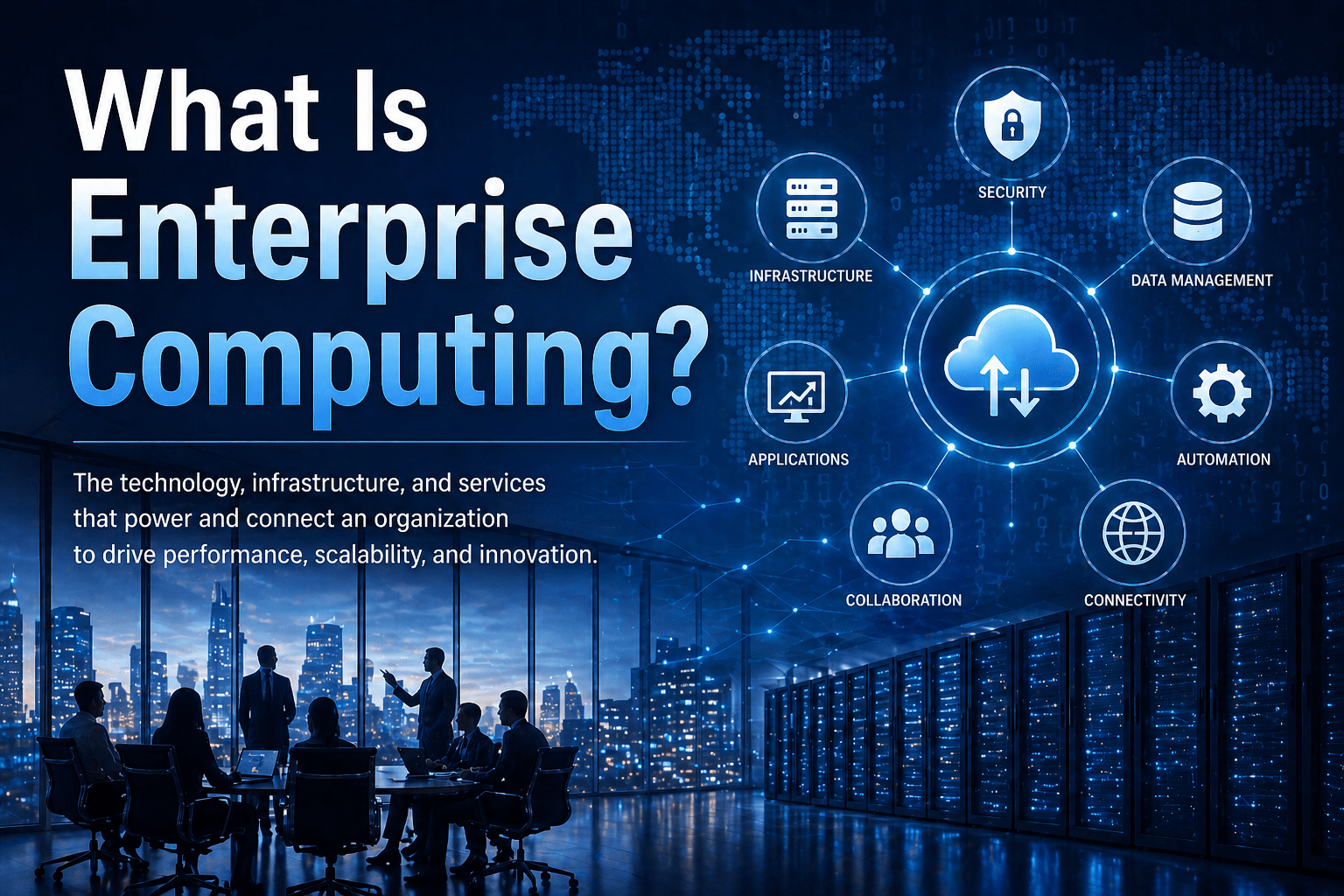
Enterprise computing refers to the use of information technology at organizational scale — the deployment and management of computing resources, platforms, and systems to support the operations, communications, data management, and business processes of an organization rather than an individual user.
The distinction from personal or consumer computing is not just size. Enterprise computing introduces requirements that personal computing does not: multi-user access management, centralized administration, organizational security controls, integration between systems, high availability, compliance documentation, and management at hundreds or thousands of device scale simultaneously.
A business with fifty employees using Microsoft 365 managed through a centralized IT policy is engaged in enterprise computing. The same employees using personal free-tier accounts are using consumer software — fundamentally the same tools, but without the management, security, and accountability layer that enterprise computing requires.
For organizations working with managed IT services providers, enterprise computing is the practice that managed IT services enable and maintain.
What Enterprise Computing Includes
Centralized management: administrative control over devices, accounts, and applications across the organization. In a managed enterprise environment, IT can deploy software, enforce security policies, reset passwords, and manage access from a central console rather than device by device.
Identity and access management: organizational control over who has access to what — through Active Directory, Azure AD, or similar platforms — with consistent policy enforcement across the environment.
Data governance: policies and systems that determine where organizational data is stored, who can access it, how long it is retained, and how it is protected. Data governance is the enterprise computing layer over individual data handling.
High availability and redundancy: enterprise computing infrastructure is designed with resilience — redundant systems, failover capability, backup and recovery — that personal computing does not require. A business cannot afford the same tolerance for downtime that an individual user accepts.
Compliance and audit capability: regulated industries require enterprise computing infrastructure that generates and retains audit logs, enforces access controls, and documents security events in ways that compliance audits require.
The 5 Why’s
- Why does enterprise computing require centralized management rather than individually managed devices? Because device-by-device management does not scale. Manually managing security settings, software updates, and access controls on each individual device in a fifty-person organization is operationally unsustainable. Centralized management applies configuration and security policy to all devices simultaneously — enabling consistent security posture that individual management cannot maintain.
- Why is enterprise computing specifically important for cybersecurity? Because most security controls in modern environments depend on enterprise computing infrastructure to function. EDR deployment requires device management enrollment. Email security configuration requires centralized email platform management. Access control policy requires identity management infrastructure. Without enterprise computing, these controls cannot be deployed, enforced, or monitored consistently.
- Why does enterprise computing require different hardware and software than consumer alternatives? Because enterprise requirements — scalability, manageability, reliability, integration, and support — are not priorities for consumer product design. Consumer hardware is designed for individual use by non-technical users. Enterprise hardware and software are designed for centralized management, high-availability deployment, and integration with organizational infrastructure.
- Why has cloud computing specifically changed enterprise computing architecture? Because cloud platforms enable enterprise computing capabilities — centralized management, high availability, scalability, security controls — without requiring on-premises infrastructure investment. Organizations can implement enterprise computing practices through Microsoft 365 and cloud platforms rather than purchasing and managing servers.
- Why do SMBs need enterprise computing practices even if they are not large enterprises? Because the threats, compliance requirements, and operational needs that enterprise computing addresses are not proportional to organization size. A 20-person healthcare practice needs centralized identity management, data governance, and security controls for the same reasons a 2,000-person hospital does. The scale is different; the requirements are not.
Final Takeaway
Enterprise computing is the organizational-scale use of IT with centralized management, security controls, data governance, high availability, and compliance capability. It is what separates a professionally managed IT environment from a collection of individually managed devices — and it is the foundation that effective cybersecurity, operational reliability, and compliance depend on.
Enterprise Computing Management From Mindcore Technologies
Mindcore provides managed IT services that implement and maintain enterprise computing practices for organizations across Louisiana and the Gulf South. Our IT consulting services help organizations design and build the enterprise computing infrastructure appropriate for their size and requirements.
Talk to Mindcore Technologies About Enterprise Computing for Your Organization

