

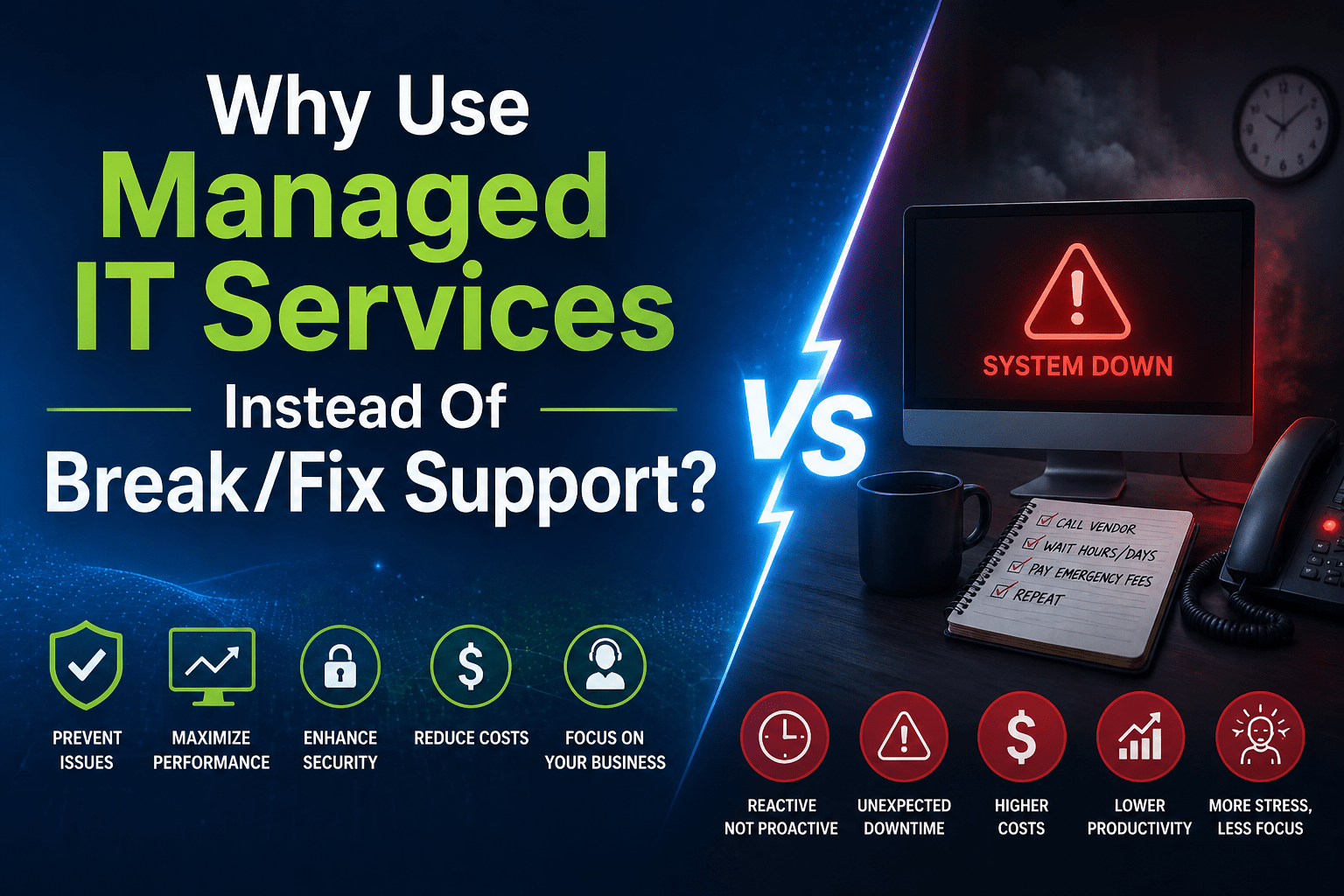
Break/fix IT support has a simple premise: something breaks, you call, someone fixes it, you pay. For businesses with simple, infrequent IT needs, that model works. For businesses where technology is central to daily operations — which describes virtually every organization today — break/fix has a structural problem: it is entirely reactive.
The break/fix model does not prevent failures. It does not monitor for emerging problems. It does not maintain your systems proactively. It waits for things to go wrong and then responds. In an environment where downtime has direct revenue impact and security threats are continuous, that waiting posture is expensive.
Managed IT services was built specifically to replace that posture with a proactive alternative. Here is why the shift produces better outcomes for most businesses.
Overview
The difference between managed IT services and break/fix support is not just the billing model — it is the entire operational posture. Break/fix is reactive by design. Managed IT is proactive by design. Every structural element of the managed IT model — continuous monitoring, flat monthly fees, defined SLAs, proactive patching — is oriented toward preventing the failures that break/fix is designed only to respond to.
- Break/fix generates revenue when things break; managed IT generates value when things do not break
- Proactive monitoring addresses issues before they become downtime
- Flat monthly fees produce predictable IT budgets instead of unpredictable repair bills
- Managed IT includes security maintenance; break/fix typically does not
- SLAs create accountability; break/fix engagements typically lack formal commitments
The 5 Why’s
- Why does the break/fix billing model create misaligned incentives? A break/fix provider is paid per incident. More incidents mean more revenue. There is no financial incentive to prevent problems — and a quiet period where systems run well is a revenue gap. Managed IT’s flat monthly model inverts this: a stable environment with fewer incidents means lower delivery costs for the provider and better outcomes for the client. The incentives align.
- Why is downtime more expensive under break/fix than businesses realize? Break/fix downtime cost includes the repair bill plus the cost of the downtime itself — lost productivity, missed revenue, frustrated employees and customers, and the time spent recovering. Those costs are invisible on the break/fix invoice. Under managed IT, proactive monitoring catches issues before they become downtime. The comparison is not break/fix cost vs. managed IT cost; it is break/fix total cost (including downtime) vs. managed IT total cost.
- Why does break/fix fail as a security model? Security is not a repair task — it is an ongoing operational practice. Break/fix providers respond to security incidents after they occur. They do not maintain security controls, monitor for threats, or patch systems proactively. A business relying on break/fix for security is relying on the hope that nothing is exploited before it calls for help. Managed IT services include continuous security management as an operational function.
- Why do break/fix relationships produce poor vendor knowledge of your environment? A break/fix technician called in for an emergency has limited context about your environment. They work from what they can observe in the moment. A managed IT provider monitors your environment continuously and accumulates deep familiarity with its normal state, its history, and its vulnerabilities. That context makes every service interaction faster and more effective.
- Why do businesses stay on break/fix longer than they should? Break/fix costs are invisible when nothing is breaking. The monthly managed IT fee is always visible. Organizations that have not experienced a significant IT incident yet underestimate the cost of reactive support and overestimate the cost of proactive management. The calculation shifts the first time a major incident produces a large repair bill plus days of lost productivity.
What Managed IT Delivers That Break/Fix Cannot
Proactive Issue Resolution
Monitoring software deployed across your environment detects developing issues — a drive approaching failure, a server running low on capacity, a network device behaving abnormally — before they cause outages. Problems are addressed before users notice them.
Continuous Security Maintenance
Patches, updates, and security configurations are maintained on a defined schedule. Endpoint protection is monitored and current. Access management is reviewed. Cybersecurity is not a separate engagement — it is built into the managed IT operational routine.
Predictable Costs
A flat monthly fee converts unpredictable IT costs into a known operational line item. Budget planning is straightforward. There are no surprise repair bills, no emergency service charges, and no invoices that spike after incidents.
Accountability
Managed IT service agreements include SLAs — defined response times, resolution targets, and performance metrics. Those commitments are contractual. Break/fix engagements typically have no formal accountability structure.
Final Takeaway
Managed IT services is the answer to the structural problems of break/fix support — reactive posture, misaligned incentives, no security maintenance, unpredictable costs, and no accountability. The shift is not just operational — it changes the economics of IT for most businesses in a way that favors prevention over repair.
Move From Break/Fix To Managed IT With Mindcore
Mindcore Technologies provides managed IT services that replace reactive support with proactive management. We help businesses transition from break/fix with a clear onboarding process and no disruption to operations.

