

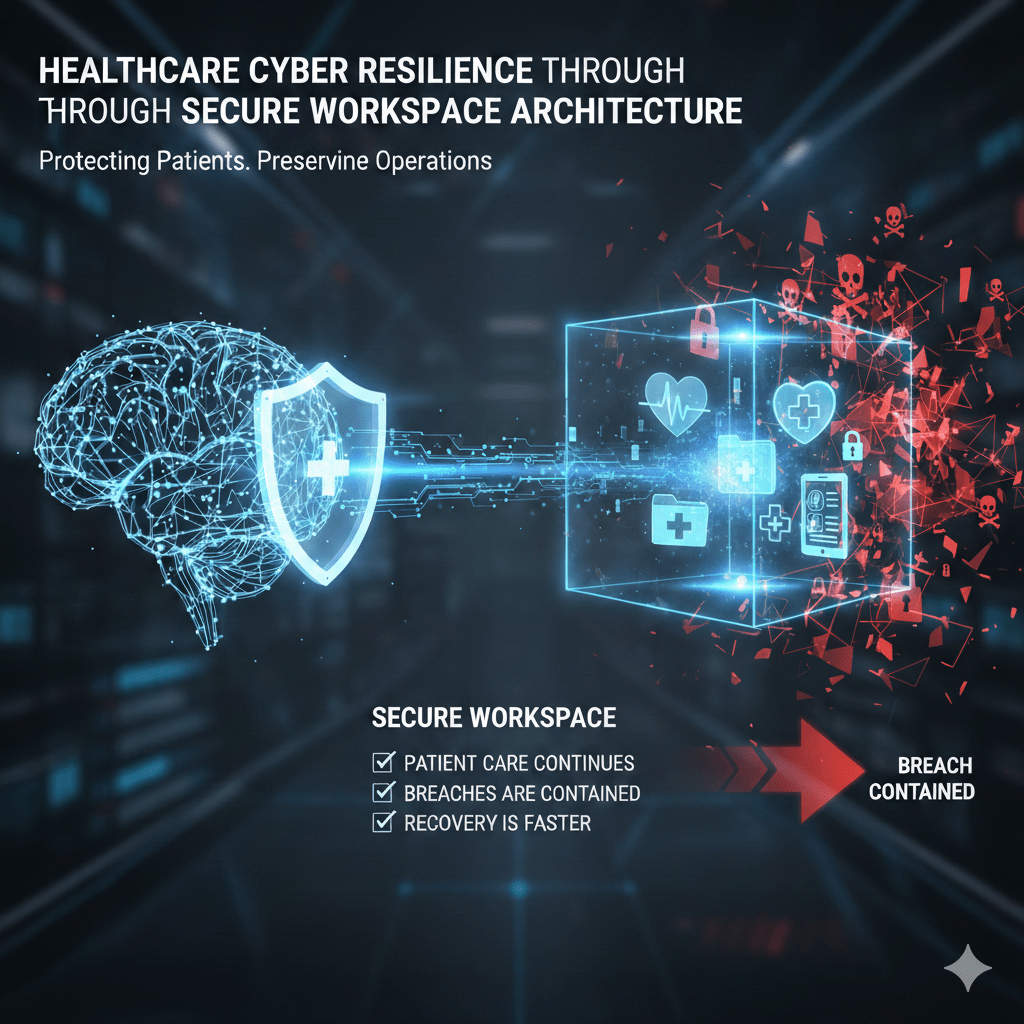
Healthcare cyber resilience is not about stopping every breach. That goal is unrealistic. Real resilience is the ability to absorb an attack, contain the damage, and continue delivering care without losing control of patient data or operations.
Most healthcare environments fail this test because their access architecture assumes trust after login. Secure workspace architecture exists to remove that assumption.
At Mindcore Technologies, post-incident reviews consistently show that organizations with secure workspace models recover faster, contain incidents earlier, and avoid the cascading failures that turn cyber events into operational crises.
What Cyber Resilience Actually Means in Healthcare
Cyber resilience is the ability to maintain clinical operations and protect PHI even when security controls are bypassed.
In healthcare, that means:
- Patient care continues during incidents
Systems remain available even when attacks occur. - Breaches are contained, not amplified
One compromise does not spread across the environment. - Recovery does not require full shutdowns
Isolation happens at the session or workspace level. - Compliance exposure is limited
Fewer systems and records are affected.
Resilience is architectural, not procedural.
Why Traditional Healthcare Security Models Break Under Pressure
Most healthcare security models fail because they are built for prevention, not endurance.
Common failure points include:
- Flat or semi-segmented networks
Once inside, attackers can move freely. - VPN-based remote access
Compromised credentials grant internal visibility. - Endpoint-dependent controls
Security fails when devices are unmanaged or compromised. - Manual incident response workflows
Containment takes too long to prevent damage.
These models collapse quickly during real attacks.
How Secure Workspace Architecture Changes the Resilience Equation
Secure workspaces redesign access so compromise does not equal collapse.
They achieve this by:
- Isolating users from infrastructure
Users interact with applications, not networks. - Delivering access through controlled environments
PHI and systems remain inside protected workspaces. - Using session-based access instead of standing trust
Access ends automatically when sessions close. - Decoupling device security from data security
Even compromised endpoints cannot reach sensitive systems.
This turns breaches into contained events.
Containing Attacks Instead of Chasing Them
Secure workspace architecture limits the impact of attacks by default.
It does this by:
- Preventing lateral movement
Attackers cannot pivot across systems. - Blocking internal discovery
Systems are invisible unless explicitly authorized. - Restricting access scope automatically
Users cannot reach systems outside their role. - Allowing immediate session termination
Access can be revoked instantly without network changes.
Containment happens before investigation.
Maintaining Clinical Operations During Cyber Incidents
Downtime is often more damaging than data loss.
Secure workspaces support operational continuity by:
- Isolating affected sessions instead of shutting down environments
Care teams remain functional. - Protecting EHR and clinical systems from endpoint failures
Devices become access terminals, not points of failure. - Allowing safe remote access during incident response
IT and clinical leadership can operate without expanding risk. - Reducing dependency on emergency network reconfiguration
Response actions are precise and fast.
Care delivery does not stop because one user is compromised.
Reducing Ransomware Impact Through Architectural Control
Ransomware relies on reach and speed.
Secure workspaces disrupt both by:
- Limiting encryption scope
Attackers cannot reach file systems broadly. - Blocking data exfiltration paths
PHI remains inside controlled environments. - Preventing backup tampering
Infrastructure access is restricted. - Allowing fast isolation of affected users or vendors
Spread is stopped early.
Ransomware becomes a manageable incident, not an existential threat.
Improving Recovery Speed and Confidence
Recovery is where many healthcare organizations struggle.
Secure workspace architecture improves recovery by:
- Reducing the number of systems involved
Cleanup is targeted, not global. - Preserving clean environments during incidents
Not everything needs rebuilding. - Providing clear audit trails
Investigation and reporting are faster. - Allowing parallel recovery and operations
IT teams work without halting care.
Faster recovery reduces both cost and disruption.
Cyber Resilience and HIPAA Alignment
HIPAA expects organizations to limit exposure, control access, and demonstrate safeguards.
Secure workspaces support this by:
- Enforcing minimum necessary access automatically
Permissions are narrow and purposeful. - Containing PHI within approved environments
Data does not sprawl to endpoints. - Providing defensible audit evidence
Access is logged at the session level. - Reducing breach scope and notification impact
Fewer records and systems are involved.
Resilience strengthens compliance outcomes.
Why Detection-Only Strategies Undermine Resilience
Monitoring tools alone do not create resilience.
They fail because:
- Alerts trigger after damage occurs
- Response depends on human speed
- Attackers blend into normal behavior
Secure workspaces reduce the need for rapid detection by removing the ability to cause widespread harm.
How Mindcore Technologies Builds Cyber-Resilient Healthcare Architectures
Mindcore strengthens healthcare cyber resilience by:
- Assessing real-world access paths and trust assumptions
Identifying where collapse is possible. - Replacing VPN and network-based access with secure workspaces
Removing internal exposure. - Designing role-based, session-limited access models
Reducing scope automatically. - Containing PHI inside controlled environments
Preventing sprawl and misuse. - Aligning security architecture with operational realities
Protecting care delivery, not disrupting it.
The focus is resilience through design, not reaction.
A Simple Cyber Resilience Reality Check
Your healthcare environment lacks resilience if:
- VPN access exposes internal networks
- Compromised accounts can reach multiple systems
- Incident response requires shutdowns
- PHI exists on endpoints
- Recovery involves rebuilding large portions of the environment
These conditions turn incidents into crises.
Final Takeaway
Healthcare cyber resilience is not achieved through more alerts or faster reactions. It is achieved through architecture that limits damage automatically.
Secure workspace architecture gives healthcare organizations the ability to contain attacks, protect patient data, and maintain operations even under active threat. Those that adopt it recover faster and with far less disruption. Those that do not learn resilience the hard way.

