

Enterprise healthcare organizations cannot rely on fragmented cybersecurity tools, disconnected compliance dashboards, or perimeter-based defenses. Hospitals and multi-facility health systems operate across hybrid cloud environments, remote clinicians, imaging platforms, billing integrations, and vendor ecosystems. Every integration point increases systemic exposure.
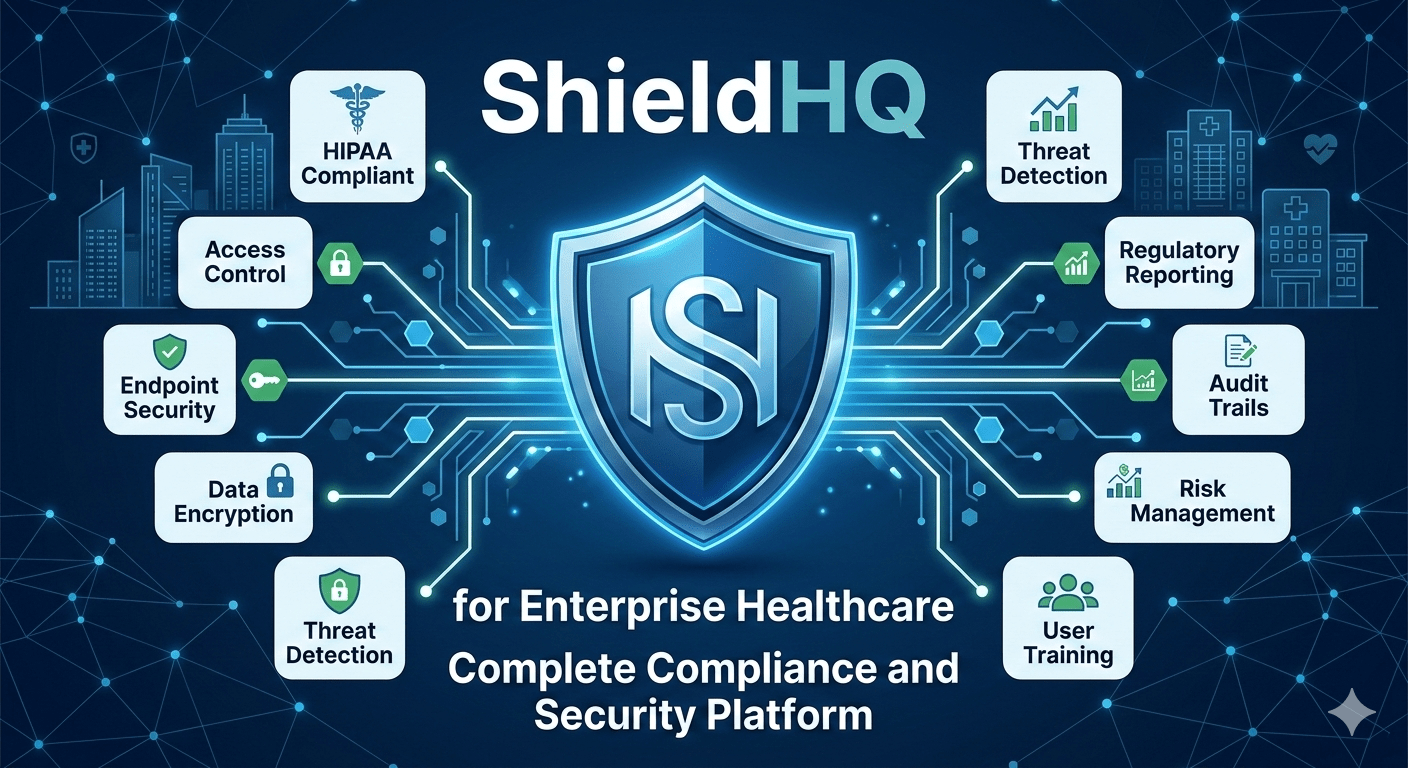
ShieldHQ for Enterprise Healthcare is built to address this reality. It is not a collection of security products. It is a containment-driven compliance and security platform engineered for enterprise-scale environments. ShieldHQ Powered by Dispersive® Stealth Networking integrates identity governance, segmentation, encryption enforcement, centralized monitoring, vendor discipline, and executive-level reporting into one structured architecture.
In complex healthcare systems, security and compliance must operate continuously. They cannot rely on annual audits or reactive patching cycles.
Why Enterprise Healthcare Requires a Complete Platform
Healthcare organizations managing 500+ employees face structural complexity:
• High PHI concentration across departments
Increase breach impact and regulatory exposure.
• Distributed workforce environments
Expand credential compromise risk.
• Hybrid cloud and on-prem integration
Complicate visibility.
• Extensive vendor partnerships
Increase third-party exposure.
ShieldHQ addresses these systemic challenges through containment architecture and continuous oversight. These enterprise scalability principles are expanded in ShieldHQ Enterprise Solutions: Comprehensive Healthcare Security Guide.
Core Capabilities of ShieldHQ for Enterprise Healthcare
1. Containment Architecture Through Segmentation
• Secure enclave isolation for sensitive workloads
Limit breach blast radius.
• Segmentation across clinical and administrative systems
Prevent lateral movement.
• Vendor access isolation pathways
Restrict third-party exposure.
Architectural comparisons are examined in ShieldHQ vs. Traditional Healthcare Security: Enterprise Comparison.
2. Phishing-Resistant Identity Governance
• Role-Based Access Control (RBAC)
Limit PHI exposure by job function.
• Phishing-resistant MFA enforcement
Reduce credential compromise.
• Automated privilege lifecycle management
Remove access immediately upon role change.
Identity discipline strengthens executive trust, a theme explored in How Healthcare Executives Build Trust with ShieldHQ Professional Solutions.
3. Centralized Monitoring and AI-Driven Detection
• Enterprise-wide SIEM integration
Consolidate log visibility.
• AI anomaly detection
Identify abnormal behavior instantly.
• Executive compliance dashboards
Provide board-ready visibility.
These capabilities directly address the operational strain described in Healthcare Compliance Challenges ShieldHQ Solves for Executives.
4. Vendor Governance and Compliance Automation
• Structured Business Associate Agreement oversight
Ensure contractual HIPAA alignment.
• Continuous vendor session monitoring
Detect abnormal behavior.
• Automated compliance reporting workflows
Reduce documentation burden.
Implementation processes are outlined in ShieldHQ Implementation Guide for Healthcare Organizations Over 500 Employees.
Executive-Level Outcomes
ShieldHQ enables enterprise healthcare organizations to:
• Reduce lateral movement risk
• Strengthen regulatory defensibility
• Improve executive reporting transparency
• Lower cyber insurance friction
• Reduce audit preparation time
• Increase leadership confidence
The strategic philosophy behind these outcomes is detailed in The ShieldHQ Approach: Serious Healthcare Security for Serious Organizations.
Key Takeaways
ShieldHQ Powered by Dispersive® Stealth Networking provides enterprise healthcare organizations with a containment-driven compliance and security platform built for scale. By integrating segmentation, phishing-resistant identity governance, AI-driven monitoring, vendor risk discipline, and executive reporting automation, ShieldHQ transforms fragmented cybersecurity operations into a structured, continuously enforced architecture capable of sustaining resilience, regulatory defensibility, and executive confidence.

