


Remote and hybrid work environments did not create ransomware risk. They redistributed it in ways that most organizations have not fully addressed.
The perimeter that once defined the boundary between trusted and untrusted network space no longer exists in the same form for organizations with distributed workforces. Endpoints sit in home networks that the organization does not control, connect through consumer-grade routers with default credentials, and access organizational systems through remote access infrastructure that has become one of the most targeted initial access vectors in enterprise ransomware attacks.
When ransomware hits a remote or hybrid environment, the response faces challenges that office-only incident response does not: endpoints that cannot be physically isolated by pulling a cable, users who cannot be briefed in person and who may take counterproductive actions without guidance, remote access infrastructure that is simultaneously a required business tool and a potential attacker pathway, and IT teams that may themselves be remote when the incident occurs.
This article covers how ransomware attacks specifically exploit remote and hybrid work environments, what containment looks like when your workforce is distributed, how to coordinate an effective response across a geographically dispersed team, and what the preparation investments are that make remote environment ransomware response executable under pressure.
How Ransomware Exploits Remote and Hybrid Environments
The specific vulnerabilities that remote and hybrid work creates are not theoretical. They are the actual initial access vectors and lateral movement enablers that incident response firms document in post-incident investigations.
Exposed Remote Access Infrastructure
Remote Desktop Protocol exposed to the internet is consistently among the top two or three initial access vectors in enterprise ransomware attacks. The expansion of remote work dramatically increased the number of organizations with RDP accessible from the internet because the fastest way to enable remote access during the rapid shift to remote work was to open RDP to the internet without the additional controls that a more deliberate deployment would include.
RDP credentials obtained through brute force, credential stuffing against credentials exposed in prior breaches, or purchase from initial access brokers on criminal markets provide direct interactive access to whatever system’s RDP port is exposed.
VPN concentrators running unpatched software present similar initial access risk. The critical vulnerabilities in VPN products from major vendors that have been exploited by ransomware groups are well-documented in CISA advisories and represent a category of exposure that the expansion of remote access infrastructure created at scale.
Remote monitoring and management tools deployed by managed service providers provide administrative access to client endpoints by design and are high-value supply chain targets specifically because compromising the RMM tool provides access to all endpoints it manages simultaneously.
Organizations can reduce exposure by implementing stronger Zero Trust security controls, network security measures, and secure remote access infrastructure.
Personal Device and Home Network Exposure
Employees working from personal devices that are not enrolled in organizational management and do not have organizational endpoint detection tools installed represent endpoints that the organization cannot monitor, cannot remotely wipe, and cannot confirm are clean during an incident assessment.
Personal devices that access organizational resources through VPN or cloud applications introduce risk in both directions: organizational data accessed on personal devices may be exposed to malware present on those devices, and credentials stored on personal devices may be compromised through personal device malware and then used for organizational access.
Home networks that route organizational traffic through consumer-grade routers with default credentials and without enterprise network security controls provide no protection against network-level threats that enterprise network infrastructure would address.
Cloud Application and Identity Vulnerabilities
Remote and hybrid environments rely on cloud applications and identity infrastructure that present attack surfaces different from on-premises environments. OAuth token theft, session cookie theft, and cloud credential compromise provide access to cloud-hosted organizational resources without requiring access to on-premises infrastructure.
Identity providers that federate authentication across cloud applications are high-value targets because compromising the identity provider provides access to everything it authenticates.
Organizations should strengthen cloud governance, cloud security, and identity protection controls to reduce this risk.
Split Tunnel VPN and Cloud-Direct Access Paths
Remote work configurations that allow direct cloud access without routing through corporate network inspection create visibility gaps for security monitoring.
Traffic that goes directly from the employee’s home network to cloud applications does not traverse security controls that would detect malicious activity.
What Containment Looks Like in a Remote Environment
The immediate containment actions that remote environments require differ from office-only environments in ways that require specific preparation to execute effectively.
Remote Endpoint Isolation
Remote endpoints cannot be physically isolated by pulling a network cable. They must be isolated through software controls, which requires that those controls are deployed, functional, and accessible to the response team before the incident requires their use.
Endpoint management platforms including Microsoft Intune, Jamf, and similar tools provide the capability to remotely isolate enrolled devices from network access.
Remote isolation through endpoint detection and response tools provides an additional mechanism. Most enterprise EDR platforms include network isolation capability that can be triggered remotely from the management console.
Organizations with managed detection and response (MDR) capabilities and strong endpoint management programs are better positioned to contain ransomware quickly.
Remote Access Infrastructure Shutdown
Remote access infrastructure, including VPN concentrators, RDG servers, and RMM tools, must be disabled during active ransomware containment as it would in an office environment.
The operational disruption of shutting down remote access infrastructure is the correct response to an active threat.
Alternative remote access pathways that are not affected by the incident should be identified before the incident so that essential remote work can continue through alternative means during the period when primary remote access infrastructure is offline.
Cloud Application Access Control
Cloud application access must be restricted during containment in the same way that on-premises network access is restricted.
This means implementing conditional access policies that block access from unmanaged devices, implementing restrictions that require known-compliant device states for sensitive application access, and revoking OAuth tokens and active sessions for accounts whose credentials may be compromised.
Identity provider controls are the mechanism for cloud access containment.
Coordinating Response Across a Distributed Team
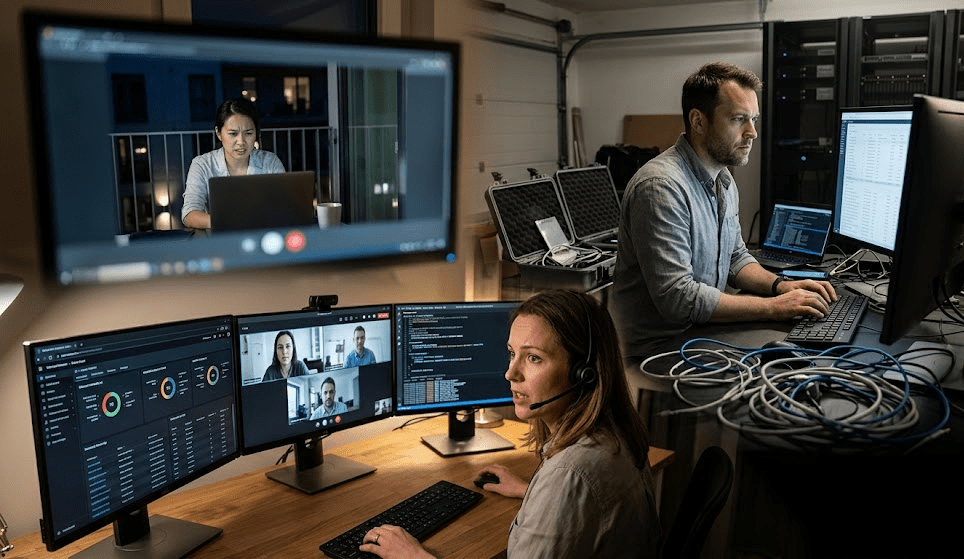
The coordination challenge of ransomware response in a remote and hybrid environment is the same coordination challenge that remote work creates for any complex organizational activity, with the added complication that the normal communication infrastructure may be affected by the incident.
Out-of-Band Communication From the Start
Establish out-of-band communication for the response team immediately when the incident is detected. Do not coordinate ransomware response through organizational email, Teams, Slack, or any other platform that may be affected by the incident or that the attacker may be monitoring.
Personal mobile phones provide the most immediate out-of-band channel.
A pre-established group text or mobile-native messaging application that includes the core response team provides the coordination channel that does not depend on organizational infrastructure.
Remote Response Team Coordination
When the IT and security team is itself remote, incident response coordination requires that team members know exactly what to do without requiring physical presence or real-time verbal communication for every action.
A response team coordinator who is responsible for maintaining awareness of what each team member is doing, directing attention to the highest-priority actions, and communicating with external resources including the incident response firm and breach coach is the role that prevents response fragmentation when the team is geographically distributed.
Organizations should align these activities with a documented incident response plan and clearly defined incident response team responsibilities.
Remote User Guidance
Remote employees who are not part of the IT or security response team need immediate, clear guidance about what to do when ransomware is detected or suspected.
- Stop using affected systems immediately.
- Disconnect from VPN.
- Do not attempt to reconnect until instructed.
- Do not attempt to fix the problem independently.
- Contact the designated out-of-band number to report system status.
- Do not communicate about the incident externally.
Incident Command for Distributed Response
A clear incident command structure that assigns authority and responsibility to specific roles, communicated and practiced before the incident, allows distributed response teams to operate with the decisiveness and coordination that an incident requires.
This structure is equally important in office environments and more critical in remote environments where the informal coordination that physical proximity enables is absent.
Remote Forensic Evidence Preservation
Forensic evidence preservation in a remote environment requires specific adaptations for endpoints that cannot be physically accessed by the response team.
Remote memory capture tools deployed through endpoint management platforms allow the response team to capture volatile memory from remote infected endpoints without physical access.
Remote log collection from endpoints can be accomplished through endpoint management platforms and SIEM integrations that maintain log forwarding to central collection infrastructure.
Cloud application logs from identity providers, cloud storage, email platforms, and other cloud applications provide forensic evidence about attacker activity in cloud environments that endpoint forensics do not capture.
What Remote and Hybrid Organizations Need Before an Incident
The preparation investments that make remote and hybrid environment ransomware response executable share a common theme: the capabilities that office environments take for granted through physical proximity and physical infrastructure must be explicitly built for remote environments because they do not exist by default.
- Complete endpoint enrollment in organizational management.
- Remote isolation capability deployed and tested on all enrolled endpoints.
- MFA on all remote access without exception.
- Conditional access policies that enforce device compliance requirements.
- Out-of-band communication infrastructure.
- Remote employee guidance documentation.
- A tested incident response plan.
Organizations should also maintain incident response simulations, strong remote access security practices, and resilient cloud disaster recovery capabilities.
Mindcore’s managed IT services and cybersecurity services help organizations build the remote and hybrid security infrastructure and incident response capability that addresses the specific challenges of distributed workforce ransomware response.
Meet Our CEO, Matt Rosenthal
With more than 30 years of experience in business and technology leadership, Matt Rosenthal has guided organizations across healthcare, finance, legal, manufacturing, and defense through ransomware events in remote and hybrid environments where the preparation gaps specific to distributed workforces determined how effectively containment and recovery could be executed. As President and CEO of Mindcore Technologies, Matt leads a team that provides cybersecurity services and managed IT services designed around the specific security requirements of organizations whose workforces are not defined by a physical perimeter.
Matt’s approach to remote environment ransomware preparedness recognizes that the security architecture assumptions of office environments do not transfer automatically to remote and hybrid environments. The specific controls, enrollment completeness, and coordination infrastructure that remote environments require must be explicitly built rather than assumed to exist.
Frequently Asked Questions
How do we isolate a remote employee’s personal device that is not enrolled in our management system?
A personal device not enrolled in organizational management cannot be remotely isolated through organizational tools. The immediate option is to instruct the employee to disconnect the device from the internet manually by disabling Wi-Fi and unplugging any ethernet connections.
What if our IT team is also remote when the incident occurs and cannot reach the office?
Remote IT teams can execute most critical response actions without physical office presence through endpoint management consoles, hypervisor management platforms, cloud management consoles, and network device management interfaces accessible remotely.
How do we handle a remote employee who becomes unresponsive during a ransomware incident?
An employee who stops responding during an active ransomware incident may have a system that is too affected to respond, may have lost internet connectivity, or may be attempting to handle the situation independently without guidance.
Does remote work create any advantages for ransomware response compared to office environments?
Remote work creates one meaningful advantage: geographic distribution means that ransomware that begins at one location does not automatically have network-level access to other locations.
How do cloud backups hold up in remote and hybrid ransomware scenarios?
Cloud backups maintained through services that are not accessible through the same credentials as production cloud applications and that have immutable retention policies provide strong protection in remote and hybrid environments.
Build the Remote Response Capability Before the Distributed Incident
Remote and hybrid environments require response capabilities that must be explicitly built because physical proximity does not create them by default.
The endpoint enrollment completeness, remote isolation capability, MFA deployment, conditional access architecture, and out-of-band coordination infrastructure that make remote environment ransomware response effective all require deliberate investment before an incident requires them.
The organizations that contain ransomware effectively in remote and hybrid environments are those that built the response capability for their specific distributed architecture.
Mindcore’s cybersecurity services and managed IT services help organizations across healthcare, finance, legal, manufacturing, and defense build the security architecture and response capability that remote and hybrid environments require. If your organization has not assessed whether its current security controls and incident response procedures address the specific challenges of distributed workforce ransomware response, contact Mindcore to identify and close those gaps before a distributed incident reveals them.

