

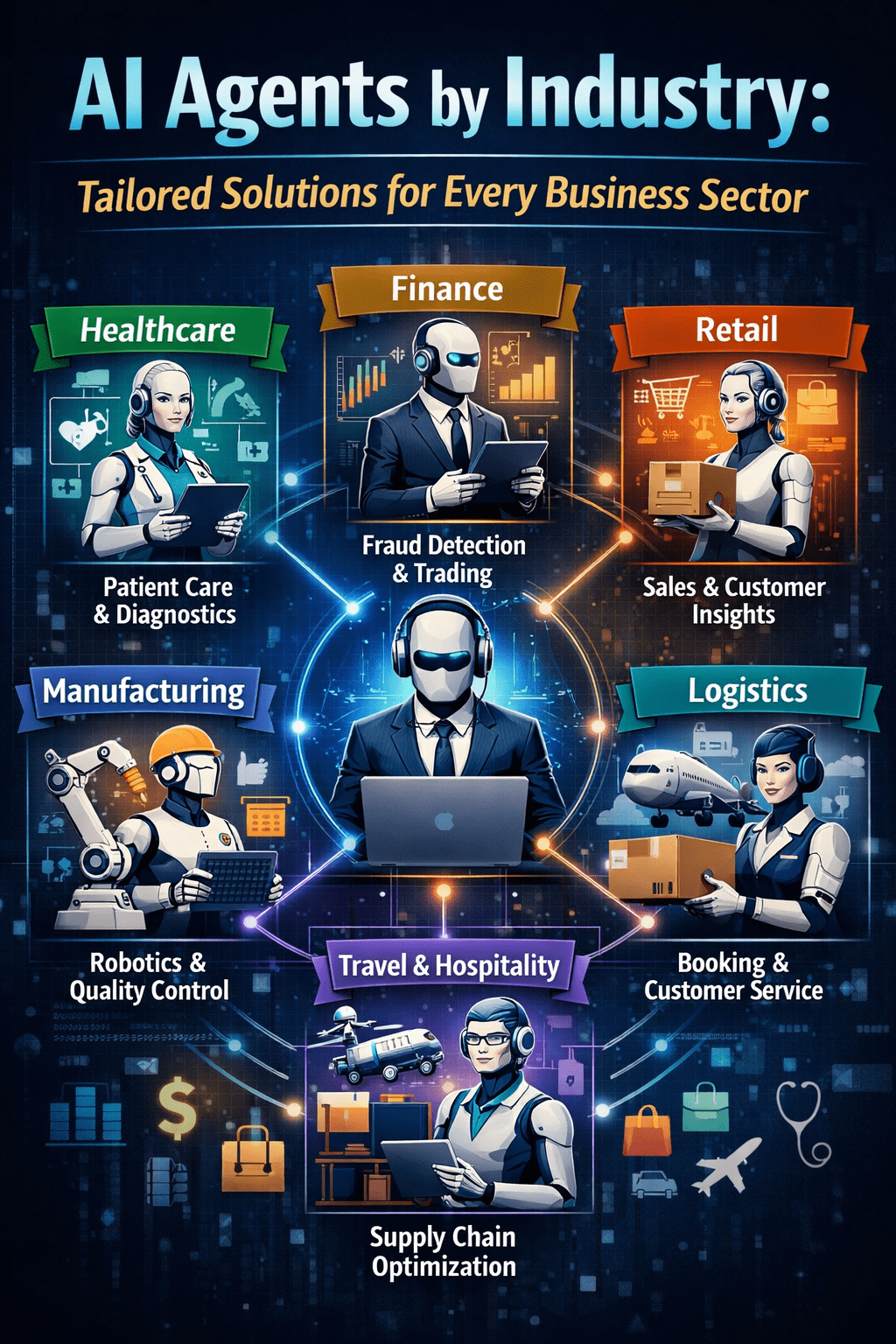
AI agents are not universal tools. They are operational systems that must reflect the structure, compliance demands, workflow complexity, and revenue model of each industry. What works for manufacturing will not work for law firms. What drives retail performance will not solve financial compliance challenges.
Industry-specific AI design determines effectiveness.
Many organizations fail because they deploy generic automation tools that ignore sector-specific processes. Real transformation happens when AI agents are engineered around how an industry operates.
Partner evaluation discipline is reinforced in How Different Industries Choose AI Agent Solutions, where businesses assess alignment before deployment.
Why Industry Context Matters
Each sector has unique:
• Regulatory requirements
Financial services and legal sectors require compliance controls.
• Workflow cadence
Construction projects differ from retail inventory cycles.
• Revenue structure
Subscription models differ from project-based billing.
• Data sensitivity
Financial and healthcare data require strict protection.
Selecting the right automation model requires sector-specific analysis, as expanded in Industry-Specific AI Automation: Finding the Right Fit for Your Sector.
Professional Services: Law, Accounting, Consulting
Professional service firms rely on billable hours, documentation accuracy, and client communication.
AI agents in these environments can:
• Automate document classification
Reduce administrative workload.
• Track billable time triggers
Improve revenue accuracy.
• Route compliance review workflows
Prevent regulatory missteps.
• Summarize client communications
Accelerate response cycles.
Sector deployment details are expanded in AI Agents for Professional Services: Law, Accounting, and Consulting.
Manufacturing and Industrial Operations
Manufacturing prioritizes efficiency and production continuity.
AI automation supports:
• Inventory threshold monitoring
Prevent material shortages.
• Predictive maintenance alerts
Reduce equipment downtime.
• Production scheduling optimization
Improve throughput consistency.
• Quality control anomaly detection
Reduce defect rates.
Operational integration depth is covered in Manufacturing AI Automation: Streamlining Production and Operations.
Construction Industry Applications
Construction workflows are project-driven and coordination-heavy.
AI agents can:
• Automate project milestone tracking
Improve timeline visibility.
• Manage subcontractor communication triggers
Reduce coordination delays.
• Monitor budget thresholds
Prevent cost overruns.
• Consolidate reporting across job sites
Improve executive clarity.
Implementation sequencing is detailed in AI Agents for Construction Companies: Project Management and Operations.
Financial Services Automation
Financial services require high compliance precision.
AI agents can:
• Monitor transaction anomalies
Detect potential fraud.
• Automate regulatory reporting
Reduce manual compliance effort.
• Route client onboarding documentation
Accelerate service activation.
• Trigger customer service escalation
Improve response consistency.
Compliance-focused deployment is expanded in Financial Services AI Automation: Compliance and Customer Service.
Retail Industry AI Applications
Retail environments require demand forecasting and inventory precision.
AI supports:
• Inventory replenishment triggers
Reduce stockouts.
• Sales trend forecasting
Improve promotional planning.
• Customer segmentation automation
Personalize marketing.
• Omnichannel reporting consolidation
Strengthen executive oversight.
Retail-specific integration depth is discussed in Retail AI Agents: Inventory, Sales, and Customer Experience.
Real Estate Industry Automation
Real estate is lead-driven and relationship-focused.
AI agents can:
• Automate lead qualification
Prioritize high-intent prospects.
• Schedule follow-up sequences
Improve response consistency.
• Track listing performance
Enhance pricing strategy.
• Consolidate CRM and transaction updates
Improve visibility.
Sector application expansion is detailed in Real Estate AI Automation: Lead Generation and Client Management.
Cross-Industry Common Requirements
Despite differences, all industries require:
• Secure system integration
Protect data flows.
• Conditional workflow logic
Adapt to business rules.
• Performance measurement
Validate ROI.
• Phased deployment
Prevent disruption.
Industry evaluation methodology is reinforced in How Different Industries Choose AI Agent Solutions.
Key Takeaways
AI agents deliver measurable value only when tailored to the operational structure, compliance requirements, revenue model, and workflow cadence of each industry. Professional services, manufacturing, construction, financial services, retail, and real estate each require customized automation architecture rather than generic tools. Businesses that align AI agent deployment with sector-specific realities create scalable operational efficiency, improved compliance oversight, and sustained competitive advantage.

