

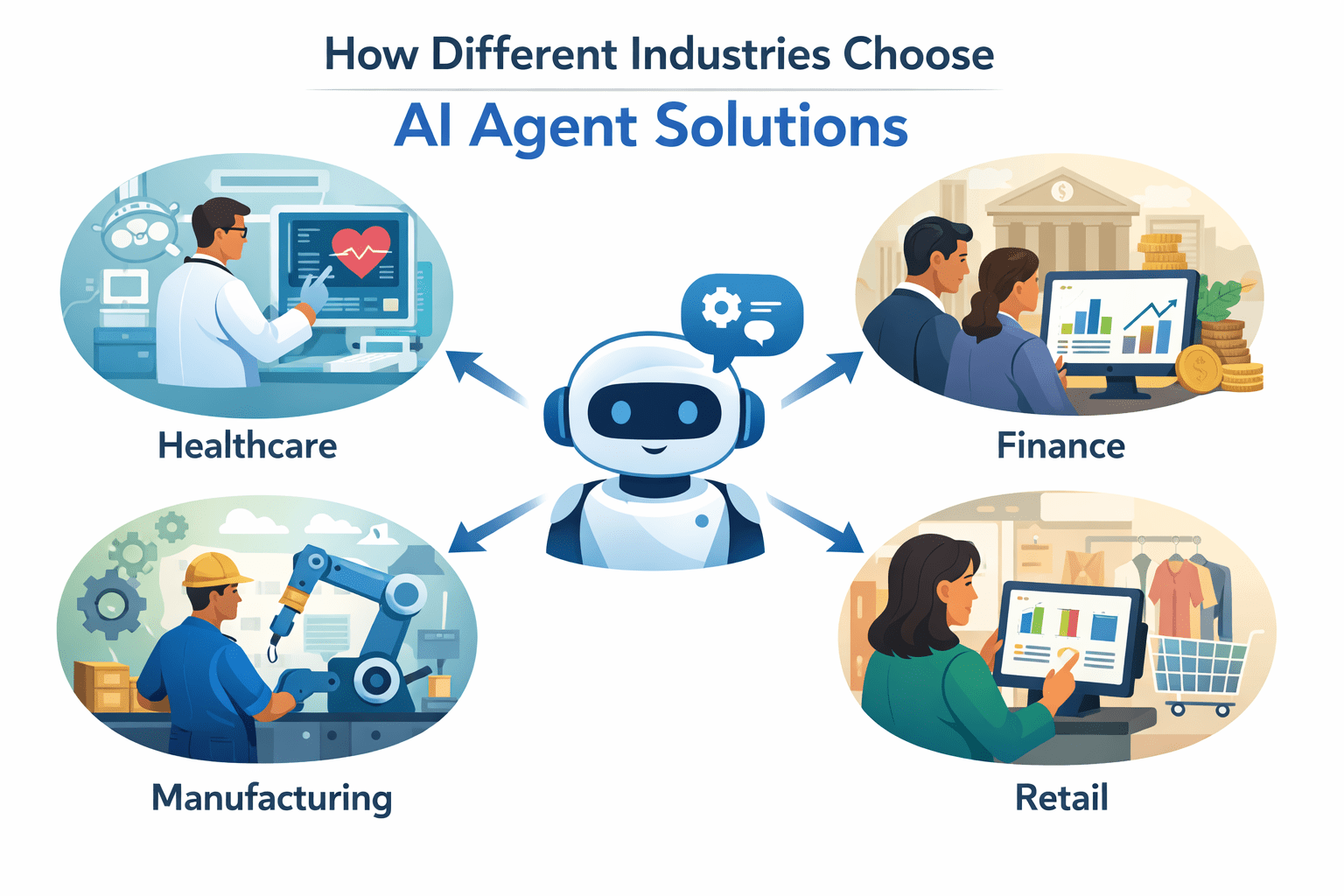
AI agents should never be selected based on features alone. Industries choose AI solutions based on workflow complexity, compliance exposure, operational scale, and revenue structure. A retail business does not evaluate AI the same way a law firm or manufacturer does.
The broader industry framework is introduced in AI Agents by Industry: Tailored Solutions for Every Business Sector, where sector-specific deployment is positioned as the foundation of successful automation.
Selection must reflect industry reality.
Step 1: Evaluate Industry Workflow Structure
Each industry operates differently.
Assess:
• Is the business project-based or recurring?
Construction differs from subscription models.
• Are workflows compliance-heavy?
Financial and legal sectors require stronger controls.
• Are operations asset-intensive?
Manufacturing demands predictive monitoring.
• Is revenue lead-driven?
Real estate prioritizes follow-up automation.
Workflow fit analysis is expanded in Industry-Specific AI Automation: Finding the Right Fit for Your Sector.
Step 2: Assess Regulatory and Compliance Exposure
Industries with regulatory oversight must prioritize governance.
Examples:
• Financial services
Transaction monitoring and reporting controls.
• Professional services
Confidential document management.
• Construction
Contract and compliance documentation.
Compliance-driven deployment is detailed in Financial Services AI Automation: Compliance and Customer Service.
Step 3: Identify Operational Bottlenecks
Industry AI selection should target friction points.
Common bottlenecks include:
• Inventory misalignment
Retail and manufacturing exposure.
• Project milestone delays
Construction inefficiency.
• Client onboarding delays
Financial services and consulting firms.
• Lead follow-up inconsistency
Real estate revenue leakage.
Step 4: Evaluate Integration Ecosystem
AI agents must integrate with existing systems.
Validate:
• ERP compatibility
Manufacturing and enterprise sectors.
• CRM synchronization
Professional services and real estate.
• Financial platform integration
Accounting and banking workflows.
• Multi-site reporting consolidation
Retail and construction operations.
Professional service integration depth is discussed in AI Agents for Professional Services: Law, Accounting, and Consulting.
Step 5: Measure Scalability and Growth Fit
Industry growth pace impacts AI selection.
Consider:
• Expansion into multiple locations
• Increasing compliance requirements
• Rising transaction volume
• Growing customer data complexity
Scalability analysis is reinforced in Industry-Specific AI Automation: Finding the Right Fit for Your Sector.
Step 6: Define Measurable Success Metrics
Industry selection must include ROI clarity.
Track:
• Reduction in administrative hours
• Faster project completion cycles
• Improved compliance reporting speed
• Increased revenue cycle acceleration
• Reduced operational errors
Sector-specific ROI frameworks are implied across:
• Manufacturing AI Automation: Streamlining Production and Operations
• Retail AI Agents: Inventory, Sales, and Customer Experience
Common Industry Selection Mistakes
• Choosing generic AI tools
• Ignoring compliance requirements
• Automating without workflow mapping
• Failing to validate system compatibility
• Scaling before pilot testing
Industry alignment must precede deployment.
Key Takeaways
Different industries choose AI agent solutions based on workflow structure, regulatory exposure, operational bottlenecks, system integration requirements, and scalability demands. Retail, manufacturing, construction, financial services, professional services, and real estate each require tailored automation architecture rather than generic tools. Businesses that evaluate AI through an industry-specific lens create sustainable operational efficiency, measurable ROI, and reduced compliance risk.

