

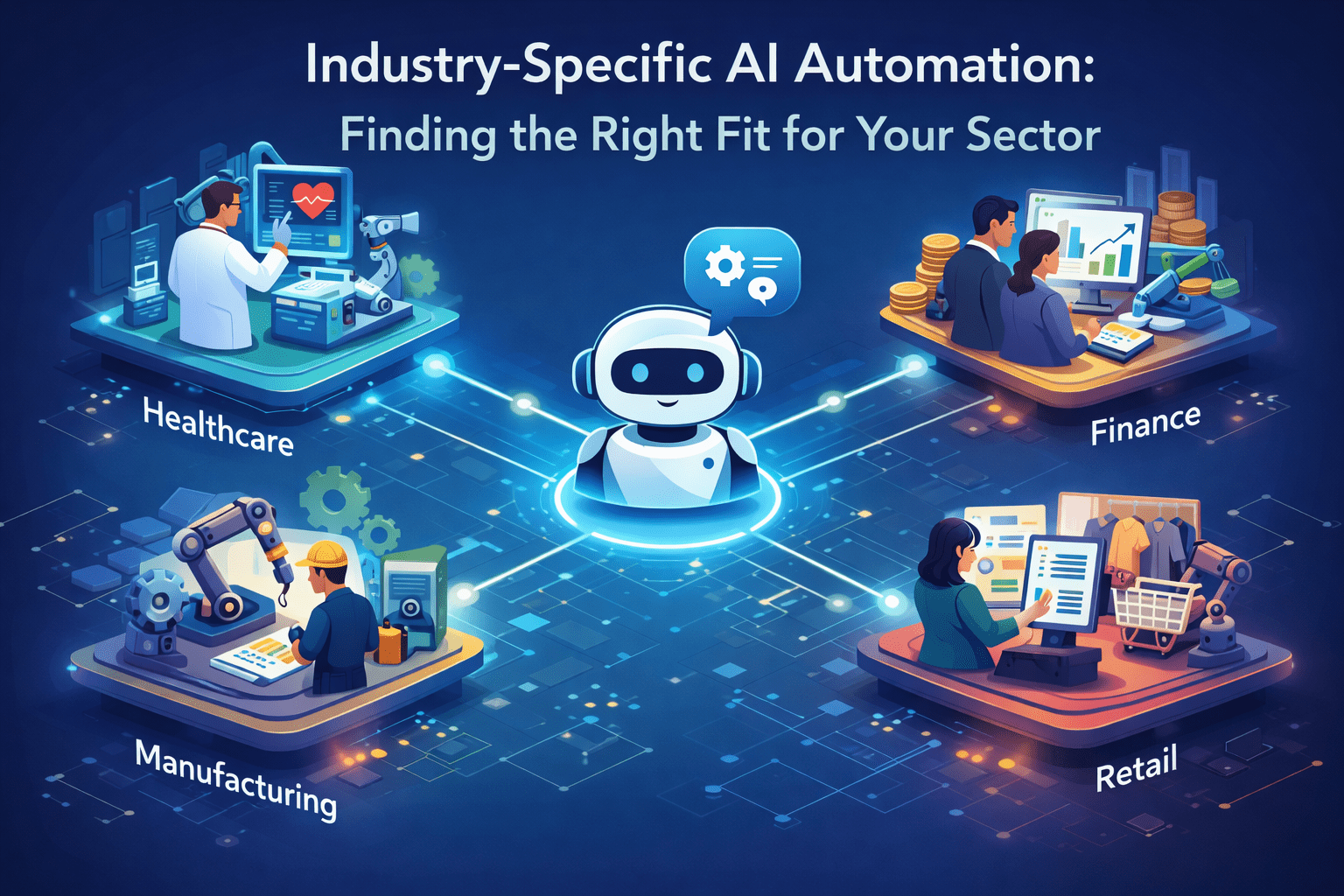
AI automation fails when businesses try to force generic solutions into industry-specific workflows. Every sector operates under different timing pressures, regulatory frameworks, margin structures, and operational models. Finding the right AI fit requires understanding those differences before development begins.
The broader industry strategy is outlined in AI Agents by Industry: Tailored Solutions for Every Business Sector, where AI deployment is framed as sector-aligned infrastructure rather than universal tooling.
Fit determines performance.
Step 1: Analyze Operational Model
Each sector has a dominant operational pattern.
Examples include:
• Project-based execution
Construction and consulting environments.
• Production-cycle operations
Manufacturing and logistics sectors.
• Transaction-heavy workflows
Financial services and retail.
• Relationship-driven revenue
Real estate and professional services.
Sector selection methodology is reinforced in How Different Industries Choose AI Agent Solutions.
Step 2: Identify High-Impact Automation Areas
Industry-specific automation must focus on operational pressure points.
Examples by sector:
• Professional services
Document classification and compliance routing.
• Manufacturing
Inventory forecasting and predictive maintenance.
• Construction
Milestone tracking and subcontractor coordination.
• Financial services
Compliance reporting and anomaly detection.
• Retail
Demand forecasting and omnichannel reporting.
• Real estate
Lead qualification and follow-up sequencing.
Detailed sector breakdowns are provided in:
• AI Agents for Professional Services: Law, Accounting, and Consulting
• Manufacturing AI Automation: Streamlining Production and Operations
• AI Agents for Construction Companies: Project Management and Operations
• Financial Services AI Automation: Compliance and Customer Service
• Retail AI Agents: Inventory, Sales, and Customer Experience
• Real Estate AI Automation: Lead Generation and Client Management
Step 3: Match AI Architecture to Sector Complexity
Not all industries require the same automation depth.
Consider:
• Integration intensity
Manufacturing requires deeper ERP integration than retail startups.
• Compliance enforcement
Financial sectors require strict documentation logging.
• Multi-location coordination
Construction firms require site-level reporting.
• Data sensitivity
Professional services handle confidential documentation.
Sector complexity assessment ensures proper architecture alignment.
Step 4: Evaluate Scalability Requirements
Industry growth trajectories vary.
Assess:
• Seasonal demand cycles
• Expansion into new markets
• Increasing regulatory scrutiny
• Growth in transaction volume
Automation must scale without redesign.
Step 5: Validate Integration Ecosystem
Industry AI must connect seamlessly to core systems.
Examples:
• CRM and case management tools for legal firms
• ERP and supply chain software for manufacturing
• Project management platforms for construction
• Core banking systems for financial services
• POS and inventory platforms for retail
• MLS and CRM platforms for real estate
Integration validation protects long-term performance.
Step 6: Define Sector-Specific ROI
Each industry measures performance differently.
Manufacturing metrics:
• Downtime reduction
• Defect rate improvement
• Inventory optimization
Retail metrics:
• Stockout reduction
• Sales conversion rate increase
• Customer retention improvement
Financial services metrics:
• Compliance reporting speed
• Fraud detection accuracy
• Onboarding acceleration
Professional services metrics:
• Billable hour capture
• Documentation accuracy
• Client response time
Real estate metrics:
• Lead response speed
• Conversion rate
• Listing performance visibility
ROI clarity supports informed deployment.
Common Mistakes in Sector Alignment
• Treating AI as universal
• Ignoring industry regulation
• Underestimating workflow complexity
• Choosing low-integration tools
• Skipping pilot testing
Industry alignment must precede scale.
Key Takeaways
Industry-specific AI automation succeeds when businesses align automation architecture with their operational model, compliance demands, integration ecosystem, scalability trajectory, and sector-specific ROI metrics. Manufacturing, construction, financial services, professional services, retail, and real estate each require tailored AI deployment strategies rather than generic solutions. Proper sector alignment transforms AI from a tool into operational infrastructure that delivers measurable performance improvements.

