

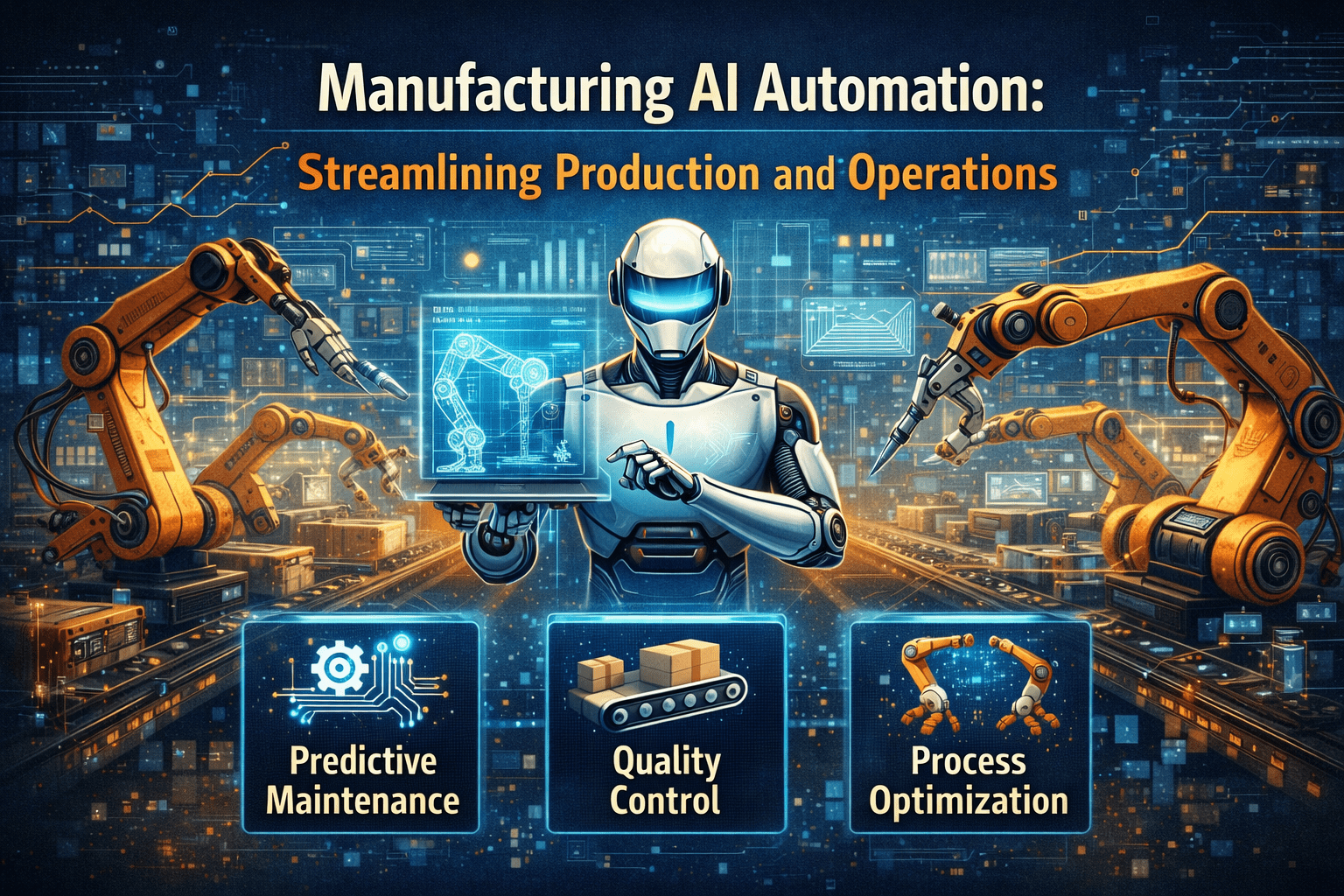
Manufacturing environments operate on precision, timing, and throughput. Downtime, supply chain delays, inventory misalignment, and quality control errors directly impact margins. AI automation in manufacturing must enhance operational continuity without disrupting production flow.
The broader sector strategy is introduced in AI Agents by Industry: Tailored Solutions for Every Business Sector, where AI is positioned as industry-aligned infrastructure.
Manufacturing requires production-aware automation.
Core Manufacturing Pain Points
Common operational friction includes:
• Unplanned equipment downtime
Reduces production output.
• Inventory shortages or overstock
Impacts cash flow and delivery timelines.
• Manual production scheduling
Creates inefficiencies.
• Quality control inconsistencies
Increase defect rates.
Industry fit evaluation is reinforced in Industry-Specific AI Automation: Finding the Right Fit for Your Sector.
Predictive Maintenance Automation
AI agents can monitor machine performance continuously.
Capabilities include:
• Real-time equipment anomaly detection
Identify issues before breakdown.
• Maintenance scheduling triggers
Reduce unplanned downtime.
• Performance trend analysis
Improve asset lifespan planning.
• Automatic alert escalation
Notify supervisors immediately.
Operational selection discipline is discussed in How Different Industries Choose AI Agent Solutions.
Inventory and Supply Chain Optimization
Inventory mismanagement increases cost.
AI supports:
• Inventory threshold monitoring
Prevent stockouts.
• Demand forecasting
Align production with sales trends.
• Supplier performance tracking
Identify delays early.
• Automated reorder triggers
Maintain material availability.
Retail parallels are explored in Retail AI Agents: Inventory, Sales, and Customer Experience.
Production Scheduling and Workflow Automation
Manual scheduling creates bottlenecks.
AI agents can:
• Optimize production sequencing
Maximize equipment utilization.
• Balance workload across shifts
Improve output consistency.
• Adjust schedules dynamically
Respond to demand changes.
• Track production KPIs automatically
Improve executive oversight.
Project coordination similarities appear in AI Agents for Construction Companies: Project Management and Operations.
Quality Control and Compliance Monitoring
Manufacturing quality standards require consistency.
AI agents enable:
• Defect pattern detection
Identify root causes faster.
• Automated inspection logging
Improve audit readiness.
• Compliance documentation tracking
Support regulatory oversight.
• Production variance alerts
Reduce waste.
Financial sector compliance parallels are expanded in Financial Services AI Automation: Compliance and Customer Service.
Integration Requirements in Manufacturing
Manufacturing AI must integrate with:
• ERP systems
Coordinate procurement and finance.
• Supply chain platforms
Track material movement.
• Warehouse management systems
Improve logistics efficiency.
• IoT sensor networks
Monitor machine data in real time.
Integration discipline mirrors principles in Industry-Specific AI Automation: Finding the Right Fit for Your Sector.
Measuring ROI in Manufacturing
AI automation impact should be measurable.
Track:
• Downtime reduction percentage
• Inventory turnover improvement
• Production throughput increase
• Defect rate decline
• Maintenance cost reduction
Sector ROI alignment is reinforced in How Different Industries Choose AI Agent Solutions.
Common Manufacturing AI Mistakes
• Ignoring legacy system compatibility
• Failing to validate IoT integration
• Scaling before pilot testing
• Over-automating manual safety controls
• Underestimating workforce training needs
Manufacturing automation must remain production-safe.
Key Takeaways
Manufacturing AI automation enhances production continuity through predictive maintenance, inventory optimization, production scheduling automation, and quality control monitoring. Sector-specific AI agents must integrate seamlessly with ERP systems, supply chain platforms, and machine data networks while maintaining operational safety and compliance. When deployed strategically, AI automation reduces downtime, improves throughput, lowers defect rates, and strengthens overall manufacturing efficiency.

