

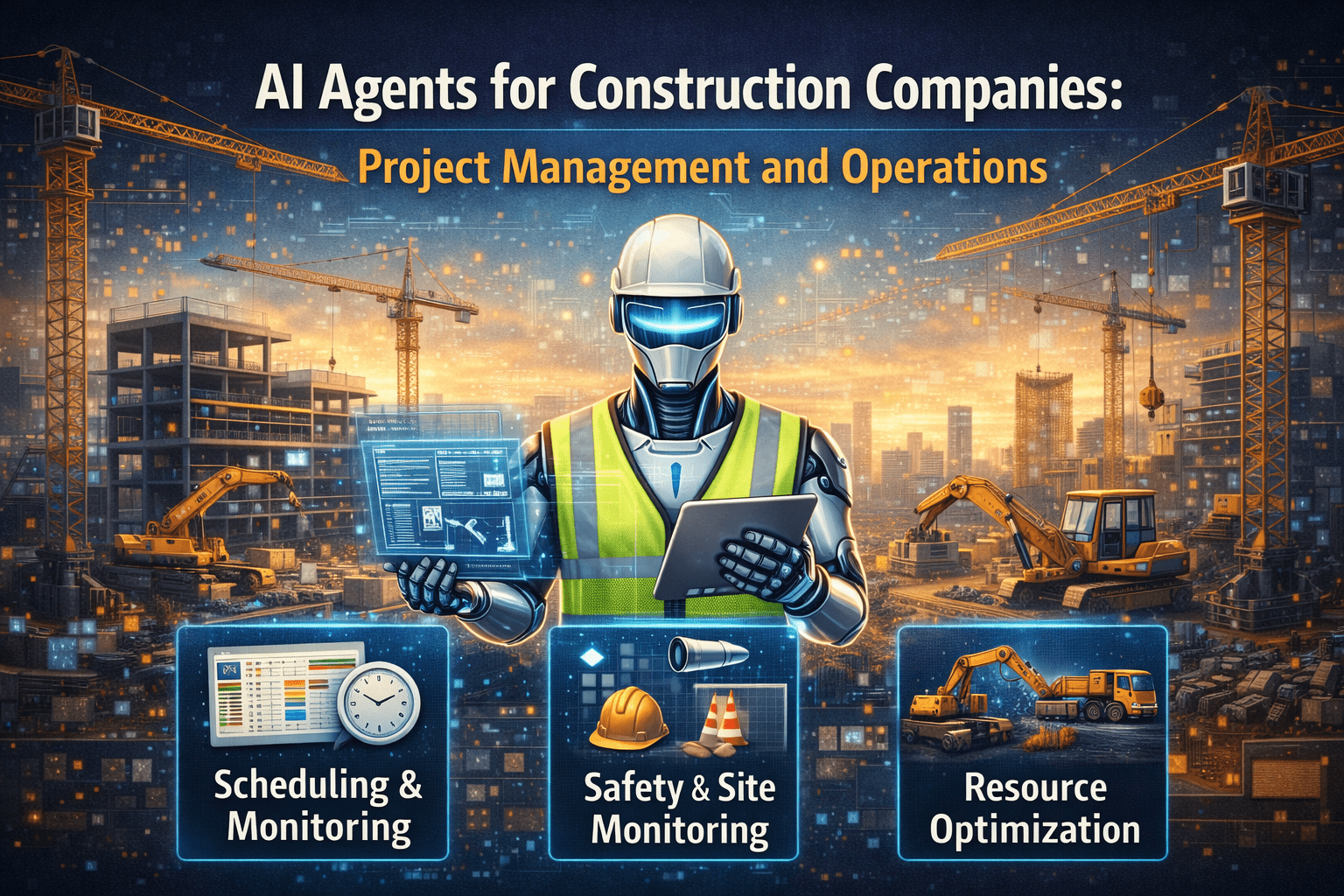
AI in construction industry solutions help companies improve project coordination, reduce delays, and enhance reporting visibility, transforming operational inefficiencies into measurable gains. AI agents in construction must improve visibility and coordination without disrupting project execution.
The broader industry alignment strategy is introduced in AI Agents by Industry: Tailored Solutions for Every Business Sector, where sector-specific automation is emphasized.
Construction demands structured, project-aware automation.
Core Construction Industry Challenges
Common friction points include:
• Project milestone delays
Impacts contractual commitments.
• Budget tracking inconsistencies
Leads to cost overruns.
• Subcontractor coordination gaps
Causes workflow disruptions.
• Multi-site reporting fragmentation
Reduces executive visibility.
Industry selection discipline is reinforced in Industry-Specific AI Automation: Finding the Right Fit for Your Sector.
Project Milestone Monitoring Automation
AI agents can track construction timelines continuously. Implementing AI in construction industry for project milestone monitoring enables automated alerts, task dependency tracking, and escalation triggers to prevent schedule overruns.
Capabilities include:
• Automated milestone alerts
Flag schedule deviations early.
• Task dependency tracking
Identify bottlenecks across crews.
• Escalation triggers for missed deadlines
Improve response speed.
• Consolidated progress dashboards
Provide executive clarity.
Sector selection considerations are expanded in How Different Industries Choose AI Agent Solutions.
Budget Oversight and Cost Control
Construction budgets require precision.
AI in construction industry assists in budget oversight by:
• Real-time budget threshold monitoring
Prevent overspending.
• Automated cost variance reporting
Highlight anomalies quickly.
• Subcontractor invoice verification
Reduce billing discrepancies.
• Financial forecast updates
Improve project margin control.
Compliance parallels are reflected in Financial Services AI Automation: Compliance and Customer Service.
Subcontractor and Vendor Coordination
Coordination complexity increases with project scale.
Utilizing AI in construction industry enhances:
• Automate subcontractor communication triggers
Reduce manual follow-ups.
• Track documentation compliance
Ensure required certifications are current.
• Manage vendor delivery schedules
Prevent material delays.
• Escalate missing approvals automatically
Protect project flow.
Operational similarities exist with structured workflow sectors like Manufacturing AI Automation: Streamlining Production and Operations.

Multi-Site Reporting Consolidation
Construction firms often manage multiple projects simultaneously.
AI in construction industry supports:
• Unified reporting dashboards
Consolidate site-level data.
• KPI tracking across projects
Compare performance.
• Automated daily summary generation
Improve oversight efficiency.
• Risk flagging for underperforming sites
Support proactive management.
Retail parallels in reporting consolidation are explored in Retail AI Agents: Inventory, Sales, and Customer Experience.
Integration Requirements in Construction
AI automation must connect with:
• Project management platforms
Track tasks and timelines.
• Accounting and payroll systems
Align financial reporting.
• Vendor management systems
Coordinate procurement.
• Mobile workforce apps
Capture real-time updates.
Integration validation mirrors principles in Industry-Specific AI Automation: Finding the Right Fit for Your Sector.
Measuring ROI in Construction AI
Construction ROI metrics include:
• Reduced project delays
• Improved budget accuracy
• Faster subcontractor communication
• Decreased reporting preparation time
• Lower administrative overhead
Sector-specific ROI discipline is reinforced in How Different Industries Choose AI Agent Solutions.
Common Construction AI Mistakes
• Ignoring project-based variability
• Over-automating safety-critical decisions
• Failing to pilot on a single project
• Underestimating integration complexity
• Not training field teams
Construction automation must remain execution-focused.
Key Takeaways
AI agents in construction environments improve project management, budget oversight, subcontractor coordination, and multi-site reporting through structured automation aligned with project workflows. Sector-specific AI integration strengthens executive visibility, reduces delays, enhances cost control, and lowers administrative burden while preserving operational safety. When implemented strategically, construction AI automation transforms coordination complexity into measurable efficiency gains.
Frequently Asked Questions
How are AI agents used in construction project management?
AI agents help construction companies automate project tracking, milestone monitoring, subcontractor coordination, and operational reporting. These systems improve visibility across projects and help teams respond faster to delays and workflow disruptions.
Can AI agents help reduce construction project delays?
Yes, AI agents monitor schedules, task dependencies, and project milestones in real time to identify bottlenecks early. Automated alerts and escalation workflows help teams address issues before delays impact the overall project timeline.
How do AI agents improve budget control in construction?
AI agents track spending patterns, monitor budget thresholds, verify invoices, and generate cost variance reports automatically. This helps construction firms reduce financial inconsistencies and maintain stronger project margin control.
What systems should construction AI agents integrate with?
Construction AI agents should integrate with project management platforms, accounting systems, payroll software, vendor management tools, and mobile workforce applications. Proper AI integration improves reporting accuracy and operational coordination across teams.
What are common mistakes when implementing AI in construction?
Common mistakes include over-automating critical decisions, ignoring project variability, skipping pilot programs, and underestimating integration complexity. Successful AI adoption requires phased implementation, field team training, and operational oversight.
Construction AI Strategy Expertise from Matt Rosenthal
Matt Rosenthal, CEO of Mindcore Technologies, has extensive experience helping organizations implement secure and scalable AI-driven operational strategies across complex business environments. His expertise in automation, systems integration, infrastructure management, and operational efficiency helps construction companies improve project coordination, reporting visibility, budget oversight, and workflow consistency through AI agents. His leadership focuses on practical AI adoption strategies that strengthen execution, reduce operational friction, improve decision-making, and support long-term scalability without disrupting day-to-day construction operations.

