

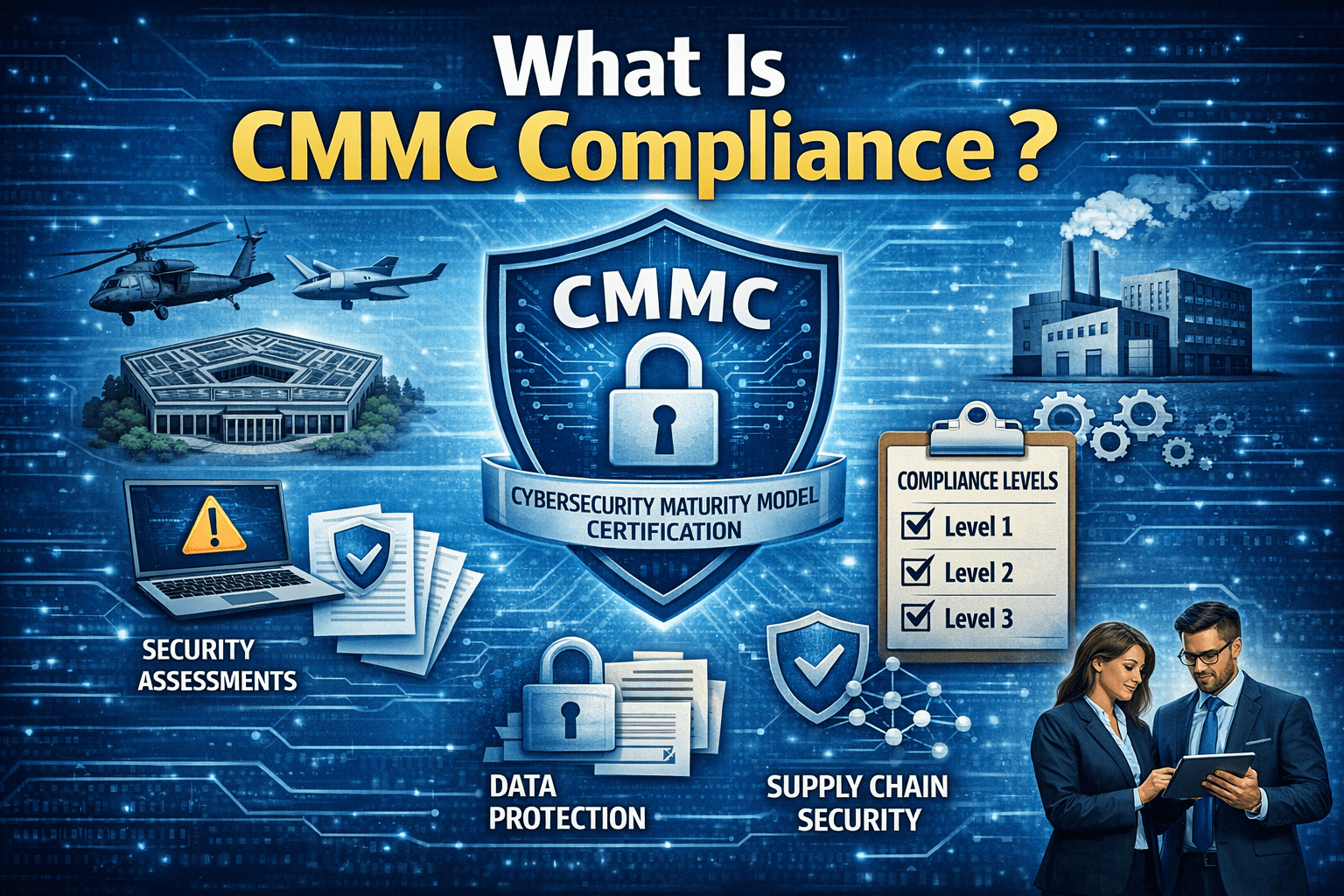
CMMC compliance refers to the Cybersecurity Maturity Model Certification, a framework developed by the U.S. Department of Defense (DoD) to ensure contractors properly protect Controlled Unclassified Information (CUI) within the defense supply chain.
For years, defense contractors were expected to follow NIST SP 800-171 security standards, but many organizations simply self-attested compliance without implementing the controls in practice. This created serious vulnerabilities across the defense ecosystem.
CMMC was created to fix that problem.
Instead of relying on self-reporting, CMMC requires organizations to prove their cybersecurity capabilities through formal assessments and documented security practices.
Organizations that handle sensitive defense information must demonstrate that they have the infrastructure, policies, and monitoring capabilities needed to protect that data.
At Mindcore Technologies, we help organizations implement CMMC-aligned security architectures that protect sensitive information while preparing companies for successful certification assessments.
Why CMMC Compliance Exists
The Department of Defense depends on a vast network of contractors, subcontractors, and service providers.
Many of these organizations handle sensitive government information during projects, including technical documentation, engineering data, and operational details.
Without proper cybersecurity controls, this information becomes vulnerable to espionage and cybercrime.
Protection of Controlled Unclassified Information (CUI)
- CUI includes sensitive government data that is not classified but still requires protection
Examples include engineering plans, defense system documentation, and procurement details. - If attackers gain access to CUI, they can compromise defense supply chains
Stolen data may reveal system vulnerabilities or military capabilities. - CMMC ensures contractors implement security controls to protect this information
The framework enforces standards for how data must be stored, accessed, and monitored.
Protecting CUI is the primary goal of CMMC.
Strengthening the Defense Industrial Base
- The defense supply chain includes thousands of private companies
Each organization may introduce potential cybersecurity risk. - Weak cybersecurity in one contractor can expose others
Attackers often target smaller vendors to gain indirect access to larger defense systems. - CMMC ensures consistent security practices across the entire supply chain
Every participating organization must demonstrate cybersecurity maturity.
This reduces systemic risk within the defense ecosystem.
Understanding CMMC Levels
CMMC 2.0 simplified the original framework into three maturity levels, each representing a different level of cybersecurity capability.
Organizations must achieve the appropriate level depending on the type of information they handle.
Level 1: Foundational Cybersecurity
- Focuses on basic cybersecurity practices that protect Federal Contract Information (FCI)
These practices include basic access control and system protection measures. - Organizations perform self-assessments to confirm compliance
Formal third-party certification is not required for this level. - Controls align with basic cyber hygiene practices
The goal is to establish minimum security protections.
Level 1 addresses fundamental cybersecurity controls.
Level 2: Advanced Cybersecurity (Most Common)
- Designed for organizations that handle Controlled Unclassified Information (CUI)
This level introduces stronger security requirements. - Controls align with the NIST SP 800-171 cybersecurity framework
Organizations must implement over 100 security controls. - Third-party assessments are required for many contractors
Certified auditors evaluate whether controls are properly implemented.
Level 2 is the most relevant for defense contractors.
Level 3: Expert Cybersecurity
- Focuses on protecting highly sensitive defense programs
These organizations face more advanced cyber threats. - Additional controls extend beyond NIST SP 800-171
Advanced threat detection and response capabilities are required. - Assessments are conducted by government authorities
This level involves the most rigorous evaluation.
Level 3 is intended for organizations supporting critical national defense systems.
Core Security Domains Within CMMC
CMMC controls cover a wide range of cybersecurity capabilities designed to protect systems and sensitive information.
Access Control
- Access policies restrict who can use systems handling sensitive data
Only authorized users can reach protected environments. - Multi-factor authentication protects critical accounts
Stolen passwords alone cannot grant system access. - Least-privilege access policies limit user permissions
Users receive only the access necessary for their responsibilities.
Strong access control reduces unauthorized activity.
Incident Response
- Organizations must maintain formal incident response procedures
Teams need clear guidance on how to handle security events. - Security incidents must be documented and investigated
Proper reporting ensures accountability. - Response plans help contain threats quickly
Rapid containment reduces breach impact.
Incident response strengthens resilience.
System and Network Security
- Network protections monitor traffic entering and leaving protected environments
Suspicious activity can trigger alerts. - Segmentation limits communication between systems
This prevents attackers from moving freely within networks. - Security tools detect malicious activity across endpoints and servers
Continuous monitoring improves threat detection.
Network security supports containment.
Audit and Accountability
- Systems must generate logs recording security events
These logs help track user activity and system changes. - Security teams analyze logs to detect suspicious behavior
Monitoring tools identify potential attacks. - Logs support forensic investigations during incidents
Organizations can reconstruct attack timelines.
Audit controls provide visibility.
Infrastructure Implications of CMMC Compliance
Achieving CMMC compliance often requires organizations to modernize their IT environments.
Security controls cannot be implemented effectively without proper infrastructure.
Identity-Driven Security
- Centralized identity systems manage authentication across environments
This improves consistency in access control policies. - Multi-factor authentication protects remote and privileged access
Attackers cannot rely on stolen credentials alone. - Identity monitoring tools track suspicious login behavior
Security teams gain visibility into authentication activity.
Identity governance strengthens security.
Segmented Security Architecture
- Sensitive systems handling CUI must be isolated from general IT environments
This limits exposure to unauthorized users. - Network segmentation restricts communication paths
Attackers cannot easily move between systems. - Boundary protection systems monitor traffic entering protected networks
Security teams gain visibility into system access.
Segmentation supports breach containment.
Continuous Monitoring
- Security monitoring tools analyze logs across infrastructure
Suspicious activity can trigger alerts. - Threat detection systems identify anomalies in user or system behavior
Early detection reduces attack impact. - Incident response teams investigate alerts and contain threats
Monitoring improves operational security.
Continuous monitoring improves defense.
How Secure Workspace Architecture Supports CMMC Compliance
Modern secure workspace environments help organizations implement CMMC controls more effectively.
Instead of allowing endpoints direct access to sensitive systems, secure workspace environments keep applications and data inside protected infrastructure.
- User devices connect to controlled workspace environments instead of internal networks
This reduces exposure from compromised devices. - Session monitoring records user activity inside secure environments
Security teams gain detailed audit visibility. - Identity verification controls each access request
Unauthorized users cannot reach protected systems.
Workspace architecture strengthens compliance enforcement.
How ShieldHQ Helps Organizations Achieve CMMC Compliance
ShieldHQ Powered by Dispersive® Stealth Networking provides a secure workspace platform designed to support modern cybersecurity and compliance requirements.
- Stealth networking hides infrastructure from external discovery
Attackers cannot scan or map protected systems. - Secure workspaces isolate applications and sensitive data environments
This protects systems handling Controlled Unclassified Information. - Identity-driven access policies enforce strict authentication requirements
Unauthorized users cannot reach protected resources. - Centralized monitoring tools provide visibility into user activity
Security teams gain detailed audit trails for compliance.
ShieldHQ enables compliance through architecture.
How Mindcore Technologies Helps Organizations Prepare for CMMC
Mindcore Technologies helps organizations design and implement environments aligned with CMMC requirements by:
- Performing CMMC readiness and gap assessments.
- Designing segmented infrastructure for CUI environments.
- Implementing identity governance and multi-factor authentication.
- Deploying secure workspace environments through ShieldHQ.
- Establishing centralized monitoring and incident response procedures.
- Preparing organizations for formal certification assessments.
Preparation improves certification success.
Final Takeaway
CMMC compliance ensures that organizations handling defense-related information implement the cybersecurity controls necessary to protect sensitive data.
By combining strong identity governance, segmented infrastructure, continuous monitoring, and modern secure workspace environments, organizations can strengthen both their compliance posture and their overall cybersecurity resilience.

