

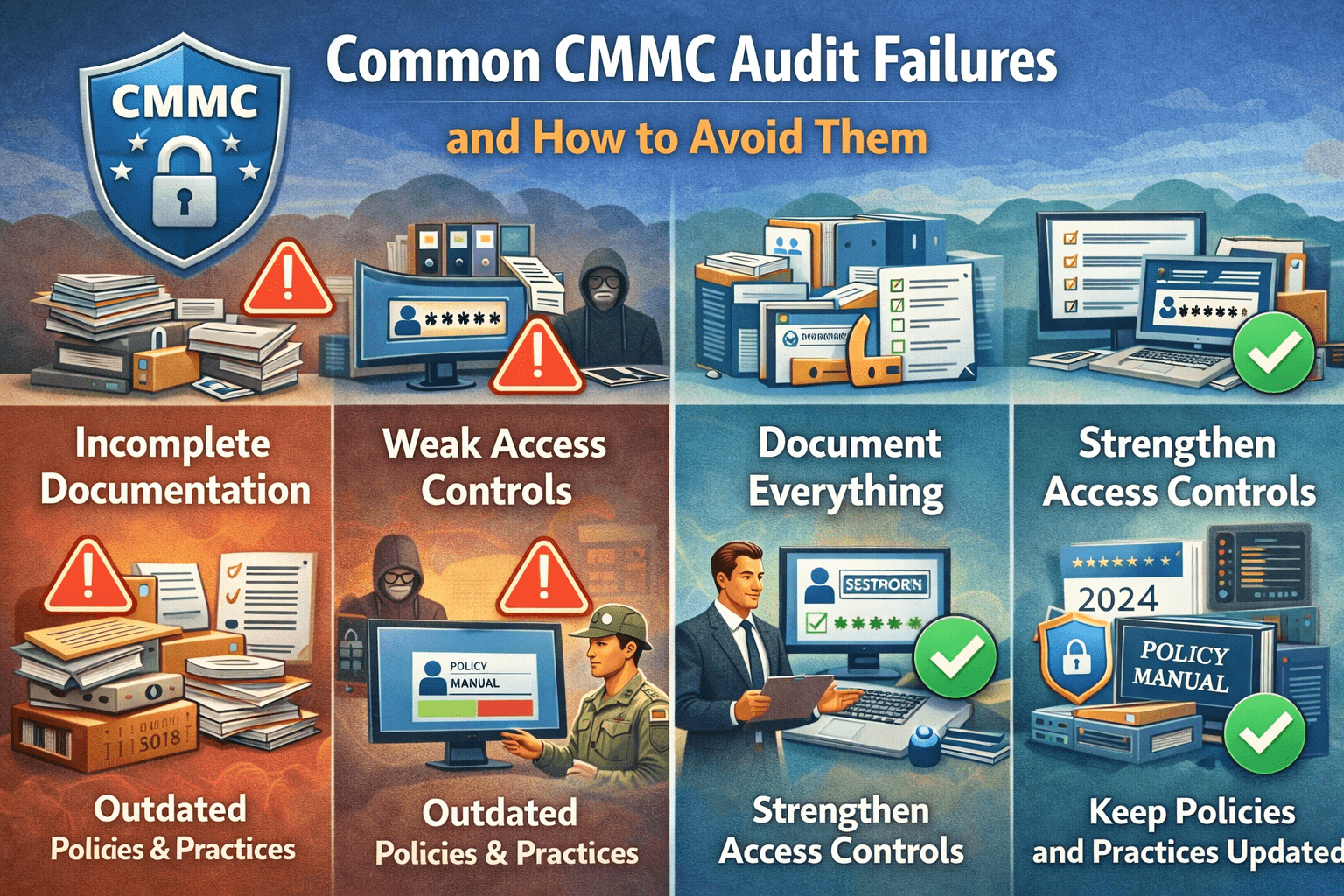
CMMC assessment findings are not random. The same gaps appear consistently across DIB contractors at every size and maturity level — because they reflect systemic misunderstandings about what CMMC requires, not isolated implementation mistakes.
At Mindcore Technologies, our pre-assessment gap analysis work with defense contractors reveals a clear pattern: the organizations that fail or receive significant findings in C3PAO assessments almost always have the same set of gaps. Those gaps are predictable. They are also preventable — if organizations understand what assessors actually examine versus what organizations assume assessors will accept.
This is the honest account of what C3PAO assessors consistently find — and what organizations need to do differently to avoid those findings.
Overview
CMMC assessment failures cluster around five categories: system boundary scoping errors that leave CUI-handling systems outside the assessed environment, access control implementations that are documented but not technically enforced, audit logging coverage that misses required event types, evidence that exists but is not in assessor-verifiable formats, and incident response procedures that have never been tested. Each category reflects a gap between what organizations believe they have implemented and what C3PAO assessors can verify as actually operating.
- System boundary scoping errors are the most consequential assessment failures — they invalidate findings across all domains
- Access control gaps are the most common — MFA, least privilege, and privileged account management consistently under-implemented
- Audit logging coverage gaps are the most frequently underestimated — organizations think they log everything and miss critical event types
- Evidence format problems convert implemented controls into findings — assessors cannot verify what they cannot access
- Untested incident response produces the most exposed findings — procedures documented but never validated
The 5 Why’s
- Why do system boundary scoping errors produce the most serious assessment findings? An incorrectly scoped system boundary excludes systems that touch CUI from the assessed environment. When assessors discover those systems during document review or staff interviews, the finding is not just a missing control — it is evidence that the assessment scope was inaccurate, which can invalidate the entire assessment and require rescoping. Boundary scoping errors discovered during assessment are the most expensive finding possible.
- Why do organizations consistently misidentify their system boundary? Organizations tend to scope the CMMC boundary around the systems IT manages and considers “security systems.” They miss the systems that handle CUI incidentally — email systems that receive DoD correspondence, file sharing platforms used for contract document exchange, cloud storage used by business development for proposal CUI, administrative systems that process DoD invoice data. The correct boundary scope is every system that stores, processes, or transmits CUI — not every system that IT consciously deployed for CUI handling.
- Why is “we have a policy for that” insufficient for access control assessment findings? Policy documentation demonstrates intent. C3PAO assessors verify implementation — whether the policy is technically enforced or merely documented. An MFA policy that permits users to bypass MFA for specific system types, a least-privilege policy that has not been verified against actual user access grants, a privileged account management policy that does not reflect the actual administrative account structure — all of these produce assessment findings despite having policy documentation.
- Why does audit logging coverage produce more findings than organizations expect? Organizations that have deployed SIEM solutions believe they have comprehensive logging. What they actually have is the logging sources they configured — which often misses authentication events from legacy systems, file access events from CUI repositories, privileged account usage on on-premises systems, and object access logging that requires specific system configuration to generate. Coverage assessment — verifying that the required CMMC AU event types are actually being captured for every CUI-touching system — is what reveals the gaps that SIEM deployment alone does not close.
- Why does untested incident response produce assessment findings even when procedures are documented? C3PAO assessors assess IR procedures against CMMC IR domain practices that require not just documented procedures but evidence of testing and operational readiness. Procedures that have never been tested against a realistic scenario, notification chains that have never been verified as functional, and 72-hour DIBNet reporting capability that has never been exercised — these produce findings because testing records do not exist and assessors cannot verify operational readiness from documentation alone.
The Most Common CMMC Assessment Findings — and How to Avoid Them
Finding 1: Incorrect System Boundary Scope
What assessors find: Systems that store, process, or transmit CUI that were not included in the assessed environment — email systems, cloud storage, collaboration platforms, administrative applications.
How to avoid it: Conduct a data flow mapping exercise that follows CUI from entry points (where does CUI enter the organization?) through every system it touches to disposal. Every system in that flow is in the boundary.
Finding 2: MFA Not Enforced Across All CUI System Access
What assessors find: MFA deployed for remote access but not for on-premises privileged account use; MFA enrollment that does not cover all users with CUI system access; service accounts that bypass MFA through legacy authentication protocols.
How to avoid it: Verify MFA enforcement for every access path to CUI systems — remote access, on-premises administrative access, and service account authentication. Block legacy authentication protocols that permit MFA bypass.
Finding 3: Least Privilege Not Verified Against Actual Access Grants
What assessors find: Least privilege policy documented but user access grants not verified against role requirements; privilege accumulation from role changes not cleaned up; service accounts with broad access beyond operational requirements.
How to avoid it: Conduct an access rights review that compares actual user and service account access grants against documented role requirements. Remediate over-privileged accounts before assessment.
Finding 4: Audit Log Coverage Gaps
What assessors find: Authentication events from specific systems not collected; file access logging not configured for CUI repositories; privileged account actions not captured in centralized logging; log review not occurring on documented cadences.
How to avoid it: Map required CMMC AU event types to each CUI-touching system. Verify that each event type is being captured and forwarded to centralized storage. Document review procedures and maintain review records.
Finding 5: System Security Plan Does Not Reflect Current Implementation
What assessors find: SSP documentation that describes the environment as it was when the SSP was written — not as it is when assessment occurs; control descriptions that do not match actual technical implementations.
How to avoid it: Treat the SSP as a living document with update obligations triggered by system changes, configuration changes, and control implementation changes. The SSP should describe the current environment on assessment day, not the environment when it was last revised.
Finding 6: Incident Response Never Tested
What assessors find: IR plan documentation with no testing records; notification chains not verified as current and functional; 72-hour DIBNet reporting capability not exercised; staff unaware of their IR roles.
How to avoid it: Conduct annual IR tabletop exercises that simulate a CUI incident requiring DoD notification. Document exercise records. Update the IR plan based on exercise findings.
Finding 7: Configuration Baselines Not Enforced
What assessors find: Configuration management policy documented; configuration baselines not verified against actual system configurations; configuration changes occurring outside documented change control processes.
How to avoid it: Conduct a configuration compliance scan against documented baselines before assessment. Remediate deviations. Verify that change control procedures are being followed through recent change records.
Final Takeaway
CMMC assessment failures are not surprises for organizations that conduct honest pre-assessment gap analyses against C3PAO standards rather than self-assessment standards. The gaps are consistent, predictable, and addressable — if they are identified early enough to remediate through normal operations rather than rushed pre-assessment corrections that create new risks while closing old ones.
The organizations that avoid these findings are the ones that understand what assessors examine, not just what CMMC requires.
Close CMMC Assessment Gaps With Mindcore Technologies
Mindcore Technologies works with DIB contractors to identify and close the CMMC assessment gaps that consistently produce findings — system boundary scoping, access control verification, audit coverage assessment, SSP currency, incident response testing, and configuration baseline enforcement that produce assessment-ready compliance rather than assessment-discovered remediation requirements.
Talk to Mindcore Technologies About CMMC Assessment Gap Closure →
Contact our team for a pre-assessment gap analysis conducted against C3PAO standards — the analysis that reveals what self-assessment misses.

