

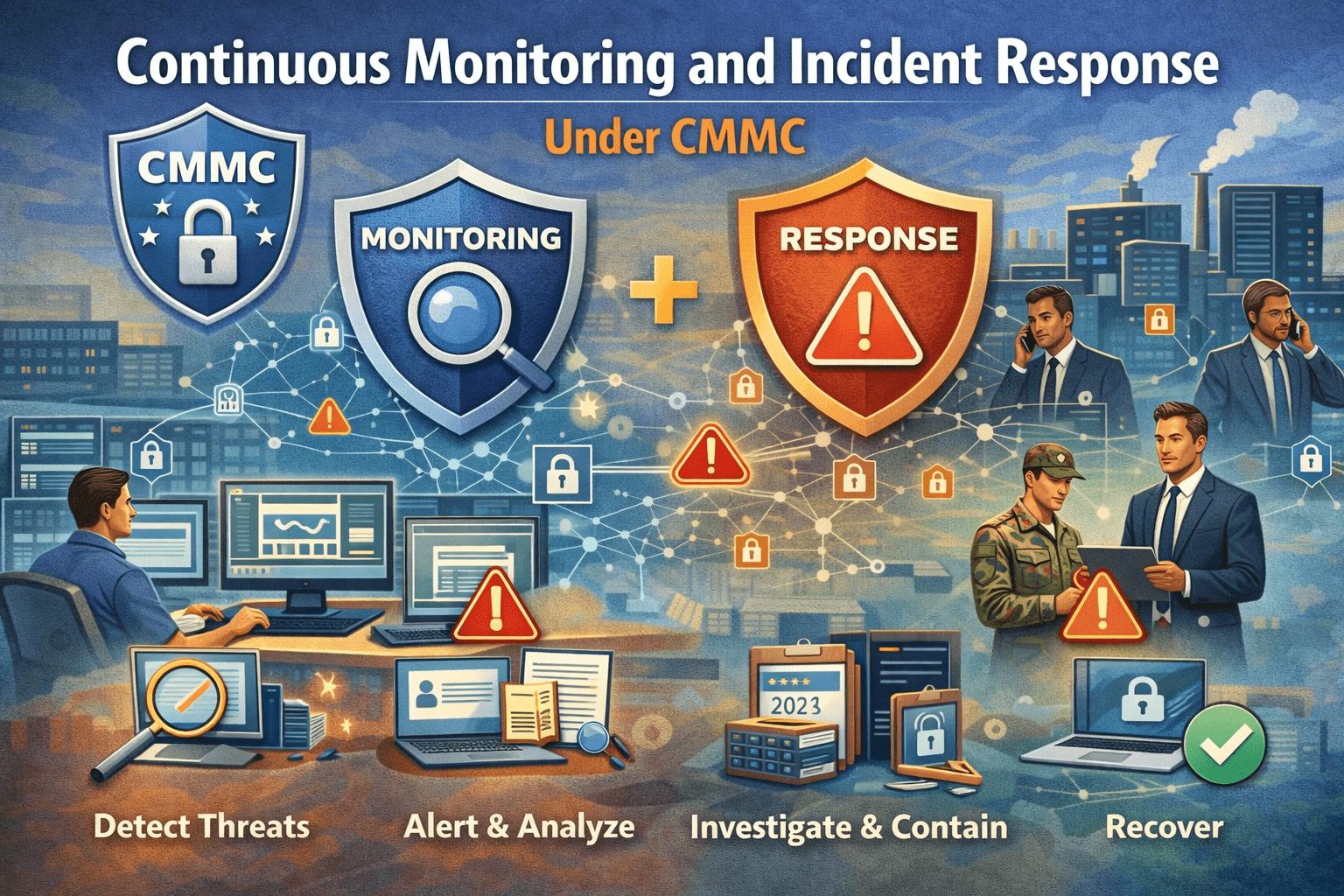
Continuous monitoring and incident response are the two CMMC domains that most consistently reveal the distance between documentation compliance and operational compliance. Every organization that has reached Level 2 assessment readiness has a continuous monitoring policy and an incident response plan. What separates the organizations that pass from those that receive findings is whether those programs are operational — actively running, regularly exercised, and producing the evidence of ongoing execution that C3PAO assessors require.
A continuous monitoring program that exists on paper and an incident response plan that was written and filed are documentation artifacts. CMMC requires operational programs — the difference between possessing a plan and being able to execute it is exactly what assessors are evaluating.
Overview
CMMC continuous monitoring requirements under the CA domain mandate ongoing security control effectiveness assessment — not periodic review. CMMC incident response requirements under the IR domain mandate operational response capability including testing, reporting procedures with specific timelines, and evidence preservation — not just documented procedures. Both programs require infrastructure, defined procedures, regular execution, and records of that execution. Organizations that have built those programs operationally arrive at assessment with the evidence that verifies they are running. Those that have documentation without operational programs produce a specific pattern of assessment findings that experienced assessors recognize immediately.
- Continuous monitoring requires defined scope, monitoring infrastructure, review procedures, and records of ongoing execution
- Incident response requires tested procedures, functional notification chains, and 72-hour DIBNet reporting capability
- Both programs require evidence of execution — not just documentation of intent
- Integration between the two programs is essential — monitoring is the detection mechanism that activates incident response
- POAM management connects both programs to the organization’s risk management infrastructure
The 5 Why’s
- Why does CMMC treat continuous monitoring as an operational program rather than a periodic assessment activity? CA.3.161 (monitor security controls on an ongoing basis) and CA.2.157 (develop, document, and periodically update plans of action) reflect the CMMC framework’s recognition that security control effectiveness changes over time — through configuration drift, system updates, evolving threats, and organizational changes. Periodic point-in-time assessments capture effectiveness at a moment. Ongoing monitoring maintains awareness of control effectiveness between those moments — which is when actual security failures occur.
- Why does the 72-hour incident reporting requirement create operational demands that most IR programs are not designed to meet? DFARS 252.204-7012 and the underlying CMMC IR requirements require that cyber incidents affecting CUI are reported to DIBNet within 72 hours of discovery. That timeline requires that incident detection triggers a notification process that can be initiated, completed, and submitted within 72 hours — including incident characterization, affected system identification, preliminary impact assessment, and DIBNet submission. Organizations that have not exercised that process under time pressure discover the process failures when an actual incident activates it.
- Why is integration between continuous monitoring and incident response a compliance requirement, not just a security best practice? The monitoring infrastructure that CMMC CA domain requires is the detection mechanism that must activate IR procedures. If monitoring alerts do not route to IR procedures — because the monitoring and IR programs were built independently without integration — the organization has two programs that do not work together when they need to. CMMC compliance requires that monitoring detects events that trigger IR activation, which requires those programs to be designed as an integrated system.
- Why does POAM management connect continuous monitoring and incident response to organizational risk management? Continuous monitoring identifies security control effectiveness gaps. IR activities identify security incidents that reveal control failures. Both feed into the POAM as documented risks requiring remediation. The POAM is not a separate program — it is the risk management mechanism that connects the monitoring and IR programs to organizational governance. CMMC requires POAM management as an active practice, not a static document.
- Why do assessors treat untested IR procedures differently from other documentation gaps? Untested IR procedures are a different category of finding than a documentation gap because the stakes of IR failure are higher than the stakes of a documentation gap. An organization that cannot execute its IR procedures under the 72-hour reporting requirement is not just non-compliant — it is operationally exposed in the scenario that CMMC compliance is specifically designed to address. Assessors treat IR testing gaps as high-priority findings for this reason.
Building an Operational Continuous Monitoring Program
Monitoring Scope Definition
Define what the continuous monitoring program covers:
- Every CUI-touching system in the CMMC boundary
- Every security control domain in the CMMC assessment scope
- The monitoring frequency appropriate to each control type — real-time for access and authentication controls, daily for configuration changes, weekly for vulnerability scan results, monthly for access rights reviews
Monitoring Infrastructure
- SIEM or centralized logging — all required CMMC AU event types collected from CUI-touching systems, normalized, and reviewable against defined baselines
- Configuration monitoring — automated detection of configuration changes against approved baselines with alerting on deviations
- Vulnerability scanning — scheduled scans of CUI-touching systems with results compared against previous scans and tracked for remediation
- Access rights monitoring — periodic review of user and service account access grants against role requirements with findings fed to access rights correction process
Review Procedures and Execution Records
For each monitoring activity type, define and execute:
- Review procedure (what is reviewed, against what criteria, by whom)
- Review cadence (how often)
- Escalation procedure (what findings trigger what response)
- Review record format (how review execution is documented for assessment evidence)
Building an Operational Incident Response Program
IR Plan Components
CMMC-compliant IR plans include:
- Incident classification criteria — what constitutes a reportable CUI incident versus a security event that does not trigger reporting obligations
- Response procedures for each incident type — containment, eradication, recovery steps
- Notification chain — internal escalation contacts and external reporting contacts including DIBNet reporting procedures and contracting officer notification procedures
- Evidence preservation procedures — media preservation requirements for incidents that may require forensic analysis
72-Hour Reporting Capability
Building the operational capability to meet the 72-hour DIBNet reporting requirement:
- Identify the specific individuals with DIBNet access and reporting authority
- Document the information required for a DIBNet incident report and the process for collecting it during an active incident
- Verify that DIBNet access credentials are current and functional — not just that DIBNet accounts exist
- Exercise the reporting process in tabletop exercises that simulate the time pressure of an actual incident
IR Testing Requirements
CMMC IR.2.093 requires testing of the IR plan. Testing that satisfies this requirement:
- Annual tabletop exercise simulating a CUI incident that triggers reporting obligations
- Exercise scenario that tests the 72-hour reporting timeline under simulated time pressure
- Post-exercise documentation identifying gaps and triggering POAM entries for remediation
- Update of IR plan based on exercise findings before the next assessment period
Evidence of Operational Execution
The evidence that demonstrates operational continuous monitoring and IR programs to C3PAO assessors:
- Monitoring review records — logs of review execution, findings identified, and escalations triggered
- Alert response records — documentation of how monitoring alerts were investigated and resolved
- POAM entries — monitoring findings and IR exercise findings documented as POAM items with remediation timelines
- IR exercise records — tabletop exercise documentation including scenario, participants, findings, and POAM actions
- DIBNet access verification — evidence that reporting capability exists and is functional
Final Takeaway
Continuous monitoring and incident response under CMMC are operational programs, not documentation exercises. The organizations that satisfy C3PAO assessors in these domains are the ones that have monitoring infrastructure running, review procedures executing on defined cadences, IR plans that have been tested under time pressure, and the records that demonstrate all of the above.
Documentation of intent satisfies no CMMC requirement that requires evidence of operational execution. Building operational programs is the work — and it is the work that determines whether assessment reveals a functioning compliance program or a filing cabinet full of policies.
Build Operational CMMC Monitoring and IR Programs With Mindcore Technologies
Mindcore Technologies works with DIB contractors to design and implement operational continuous monitoring and incident response programs — monitoring infrastructure, review procedures, IR plan development, 72-hour reporting capability, tabletop exercise design, and evidence management that produces assessment-ready operational compliance rather than documentation-only compliance.
Talk to Mindcore Technologies About CMMC Monitoring and Incident Response →
Contact our team to assess your current monitoring and IR program operational status and build the programs that satisfy CMMC requirements through demonstrated execution.

