

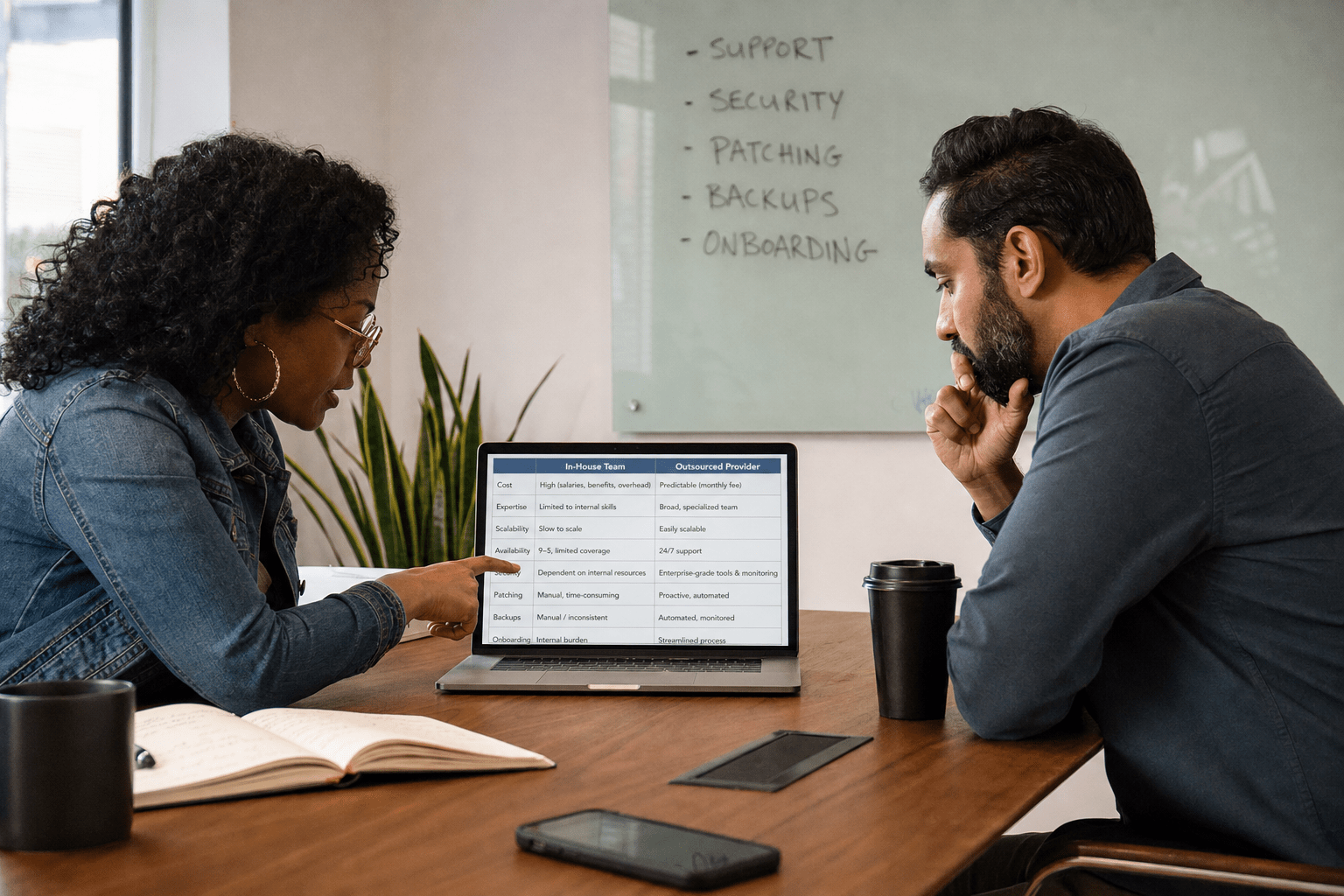
For most growing SMBs, evaluating MSP vs. Internal IT cost benefits helps determine which mix of internal and outsourced IT functions maximizes efficiency and ROI. The sharper question is which functions belong in-house and which belong with an outside provider. An internal hire gives you presence, context, and fast hands on local problems. A managed services provider gives you depth across security, networking, and after-hours coverage that one or two people cannot match. The realistic answer for most operations directors and CIOs is a co-managed model that keeps strategy and institutional knowledge inside while outsourcing the round-the-clock monitoring, patching, and specialized security work that drains a small internal team.
Overview: How the Two Models Actually Differ
The MSP vs. Internal IT comparison usually comes down to five practical factors rather than a single cost line. Here is the short version before we go deeper.
- Coverage. A solo internal hire covers business hours and a single skill set. An MSP covers nights, weekends, and a bench of specialists across security, cloud, and networking.
- Cost shape. Comparing MSP vs. Internal IT cost benefits reveals that while in-house IT incurs fixed salaries and benefits, an MSP often provides predictable pricing per-user with included tooling.
- Speed on local issues. An in-house person walks to the desk and fixes the printer or the conference room. An MSP handles that remotely, which is fast for software but slower for physical hardware.
- Security depth. Assessing MSP vs In-House IT cost benefits highlights that an MSP can provide full security coverage, whereas in-house IT may require multiple hires to achieve similar security depth.
- Scalability. Adding internal capacity means hiring, which takes months. An MSP scales seats up or down as headcount changes.
Why the Stakes Are Higher Than a Simple Cost Comparison
The MSP vs. Internal ITquestion carries more risk than most SMB budgets account for, because a wrong call shows up as downtime and breach exposure, not just payroll. When you frame this purely as salary versus monthly invoice, you miss the parts that actually hurt. A single in-house generalist is a single point of failure. When that person is sick, on vacation, or quits, your coverage goes to zero. Security incidents do not wait for business hours, and the average time to detect an intrusion stretches into weeks when no one is watching overnight.
There is also the opportunity cost of how an internal hire spends their day. A talented systems administrator who is buried in password resets and printer tickets is not the person planning your cloud migration or hardening your defenses. The federal guidance is clear that basic cyber hygiene, asset inventory, patching, and access control, requires sustained attention, as CISA’s Cyber Essentials lays out for smaller organizations. That sustained attention is exactly what gets dropped when one person is doing everything.
Side-by-Side: In-House IT vs Managed IT Services for SMBs
When you compare in-house IT and managed IT services for SMBs across the factors that matter, each model wins in different columns rather than one being flatly better. Below is how the trade-offs land in practice.
Where In-House IT Wins
An internal hire knows your business. They learn which executive needs handholding, which application the finance team cannot live without, and where the cables actually run. They are physically present for hardware swaps, new-hire setups, and the moments when someone needs a human at the desk. For companies with heavy on-site equipment, a manufacturing floor, a lab, a clinic with imaging machines, that physical presence has real value. Institutional knowledge is the strongest argument for keeping IT internal.
Where an MSP Wins
A managed services provider brings a team instead of a person. You get monitoring that runs at 2 a.m., a patching schedule that does not slip, and access to specialists in security, networking, and cloud that you would never justify hiring individually. The tooling, remote monitoring, endpoint protection, ticketing, comes bundled rather than billed separately. For frameworks like NIST SP 800-171, which many SMBs face through contract requirements, an MSP already has the controls and documentation patterns in place. Reaching that bar from scratch with internal staff is slow and expensive.
The Cost Reality
Cost rarely breaks the way the spreadsheet suggests. A single mid-level IT salary, once you add benefits, training, certifications, and the software stack one person needs, often lands near or above what a co-managed MSP arrangement costs for broader coverage. The MSP invoice is also predictable, which matters when you are forecasting a year out. I always tell clients to compare total cost of coverage, not headline salary against monthly fee.
The Co-Managed Middle Path
A co-managed model is often the best approach when evaluating MSP vs In-House IT cost benefits, as it balances internal presence with outsourced expertise for optimized cost efficiency. This is the part the typical comparison skips. You keep an internal person or small team for the things presence and context demand, and you hand the rest to a provider. The division usually looks like this.
What to Keep In-House
Keep the work that depends on knowing your business and being in the building. That means day-to-day user support, new-hire onboarding, hardware logistics, vendor relationships, and the strategic voice in the room when leadership plans growth. Your internal person becomes the owner of the relationship and the institutional memory, not the overnight monitor.
What to Outsource
Hand off the disciplines that need depth and never sleep. Security monitoring and incident response, patch management, backup verification, network management, and compliance documentation all run better with a team behind them. These are the functions where a single internal hire either burns out or quietly lets things slide. A co-managed arrangement means your internal staff stops carrying a 24/7 pager they were never equipped to answer, and there is a straightforward way to pick a co-managed provider that fits.
The result is coverage without a single point of failure, specialist depth without specialist headcount, and an internal presence that focuses on the business instead of drowning in tickets. Our managed IT services are built to slot into exactly this kind of split, working alongside an internal owner rather than replacing them.

How to Decide Which Model Fits Your Firm
You decide between in-house IT, an MSP, or a co-managed split by reading a few signals in your own operation rather than copying what a similar-sized company did. When deciding which approach to adopt, understanding MSP vs. Internal IT cost benefits allows you to align risk, headcount, and operational strain with budget-friendly IT strategy decisions. A handful of triggers tell you which way to lean.
Lean toward keeping more work in-house when you run heavy on-site equipment, when a regulated process demands someone physically present, or when your team already has two or more capable technical staff who can cover each other. Presence and redundancy are the conditions that make an internal team work.
Lean toward an MSP, or a co-managed arrangement, when any of these are true. You depend on a single technical person whose absence stops everything. You face a compliance framework you cannot document on your own. Your one hire spends most of the week on tickets instead of planning. Your business runs outside standard hours and no one watches the systems overnight. Each of those is a gap an internal generalist cannot close alone, which is why managed security services usually sit alongside the internal team rather than replacing it.
The honest test is simple. Write down the IT work your firm needs done in a week, then mark which items a single person can realistically own without dropping the rest. Whatever does not fit is the work to outsource, and that list is usually longer than leadership expects.
Frequently Asked Questions
Is an MSP cheaper than hiring in-house IT?
It depends on what you are comparing. A fully loaded in-house salary, with benefits, training, and the software one person needs, often matches or exceeds a co-managed MSP arrangement that delivers broader coverage. Compare total cost of coverage, not salary against monthly fee.
Can I use an MSP and still keep someone in-house?
Yes, and most SMBs should. The co-managed model keeps an internal owner for presence, context, and strategy while the provider handles monitoring, security, and patching. It is the most common arrangement I set up because it removes the single-point-of-failure risk without giving up local knowledge.
What IT functions should stay in-house?
Keep the work that depends on being in the building and knowing your business: user support, new-hire setup, hardware logistics, vendor relationships, and the strategic seat when leadership plans. Outsource the round-the-clock disciplines like security monitoring and patch management.
How fast can an MSP respond compared to in-house staff?
For software, network, and security issues, an MSP often responds faster because someone is always on. For physical hardware at your site, an in-house person is quicker. A co-managed split gives you both, remote depth plus local hands.
Does an MSP help with compliance requirements?
Yes. Providers that work with frameworks like NIST SP 800-171 or HIPAA already maintain the controls, monitoring, and documentation those frameworks demand. Building that internally from scratch is slow, which is why compliance-driven SMBs often lead with an MSP for the security side.
Talk Through Your Split With Us
You do not have to settle the MSP vs in-house IT question in the abstract. The right answer depends on your headcount, your on-site equipment, your compliance pressure, and where your current team is already stretched. We will map which functions make sense to keep internal and which to hand off, then show you what a co-managed arrangement would cover. Book a free strategy call and we will walk through your specific split together.
MSP vs In-House IT Strategy and Co-Managed IT Expertise from Matt Rosenthal
Matt Rosenthal, CEO of Mindcore Technologies, has over 30 years of experience helping SMBs evaluate the true cost of internal IT versus managed services and design co-managed models that eliminate single points of failure without sacrificing institutional knowledge. He has seen firsthand how a single in-house generalist buried in daily tickets cannot simultaneously own security monitoring, patch cadence, compliance documentation, and after-hours coverage. Matt leads a team that helps operations directors map which IT functions belong in-house and which belong with a provider, so the split serves the business rather than straining the people inside it.

