

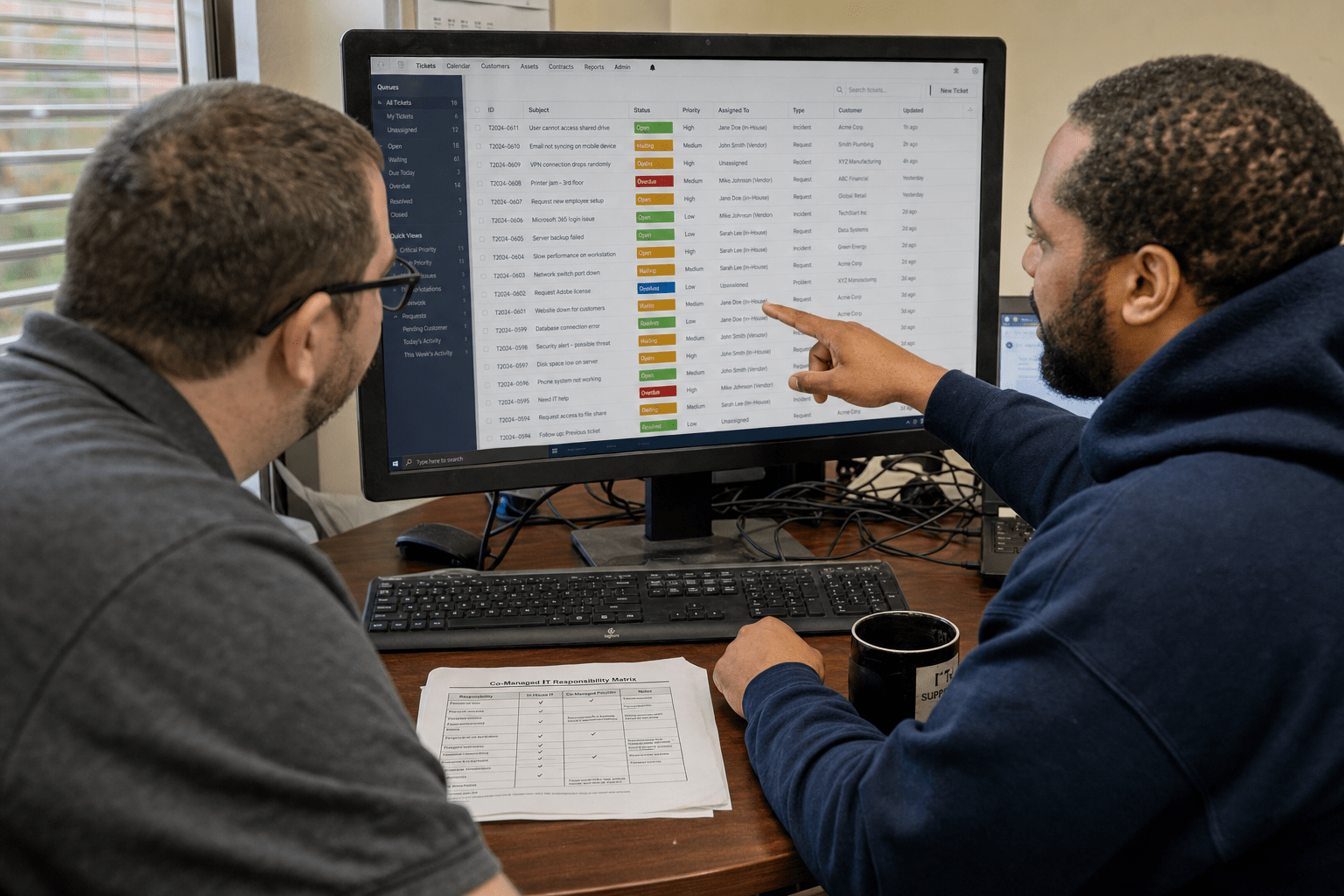
Understanding What Is Co-Managed IT services helps businesses see how an external provider can work alongside internal IT staff, splitting responsibilities without replacing the team.. It is not a cheaper version of fully managed IT. It is a different model built for organizations that already employ technical people but need more depth, after-hours coverage, or enterprise-grade tooling they cannot justify buying alone. A clear understanding of What Is Co-Managed IT services ensures ownership boundaries are documented, preventing blurred responsibilities and failed engagements. If your internal team is competent but stretched, co-managed IT services give you reach without forcing you to hand over the keys.
Co-Managed IT at a Glance
Before deciding whether this model fits, it helps to see the core ideas in one place.
- Co-managed IT splits work between your internal staff and an outside provider, with each side owning defined tasks.
- It is the right fit when you have IT people who are good but outnumbered by the workload, not when you have no IT staff at all.
- Knowing What Is Co-Managed IT services clarifies that the provider brings enterprise-grade tools and 24/7 monitoring that are costly to maintain internally.
- Success depends entirely on a written responsibility matrix that names who owns each system, ticket type, and escalation path.
- The model collapses when both sides assume the other is handling something, so clarity beats coverage every time.
Why the “Discount Managed IT” Framing Gets Businesses in Trouble
The most common misunderstanding about co-managed IT services is that they are a lighter, cheaper version of fully managed IT, and that assumption leads straight to failed engagements. Fully managed IT means an external provider owns your entire technology stack end to end. Co-managed IT means two teams own different parts of it. Those are not the same product at two price points. They are separate operating models with separate failure conditions.
When a business treats co-managed as “managed IT, but we kept a few people,” nobody draws the line clearly. The internal admin assumes the provider patches the servers. The provider assumes the internal admin owns the line-of-business app because they built it. A vulnerability sits unaddressed for weeks because each side believed it belonged to the other. I have walked into post-incident reviews where the root cause was not a technical gap. It was a sentence that was never written down.
The healthier framing is this: co-managed IT is an extension of your team’s capacity and capability, not a substitute for ownership. You are buying reach into hours, skills, and platforms you do not have in-house. You are not buying the right to stop thinking about who does what.
When Your Business Actually Needs Co-Managed IT
You need co-managed IT services when your internal team is skilled enough to run daily operations but lacks the depth, hours, or tooling to cover everything the business now demands. The trigger is rarely a single event. It is a pattern of strain that shows up in predictable ways.
Your IT team is competent but outnumbered
If you have one to four technical staff covering a growing company, they spend their days reacting to tickets and never reach the strategic work. Patching slips. Documentation goes stale. The team is busy, but the business is not getting safer or faster. Co-managed support absorbs the routine load so your people can do the work only they can do.
You cannot cover nights, weekends, or holidays
Understanding What Is Co-Managed IT services highlights how external providers fill coverage gaps during nights, weekends, and holidays when internal teams are unavailable. If a ransomware attempt fires at 2 a.m. on a Saturday and your only response is a voicemail, you have a coverage gap that no amount of internal talent fixes. A co-managed partner provides the monitoring and on-call rotation that a small team cannot staff on its own.
You need enterprise tooling you cannot justify buying alone
Security information and event management platforms, endpoint detection, and mature remote monitoring suites carry licensing and expertise costs that rarely pencil out for a small team. A co-managed provider already runs these tools across many clients, so you get enterprise-grade capability without the standalone price tag. Frameworks like the NIST Cybersecurity Framework set expectations that most SMBs simply cannot meet with spreadsheets and goodwill.
You face a compliance or audit deadline
When a client contract, cyber insurance renewal, or regulatory requirement lands, the documentation and control evidence it demands can swamp a lean team. A co-managed partner brings the process maturity and reporting to clear those bars without pulling your staff off everything else for a month.

How Ownership Boundaries Decide Whether It Works
A co-managed IT engagement lives or dies on the clarity of its responsibility matrix, the document that names who owns each system, ticket category, and escalation path. This is the single most important artifact in the relationship, and it is the one most often skipped in the rush to start.
A good matrix is boring and specific. It states that the internal team owns the line-of-business application and end-user onboarding, while the provider owns patch management, the security operations center, and after-hours response. It defines what happens when a ticket touches both domains. It names the escalation contact on each side and the response time attached to each severity level. When it works as designed, anyone can look at an open ticket and know instantly whose desk it belongs on.
What blurred ownership looks like in practice
Blurred ownership rarely announces itself. It hides until an incident exposes it. A server goes unpatched because the matrix never said who owned that subnet. An alert fires into a shared inbox nobody officially watches. Two teams both adjust the same firewall rule and undo each other’s work. The CISA incident response playbooks make the point plainly: response only works when roles are assigned before the event, not negotiated during it.
Keeping the boundaries alive
A responsibility matrix is not a one-time document. Systems change, staff turn over, and new tools enter the stack. The strongest co-managed relationships review the matrix on a regular cadence and update it whenever ownership shifts. That discipline is what separates a partnership that scales from one that slowly drifts back into confusion.
Frequently Asked Questions
What is the difference between co-managed IT and fully managed IT?
Fully managed IT means an external provider owns your entire technology environment, suitable for businesses with no internal IT staff. Co-managed IT means an external provider shares responsibility with your existing internal team, with each side owning defined systems and tasks. The difference is ownership structure, not price.
Is co-managed IT cheaper than hiring more internal staff?
It often costs less than the fully loaded expense of additional hires once you account for salary, benefits, training, and tooling. More importantly, it gives you access to specialized skills and 24/7 coverage that a single new hire cannot provide, so the comparison is about capability and reach, not headcount alone.
Will a co-managed provider replace my IT team?
No. The model is built around keeping your internal team in place and extending what they can do. Your staff retain ownership of the systems closest to your business while the provider covers depth, hours, and tooling. A provider that pushes to absorb your whole team is selling fully managed IT, not co-managed.
How do we avoid confusion over who handles what?
You write a responsibility matrix before any work begins. It names the owner of every system, ticket type, and escalation path on both sides, and you review it on a set cadence as your environment changes. Clarity defined up front is the single biggest predictor of whether the engagement succeeds.
What size business is co-managed IT right for?
It fits organizations that already employ between one and roughly a dozen IT staff and are feeling the strain of growth, coverage gaps, or rising security demands. If you have no internal IT at all, fully managed IT is usually the better starting point.
Find the Right IT Model for Your Team
Knowing What Is Co-Managed IT services guides businesses to evaluate internal capabilities versus external support, ensuring the partnership addresses gaps without overextending the internal team.. If your people are good but outnumbered, or covered by day and exposed by night, co-managed IT can give you the depth you need without taking ownership away from the team that knows your business best. The difference between a partnership that works and one that frustrates everyone comes down to clear boundaries set before the first ticket.
If you want a clear-eyed look at whether co-managed IT fits your situation, book a free strategy call and we will map your current coverage against where the gaps actually are. You can also explore how we structure managed IT services for growing teams.
Co-Managed IT Strategy and Internal IT Partnership Expertise from Matt Rosenthal
Matt Rosenthal, CEO of Mindcore Technologies, has over 30 years of experience helping growing organizations design co-managed IT models that extend internal team capacity without creating ownership gaps or accountability confusion. He has seen firsthand how blurred responsibility boundaries, missing escalation paths, and enterprise tooling shortfalls leave skilled internal teams stretched beyond what they can safely cover. Matt leads a team that builds co-managed partnerships around clearly defined responsibility matrices, 24/7 monitoring coverage, and enterprise-grade security platforms, so internal IT staff can focus on the work only they can do.

