

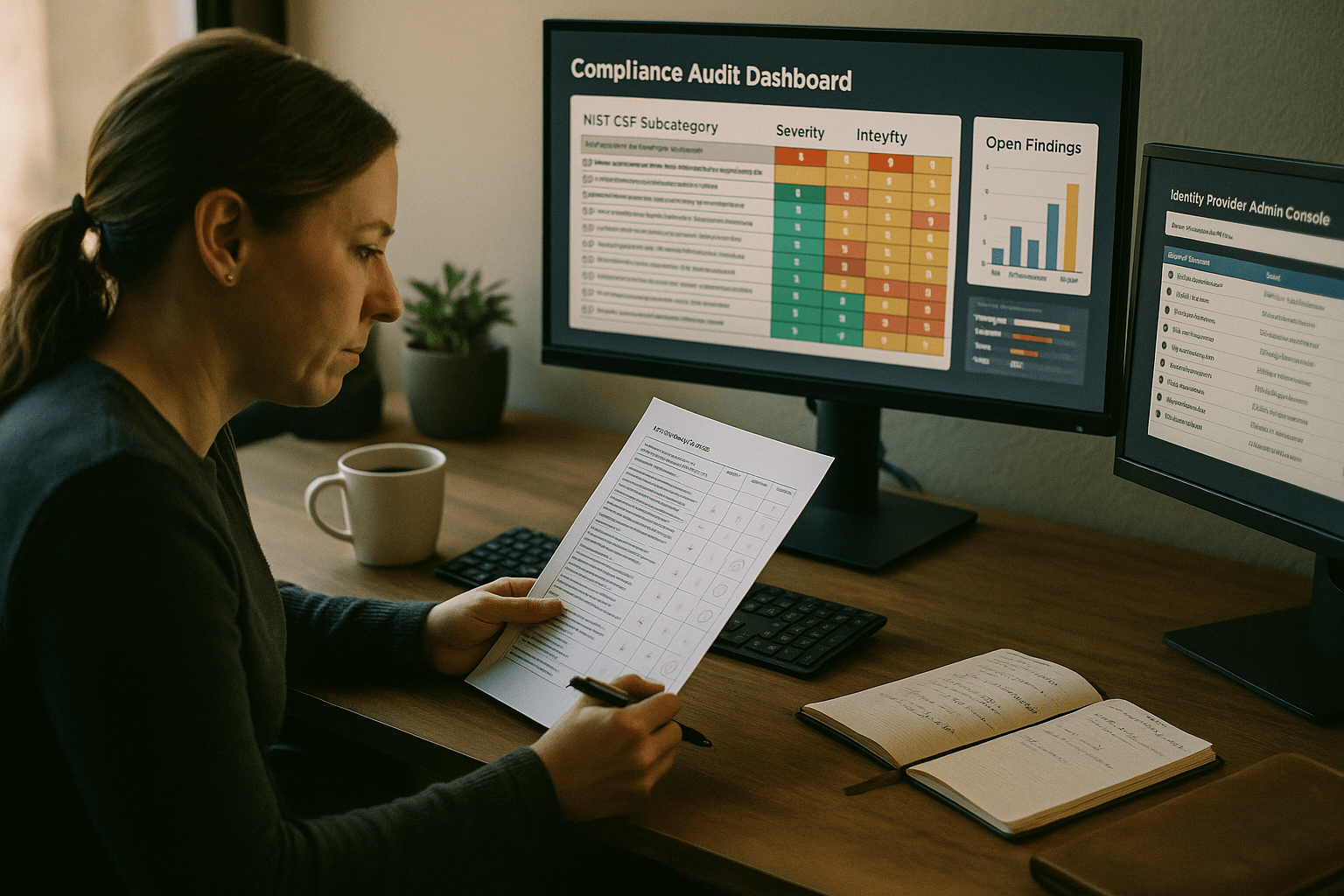
Cybersecurity audit services help small and mid-sized businesses verify that the controls protecting their data, systems, and people actually work in practice, not just on paper. The honest version of that promise is harder than most providers admit. Our team has reviewed dozens of prior-vendor audit reports for SMB clients in the 50 to 500 employee range, and the same five mistakes keep producing a clean-looking PDF and an exposed network. This article walks through those five mistakes so you can ask sharper questions before you sign the next statement of work.
The 5 audit principles SMB leaders should keep in mind
- An audit grades the gap between what you wrote down and what is actually running. If your provider never opens a console, you bought a documentation review, not an audit.
- Scope decides outcome. An audit that excludes SaaS, third-party identity providers, and remote endpoints will pass while the attacker walks in through Microsoft 365.
- Compliance frameworks are a floor, not a ceiling. SOC 2, HIPAA, and PCI tell you what to control, never how to control it for your stack.
- The report is a starting point. Findings without prioritization, owners, and dates produce zero risk reduction.
- The auditor and the remediator should not be the same vendor without a written conflict-of-interest disclosure. Mixed roles distort severity calls.
Why cybersecurity audit services fail SMBs more often than they should
Cybersecurity audit services fail SMBs when they grade evidence the buyer prepared rather than systems the buyer runs. We see this on almost every report we inherit. The provider asked for a policy document, the client uploaded one, the provider checked a box, and the attacker still has a viable phishing path into the CFO’s inbox. The audit produced a passing score, the leadership team felt safer, and the underlying exposure stayed exactly where it was.
The reason this pattern survives is incentive. A clean report renews the engagement. A messy report invites pushback from a buyer who already feels overspent on security and underserved on outcomes. Many audit shops have learned that the path of least friction is to write findings the client can close in a week, then move on. That is fine for a checkbox exercise. It is not what an SMB needs when ransomware groups are still walking through Active Directory after a phishing click. The SMB needs an auditor who is willing to deliver an uncomfortable finding and defend it.
Mistake 1, treating documentation as proof of control
The first mistake is treating a written policy as proof that a control is operating. A multi-factor authentication policy in a Word file is not the same thing as enforced multi-factor authentication on every account, including the four service accounts the prior IT team set up in 2019 and forgot. We routinely find SMB environments where the policy says one thing and the directory says another. A good audit pulls the actual sign-in logs, samples 30 days of failed login events, and tests whether MFA bypass paths exist for legacy protocols.
The opposing view, which deserves a fair hearing, is that documentation matters for legal and regulatory defense. A written and approved policy is what an insurer or regulator wants to see after an incident. Both can be true at once. The fix is not to drop documentation review. The fix is to refuse to count documentation as evidence of operation. An audit should grade both axes, and the SMB should see two separate scores.
Mistake 2, scoping the audit to the parts you already trust
The second mistake is letting the buyer scope the audit to systems they already feel good about. We have read prior reports where the network perimeter, the firewall ruleset, and the on-prem file server were all in scope, while the Microsoft 365 tenant, the third-party identity provider, the unmanaged sales-team laptops, and the four shadow SaaS apps Finance pays for were all out of scope. The attacker does not care where you drew the line.
You can argue, reasonably, that an SMB cannot afford to audit every system every year. Cost is real. The correct response is not to silently exclude high-risk surfaces, it is to disclose them in the report as known unaudited risk and put a date on when each will be covered. A two-year rotation across the full estate is defensible. A permanent exclusion of the surface where the actual attacks land is not.
Mistake 3, copy-pasting framework findings without translating to your stack
The third mistake is a report that reads like a printout of the NIST Cybersecurity Framework subcategories with generic findings written underneath. Our team has seen reports where the same paragraph appears under “PR.AC-1” and “PR.AC-3” with the company name find-and-replaced. That is not analysis. That is a template.
The defense of framework-anchored reporting is that frameworks give regulators and insurers a shared vocabulary, and they do. The fix is to keep the framework structure and force the prose underneath it to name your actual environment. If the finding is about privileged access, the report should name your privileged accounts, the directory they live in, and the specific session-recording or just-in-time control that is missing. If the auditor cannot do that, they did not look at your environment, they looked at a framework.
What a strong cybersecurity audit actually covers
A strong cybersecurity audit for an SMB covers identity, endpoint, email, SaaS, network, data, and the human layer, and it grades each one against both your written policy and the live configuration. The auditor should be willing to log in to read-only views of your identity provider, your endpoint console, your email security tool, and your SaaS admin centers. If the engagement letter does not include that access, the audit is shallower than the brochure suggests.
Our team has found that the highest-yield findings on SMB audits cluster around four areas. First, identity, where service accounts, break-glass accounts, and former-employee accounts almost always carry residual risk. Second, email, where DMARC enforcement, anti-impersonation rules, and OAuth third-party app consent are routinely under-configured. Third, endpoint, where the agent is deployed but the response policies are still in audit mode from the initial pilot. Fourth, backup and recovery, where the backup runs nightly but no one has tested a restore in 18 months. None of these show up in a documentation-only audit. All of them show up in a real one.
Mistake 4, no prioritization or owner on findings
The fourth mistake is delivering a report with 47 findings, no severity weighting that maps to your actual risk, and no named owner for any of them. We have inherited reports that list a missing screen-saver timeout next to an exposed RDP gateway as if they were peers. The buyer reads that and freezes. Six months later, nothing is closed, and the next audit produces the same list.
Some auditors argue that prioritization is the buyer’s responsibility, because only the buyer can weigh business context. That has a kernel of truth. It also abdicates the analytical work the buyer paid for. A useful report assigns a draft severity, names a draft owner, and proposes a draft target date. The buyer revises those three fields in a working session with the auditor. The output is a remediation plan, not a list. If your provider hands you a list and walks away, you bought a finding inventory, not a security improvement.
Mistake 5, hiring the auditor and the remediator as the same vendor with no disclosure
The fifth mistake is hiring one vendor to audit your environment and remediate it at the same time, with no written disclosure of the conflict. The economic incentive is obvious. The auditor sees a finding, the remediation arm of the same shop scopes the fix, and the next audit confirms it closed. Sometimes that is fine. SMBs often do not have the budget to keep auditor and remediator separate, and a combined arrangement can be faster and cheaper.
The fix is not to ban the model. The fix is to require written disclosure of every finding where the audit team and the remediation team share revenue, plus a published methodology that explains how the audit scoring stays independent. Mature managed IT and managed security providers will give you that disclosure without being asked. Smaller shops will resist it. The resistance is the signal.

How to choose an audit provider that holds these five lines
You can screen most providers in a 30 minute conversation. Ask four questions. First, will you open consoles in our identity provider, our endpoint tool, and our Microsoft 365 tenant during this audit, or will you grade evidence we upload? Second, what is in scope and what is out of scope, and where will the out-of-scope items be disclosed in the final report? Third, will your findings include a draft severity, a draft owner, and a draft target date, or will you hand us an unprioritized list? Fourth, if you also sell remediation services, where in the report will you disclose every finding where you intend to bid on the fix?
A provider that answers all four cleanly is worth a paid pilot on a narrow scope, like the Microsoft 365 tenant, before you commit to a full annual audit. A provider that gets defensive on any of the four is telling you what their audit will look like before you sign anything.
Frequently Asked Questions
How much do cybersecurity audit services cost for an SMB?
A focused tenant or environment audit for a 50 to 500 employee SMB typically runs from a few thousand dollars for a single-system review to mid five figures for a multi-domain annual audit. Cost varies with scope, framework requirements, and whether on-site work is needed. The pricing question matters less than the methodology question.
How often should an SMB run a cybersecurity audit?
Annually at minimum, with a lighter quarterly check on identity and email configuration because those drift fastest. Regulated firms in healthcare, finance, or DoD supply chain may need more frequent audits to satisfy HIPAA, PCI, or CMMC requirements. The point is steady cadence, not a single annual fire drill.
Is a cybersecurity audit the same as a penetration test?
No. An audit grades whether controls exist and operate. A penetration test simulates an attacker against those controls and tries to break in. SMBs need both, sequenced. The audit tells you what is in place, the pen test tells you whether what is in place actually stops a real attempt.
Organizations looking to validate real-world security controls should also consider penetration testing services as part of a broader security assessment strategy.
Can our internal IT team run the audit instead of an outside firm?
Internal teams can run a useful self-assessment, and they should, between formal audits. They cannot deliver an independent attestation. For insurance renewals, regulatory filings, and customer security questionnaires, you need an outside party with no operational stake in the systems being graded.
What if our last audit was clean and we still got breached?
That outcome is the strongest possible signal that the audit graded the wrong things. Pull the engagement letter, compare the scope to where the attacker actually entered, and ask the next auditor to start with that gap. A clean report and a successful intrusion in the same year is not bad luck, it is a scoping failure.
Talk to a managed IT and security team that will name the findings honestly
If your last cybersecurity audit produced a clean PDF and a feeling that something was still off, that feeling is worth listening to. Our team will sit with you for a free strategy call, review the prior report, name the surfaces it missed, and tell you what a tighter audit would change. You will walk out of the call with a draft scope, three prioritized questions for your current provider, and a clear sense of whether a second opinion is worth the spend. Book the call when you have 30 minutes. We will come prepared.
Cybersecurity Audit and Risk Management Expertise from Matt Rosenthal
Matt Rosenthal, CEO of Mindcore Technologies, has extensive experience helping organizations strengthen cybersecurity governance, operational resilience, and risk visibility through proactive audit and security assessment strategies. His expertise in identity governance, zero-trust architecture, threat monitoring, incident response planning, compliance readiness, and infrastructure risk management helps businesses identify operational weaknesses before they become major security incidents. Matt’s leadership focuses on building proactive cybersecurity frameworks that improve operational visibility, strengthen infrastructure resilience, reduce enterprise risk, and support long-term protection against evolving cyber threats.

