

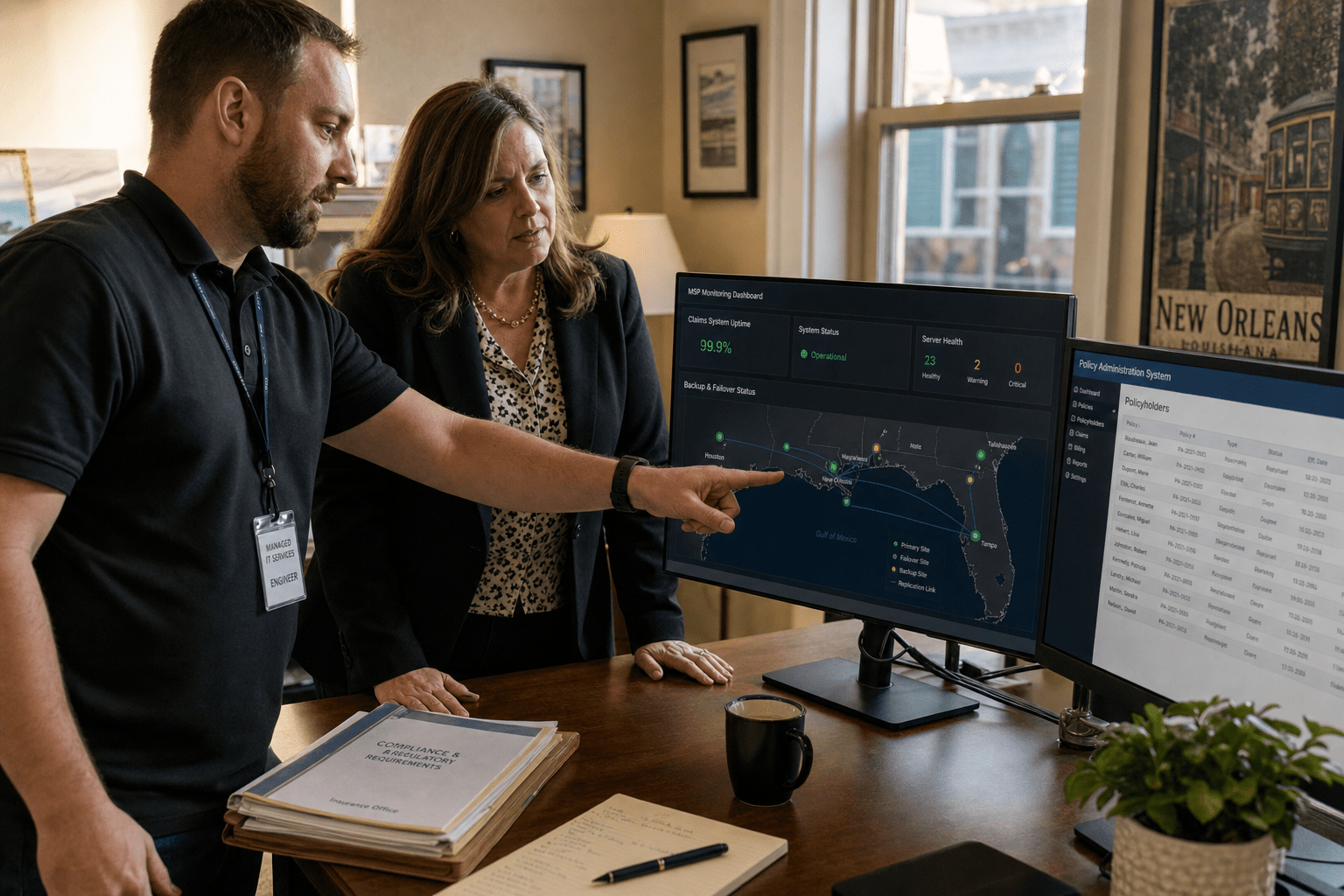
The best Managed IT Services Louisiana for insurance companies are those that satisfy the state’s Insurance Data Security Law while keeping claims and policy systems running through a hurricane-season outage. An insurance carrier, agency, or third-party administrator in Louisiana is not shopping for a generic help desk. It is choosing a partner who protects policyholder personal information, produces the documented program the Louisiana Department of Insurance expects, and recovers fast when a storm takes a building offline. This guide lays out the criteria that separate an insurance-ready provider from a generalist, so a firm in New Orleans, Metairie, Baton Rouge, or anywhere across the state can choose with the right questions in hand.
The 5 Criteria That Define an Insurance-Ready Provider
Here is what to weigh when evaluating a managed IT service provider for a Louisiana insurance company, drawn from where regulatory and operational risk in the sector actually concentrates.
- Regulatory evidence. A Managed IT Services Louisiana provider must map its program to the state’s Insurance Data Security Law and produce the written records a state examiner requests.
- Policyholder data protection. Encryption, access control, and monitoring have to center on the nonpublic personal information a carrier or agency holds.
- Storm-grade continuity. With Managed IT Services Louisiana, claims and policy systems are designed to keep running or recover within hours during a hurricane or flood.
- Sector workload fluency. A Mnaged IT Services Louisiana partner should understand agency management platforms, policy administration systems, and third-party integrations insurers rely on.
- Round-the-clock response. A rehearsed incident plan matters because an insurer cannot pause claims intake while a vendor figures out who is on call.
Why Louisiana Insurance IT Is a Different Discipline
Insurance firms in Louisiana cannot rely on the same IT playbook that fits a typical office, because they sit at the intersection of a strict data-security mandate and a geography that produces predictable, severe disruption. The Louisiana Department of Insurance enforces the state’s adoption of the NAIC Insurance Data Security Model Law, which requires licensees to maintain a written information security program, run risk assessments, oversee third-party providers, and report qualifying cybersecurity events on a fixed clock. A provider that treats those obligations as an afterthought leaves the firm exposed at exactly the point a regulator looks first.
The continuity side is just as demanding. Hurricane season puts coastal and inland Louisiana offices at real risk of losing power, connectivity, or the building itself, often during the same window when claims volume spikes. We have seen agencies learn, mid-storm, that their backups lived in the same parish as the office that flooded. A managed IT service provider built for this market designs around both pressures at once, treating regulatory documentation and storm-grade recovery as core requirements rather than upsells. Our managed IT services approach a Louisiana insurer the way the risk actually arrives, through a missed reporting deadline or a flooded server room, not only through a slow laptop.
Are National MSPs Always the Safer Choice for Insurers?
There is a real case for handing insurance IT to a large national managed services firm. Scale brings mature platforms, deep staffing benches, and security tooling refined across thousands of accounts, and a recognizable name can reassure a carrier’s board, its reinsurers, and its regulators. For a multistate carrier, that depth carries weight, which is why we run the same evaluation for insurance companies in neighboring states.
The counterargument is that a national provider may have little fluency in Louisiana’s specific insurance rules and no team that understands what a Gulf Coast hurricane does to an office in August. A large vendor can also treat a mid-sized Louisiana agency as a low-priority ticket during a regional event, exactly when response matters most. Neither answer is universal. A large carrier may need the depth of a national platform, while a regional agency often gets better protection from a provider that knows the state’s regulators and the local storm risk firsthand. The right choice depends on the firm’s size, footprint, and how much hands-on partnership it needs.
Should an Agency Replace Its IT Team or Support It?
A growing Louisiana agency often faces the question of whether to outsource IT fully or keep internal staff and add outside help. Full outsourcing can give a small firm access to security and continuity capabilities it could never staff alone, and it removes the burden of recruiting scarce technical talent in a competitive market. For a lean agency, that model has clear appeal.
The opposite case holds when a firm already has capable internal people who know its agency management system and its workflows. Replacing them can sever institutional knowledge that takes years to rebuild. A co-managed IT arrangement, where an outside provider handles security, compliance evidence, and after-hours coverage while internal staff own day-to-day operations, often fits an established insurer better than wholesale replacement. The honest read is that either model can work, but the firm should decide based on the knowledge it already holds, not on a vendor’s preference to take over everything.
Does Cyber Insurance Reduce the Need for a Strong MSP?
An insurance company, of all businesses, may reasonably ask whether its own cyber coverage lowers how much it needs to invest in managed IT. A policy can transfer financial risk after a breach, and a firm fluent in underwriting understands the value of that transfer. Coverage is a legitimate part of the picture.
The counterweight is that cyber insurers now require demonstrable controls before they pay, and a carrier that holds policyholder data is itself a high-value target. A claim can be reduced or denied if the firm cannot show it maintained the safeguards its application promised, and no policy restores the trust lost when policyholder records leak. Strong managed security is what satisfies those underwriting conditions and prevents the loss in the first place. Coverage and a capable managed security services program are complements, not substitutes, and treating one as a replacement for the other is where many firms get caught.

How to Evaluate Managed IT Providers for a Louisiana Insurer
A disciplined evaluation protects a Louisiana insurance firm more than any product demo. Start by asking each candidate how it maps its security program to the state’s Insurance Data Security Law, and listen for whether the answer references written programs, risk assessments, third-party oversight, and event reporting, or just generic antivirus and patching. An insurance-ready provider describes the documentation an examiner expects and shows it has produced that evidence before. A generalist tends to describe a capable but undocumented toolset built for a business with no regulator watching.
Then pressure-test continuity against Louisiana’s reality. Ask how the provider would keep claims intake and policy systems available if a hurricane took the primary office offline, and confirm that backups and failover live well outside the threatened region. Ask for insurance-sector references, confirm round-the-clock monitoring, and verify how the provider supports a firm in this specific market. A provider with a real presence in Metairie and the New Orleans area understands the local storm and regulatory context in a way a distant vendor often cannot. Reviewing how a provider already serving New Orleans businesses operates gives useful context for what mature support looks like.
Test Regulatory Documentation First
Documentation is where most insurance IT programs fall short, so test it before anything else. Ask the provider to show, in redacted form, the written information security program and risk-assessment format it would maintain for your firm, and how it tracks the third-party vendors that touch policyholder data. The NAIC model the state adopted, available in the Insurance Data Security Model Law text, spells out these obligations directly. A provider that cannot produce a documentation framework on request will not produce one when an examiner asks either.
Confirm Continuity Built for Hurricane Season
Ask each candidate to walk through a recovery scenario in which a named storm floods the primary office during peak claims volume. A capable provider describes geographically separated backups, tested failover, and clear recovery-time targets for the claims and policy systems that cannot go dark. Continuity in Louisiana is measured against the storm that actually hits, not against a generic checklist, and a provider that has never planned for regional disaster has not understood the market.
Verify Sector Workload Fluency
Ask the provider to describe how it supports the agency management and policy administration platforms an insurer runs every day. A provider fluent in the sector can speak to those systems, their integrations, and the access controls that keep policyholder data segmented from general office traffic. One that treats an insurance firm as an undifferentiated office will miss the workloads that matter most to the business.
Frequently Asked Questions
What makes the best managed IT service providers for insurance companies in Louisiana different?
The best providers satisfy Louisiana’s Insurance Data Security Law with documented programs while keeping claims and policy systems running through hurricane-season outages. They protect policyholder personal information through encryption, access control, and monitoring, and they understand the agency and policy platforms insurers depend on. That combination of regulatory evidence and storm-grade continuity separates an insurance-ready provider from a strong generalist.
How does Louisiana’s Insurance Data Security Law affect IT provider selection?
Louisiana’s adoption of the NAIC Insurance Data Security Model Law requires licensees to maintain a written information security program, conduct risk assessments, oversee third-party providers, and report qualifying cybersecurity events on a fixed timeline. A managed IT provider for an insurer must produce and maintain that evidence, not just run security tools. Selecting a provider that cannot document its program leaves the firm exposed during a state examination.
Should a Louisiana insurance agency outsource IT fully or use co-managed support?
Either model can work, and the right one depends on the knowledge the firm already holds. Full outsourcing gives a lean agency capabilities it could not staff alone, while co-managed support lets a provider handle security, compliance, and after-hours coverage while internal staff keep their institutional knowledge. The danger is severing experienced people who understand the firm’s agency management system.
How important is hurricane continuity for insurance IT in Louisiana?
It is central, because claims volume spikes during the same storms that can take a coastal or inland Louisiana office offline. An insurance-ready provider keeps backups and failover well outside the threatened region and sets recovery-time targets for claims and policy systems. A program whose backups sit in the same parish as the office is not built for this market.
Does cyber insurance replace the need for a strong managed IT provider?
No. Cyber coverage transfers some financial risk, but insurers now require demonstrable controls before they pay, and a claim can be reduced if a firm cannot show it kept the safeguards it promised. A strong managed security program satisfies those underwriting conditions and prevents the loss in the first place. Coverage and capable managed IT are complements, not substitutes.
Talk to a Louisiana Insurance IT Partner
Choosing a Managed IT Services Louisiana insurance company comes down to whether the provider can prove its program to a state examiner and keep claims systems alive through a hurricane, not whether it has the longest list of tools. The firms that avoid the worst outcomes are the ones that screened for regulatory documentation, policyholder data protection, and storm-grade continuity first, and treated routine help desk speed as the baseline rather than the goal. When selecting Managed IT Services Louisiana, build a shortlist, test documentation and continuity first, and confirm the provider understands both Louisiana’s insurance rules and hurricane risks. Mindcore serves insurance firms across Louisiana from our New Orleans and Metairie presence, and if your firm wants a partner that covers the whole picture, our team can show you how that works. Book a free strategy call with Mindcore and we will review your current setup against the risks Louisiana insurers actually face.
Louisiana Insurance Managed IT and Storm-Grade Continuity Expertise from Matt Rosenthal
Matt Rosenthal, CEO of Mindcore Technologies, has over 30 years of experience helping Louisiana insurance carriers, agencies, and third-party administrators build managed IT programs that satisfy the state’s Insurance Data Security Law documentation requirements while keeping claims and policy systems available through the hurricane-season outages that hit during the same window when those systems matter most. He has seen firsthand how Louisiana agencies discover mid-storm that their backups lived in the same parish as the flooded office, and how firms facing a Department of Insurance examination cannot produce the written information security program or third-party oversight evidence the NAIC model law requires because nobody treated documentation as a deliverable. Matt leads a team with New Orleans and Metairie presence that builds regulatory documentation and storm-grade continuity as core requirements from day one, not as upgrades offered after an examiner finds the gap.

