


The best cybersecurity companies for healthcare organizations in Alabama Cybersecurity are the ones that pair HIPAA Security Rule depth with two things most national vendor lists ignore: working knowledge of the Alabama Data Breach Notification Act of 2018, and an incident-response team close enough to your Birmingham, Huntsville, or Mobile facility to act inside hours, not days. A clinic in Tuscaloosa and a 300-bed hospital in Montgomery face the same federal rules but very different operational realities. The right Alabama Cybersecurity partner protects patient data, supports federal and state compliance, and responds when ransomware strikes outside business hours. This guide explains what to evaluate, so you choose on substance instead of a ranking position.
The 5 Things That Separate a Real Healthcare Security Partner
Most Alabama Cybersecurity vendor articles provide a list without explaining how to evaluate healthcare compliance, incident response, and audit readiness. We work with provider organizations every week, and the firms that fail an audit or stall during a breach almost always missed one of these five principles. Use them as your scorecard.
- Federal and state coverage together. HIPAA is the floor. Alabama Cybersecurity adds its own breach-notification clock, and a partner who only speaks HIPAA will leave you exposed on the state side.
- Proximity matters in an incident. When systems are encrypted, a team that can reach your Birmingham or Mobile site fast changes the recovery timeline. Remote-only response has limits.
- Documentation is the deliverable. Auditors and the Office for Civil Rights do not grade your intentions. They grade your evidence: risk analyses, policies, and logs.
- A signed BAA is non-negotiable. Any vendor touching protected health information must sign a Business Associate Agreement before work begins. Hesitation here is a red flag.
- 24/7 monitoring beats business-hours coverage. Attackers target nights, weekends, and holidays precisely because that is when most teams are offline.
Keep these in view as we work through the criteria below. The goal is a partner who makes you safer and more defensible, not just one with a polished sales deck.
Why Generic Vendor Lists Fail Alabama Healthcare Organizations
Generic vendor lists fail to evaluate whether an Alabama Cybersecurity provider can protect a healthcare organization under both HIPAA and state law. A national managed security provider may run an excellent Security Operations Center, yet have no familiarity with the Alabama Data Breach Notification Act or the practical question of who drives to your facility when an endpoint is compromised in Decatur.
Healthcare is one of the most targeted sectors in the country, and the Cybersecurity and Infrastructure Security Agency treats it as critical infrastructure for that reason. Patient records sell for far more than credit card numbers, and downtime in a clinical setting is not an inconvenience, it is a patient-safety event. That raises the bar well above what a list of “Top Alabama Startups” can tell you.
We built this guide around the foundation we cover in our broader article on choosing cybersecurity companies for healthcare organizations. This page adds the Alabama-specific layer on top of that base.
What HIPAA Security Rule Compliance Actually Requires
HIPAA Security Rule compliance requires documented administrative, physical, and technical safeguards across every system that creates, stores, or transmits electronic protected health information. The HHS Security Rule guidance is not a checklist of products. It is a framework that demands a current risk analysis, written policies, workforce training, access controls, audit logging, and encryption where reasonable and appropriate.
A vendor that promises “HIPAA-compliant tools” is answering the wrong question. There is no such thing as a single compliant product. Compliance is an organizational state you maintain, and your security partner should be improving that state, not selling you a box. On the other side of the discourse, some argue that strong technical controls alone keep you safe regardless of paperwork. That view has merit in pure threat terms, yet it ignores enforcement reality: under audit, undocumented safeguards are treated as absent. The honest position is that controls and documentation are two halves of the same defense, and a good partner delivers both. NIST Special Publication 800-66 Revision 2 maps these expectations in detail and is a fair benchmark for any firm you evaluate.
How Alabama’s Breach Notification Law Changes Your Timeline
Alabama Cybersecurity breach notification law changes your timeline because it adds a state-level deadline on top of HIPAA’s federal one. The Alabama Cybersecurity Data Breach Notification Act of 2018 generally requires notifying affected residents without unreasonable delay and no later than 45 days after determining a breach has occurred, with additional notice to the Alabama Attorney General when more than 1,000 residents are involved. The Alabama Attorney General’s office administers that obligation.
Alabama Cybersecurity planning must account for both HIPAA breach-notification duties and the state’s separate reporting requirements. You must satisfy both. Some vendors will tell you HIPAA preempts state law and you can ignore the Alabama statute. That position is partly true where state law is weaker, but it is dangerous as a blanket rule, because Alabama imposes obligations HIPAA does not, such as Attorney General notice thresholds. The defensible reading is to comply with whichever requirement is stricter on each point. A partner who cannot explain how the 45-day state clock interacts with your federal duties is not ready to advise an Alabama provider.
Why Local Incident Response Proximity Still Matters
Local Alabama Cybersecurity response capability matters because the first hours of a ransomware incident can determine whether recovery takes days or weeks. When clinical systems go dark in Huntsville or Mobile, the difference between a team that can be on-site that morning and one routing through a remote queue is measured in patient impact and lost revenue.
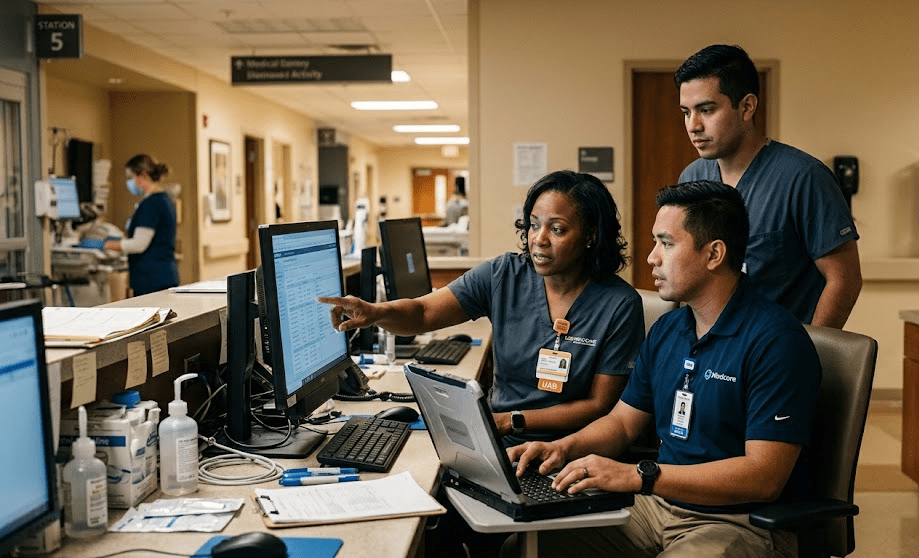
The counterargument is real and worth holding: modern response is largely remote, and the best telemetry and containment happen over the network, not in your server room. Many incidents are fully handled without anyone driving anywhere. We agree that remote-first response is the norm and often the fastest path. The nuance is that healthcare environments carry physical realities, isolated imaging systems, on-prem EHR servers, networked medical devices, where someone local can image a drive, pull a cable, or stand beside your staff during a crisis. The right answer is not “local or remote.” It is a partner with strong remote capability and a credible Alabama-area presence for the cases that need hands on hardware. Mindcore provides emergency cybersecurity and incident response built around exactly that blend.
How to Vet a Cybersecurity Company Before You Sign
You vet a cybersecurity company by testing it against the same standard an auditor or attacker will: can it prove protection, not just promise it. Treat the sales process as your first audit of the vendor. The strongest firms welcome hard questions because the answers are how they win.
The Vetting Questions That Reveal a Serious Partner
The questions that reveal a serious partner are the ones a weak vendor cannot answer cleanly. Ask each one and listen for specifics rather than reassurance.
- Will you sign a Business Associate Agreement, and can I see your standard BAA today? A BAA is the contract that makes a vendor legally accountable for the protected health information they touch. A serious firm has one ready.
- Is your Security Operations Center staffed 24/7, and where? Healthcare attacks cluster at night and on weekends. Business-hours monitoring leaves your worst-case window uncovered.
- Can you share healthcare references in Alabama or the Southeast? A firm that has defended clinics and hospitals understands clinical workflow constraints that generic IT shops miss.
- How do you support an OCR audit or attestation? The answer should include who produces evidence, how fast, and in what format.
- What is your response time to a confirmed incident, and what is local versus remote? Get the number in writing, then map it to your facilities.
If a vendor deflects on the BAA or cannot describe its audit support, stop there. Those are the two failures we see most often when a provider organization gets burned.
Matching the Partner to Your Organization Size
Matching the partner to your organization size keeps you from overpaying or underprotecting. A solo practice in Auburn and a regional health system in Birmingham need different engagement models, and the best firms scope to fit rather than forcing one tier on everyone.
A small clinic usually needs managed detection, endpoint protection, email security, and documented policies it can actually maintain. A larger organization needs all of that plus network segmentation for medical devices, identity governance, and a tested incident-response plan. Some argue that small practices can rely on built-in cloud security and skip a dedicated partner. There is truth in that for the lowest-risk setups, since platform defaults have improved. Yet the moment you store or transmit electronic protected health information, you inherit the full HIPAA obligation regardless of size, and “the cloud handles it” is not a defense an auditor accepts. Our healthcare-focused secure workspace solutions are built to scale across both ends of that spectrum, and our compliance services keep the documentation current as you grow.
Reading Past the Rankings
Reading past the rankings means treating a “top company” list as a starting point, not a decision. The firms that appear on aggregator lists earned visibility, which is not the same as fit for an Alabama Cybersecurity covered entity. Your shortlist should come from the vetting questions above, not from search position.
The opposing view deserves a fair hearing: rankings and directories do filter out fly-by-night operators, and a firm with strong third-party recognition has cleared some bar. We do not dismiss that signal. The limit is that those lists optimize for general reputation, while your decision hinges on HIPAA fluency, Alabama breach-law familiarity, response proximity, and BAA willingness, none of which a ranking measures. Use the list to find candidates, then apply your own scorecard. The right partner is the one that answers your specific questions well, whether or not it topped someone else’s chart. You can weigh Mindcore’s cybersecurity services against that same scorecard.
Frequently Asked Questions
What makes a cybersecurity company a good fit for Alabama healthcare organizations?
A good fit pairs deep HIPAA Security Rule expertise with knowledge of the Alabama Data Breach Notification Act and a credible local response capability. The firm should sign a Business Associate Agreement, run 24/7 monitoring, and produce audit-ready documentation. Fit is proven through specific answers, not rankings.
Does HIPAA replace Alabama’s state breach notification law?
No. HIPAA and the Alabama Data Breach Notification Act of 2018 both apply, and you must satisfy both. Alabama generally requires notice to affected residents within 45 days and notice to the Attorney General when more than 1,000 residents are affected, which is an obligation HIPAA does not impose on its own.
How fast should a security partner respond to a healthcare ransomware incident?
A serious partner commits to a written response-time target and distinguishes remote containment from on-site support. Remote response often begins within the hour, while physical actions at your Birmingham, Huntsville, or Mobile facility depend on local presence. Get both numbers before you sign.
Why does a Business Associate Agreement matter so much?
A Business Associate Agreement is the contract that legally binds a vendor to protect the electronic protected health information it handles. Without a signed BAA, you have no enforceable assurance and you may be out of compliance the moment the vendor touches patient data. Any hesitation to sign one is a warning sign.
Can a small Alabama clinic skip a dedicated cybersecurity company?
Once a clinic stores or transmits electronic protected health information, it carries the full HIPAA obligation regardless of size. Built-in cloud defaults help, but they do not produce the risk analysis, policies, and documented safeguards an audit requires. Most clinics need at least managed detection plus compliance documentation.
Talk to a Team That Knows Alabama Healthcare Security
Choosing a security partner is one of the most consequential decisions an Alabama healthcare organization makes, and it deserves more rigor than copying a ranking. The right firm protects patient data, keeps you defensible under both HIPAA and Alabama’s 45-day breach-notification law, and stands with you when an incident hits. Use the five principles and the vetting questions in this guide as your scorecard, ask every candidate the hard questions, and weigh the answers against your own facilities in Birmingham, Huntsville, Mobile, and everywhere in between. You are the one accountable for the outcome, and the best partner is the one that makes your job defensible rather than just easier. Mindcore works as the guide alongside healthcare teams across Alabama and the Southeast, bringing HIPAA depth, state-law fluency, 24/7 monitoring, and real incident-response capability to the table. If you want a clear read on where you stand and what to fix first, book a free strategy call and we will walk your situation with you.
Alabama Healthcare Cybersecurity and HIPAA Compliance Expertise from Matt Rosenthal
Matt Rosenthal, CEO of Mindcore Technologies, has over 30 years of experience helping Alabama healthcare organizations select cybersecurity partners who understand both the federal HIPAA Security Rule and the Alabama Data Breach Notification Act’s 45-day notification clock, rather than vendors who treat HIPAA fluency as sufficient and leave their clients exposed on the state law side when a breach forces the question. He has seen firsthand how clinics and hospitals across Birmingham, Huntsville, and Mobile sign with national vendors who run strong remote Security Operations Centers but have no credible local presence when ransomware encrypts an on-prem EHR server and someone needs to stand beside the staff during recovery. Matt leads a team that signs Business Associate Agreements without hesitation, maintains 24/7 monitoring aligned to the hours attackers actually exploit, produces the risk analyses and audit logs that OCR and state regulators grade on, and provides emergency incident response with both remote capability and Alabama-area presence for the cases that need hands on hardware.

