

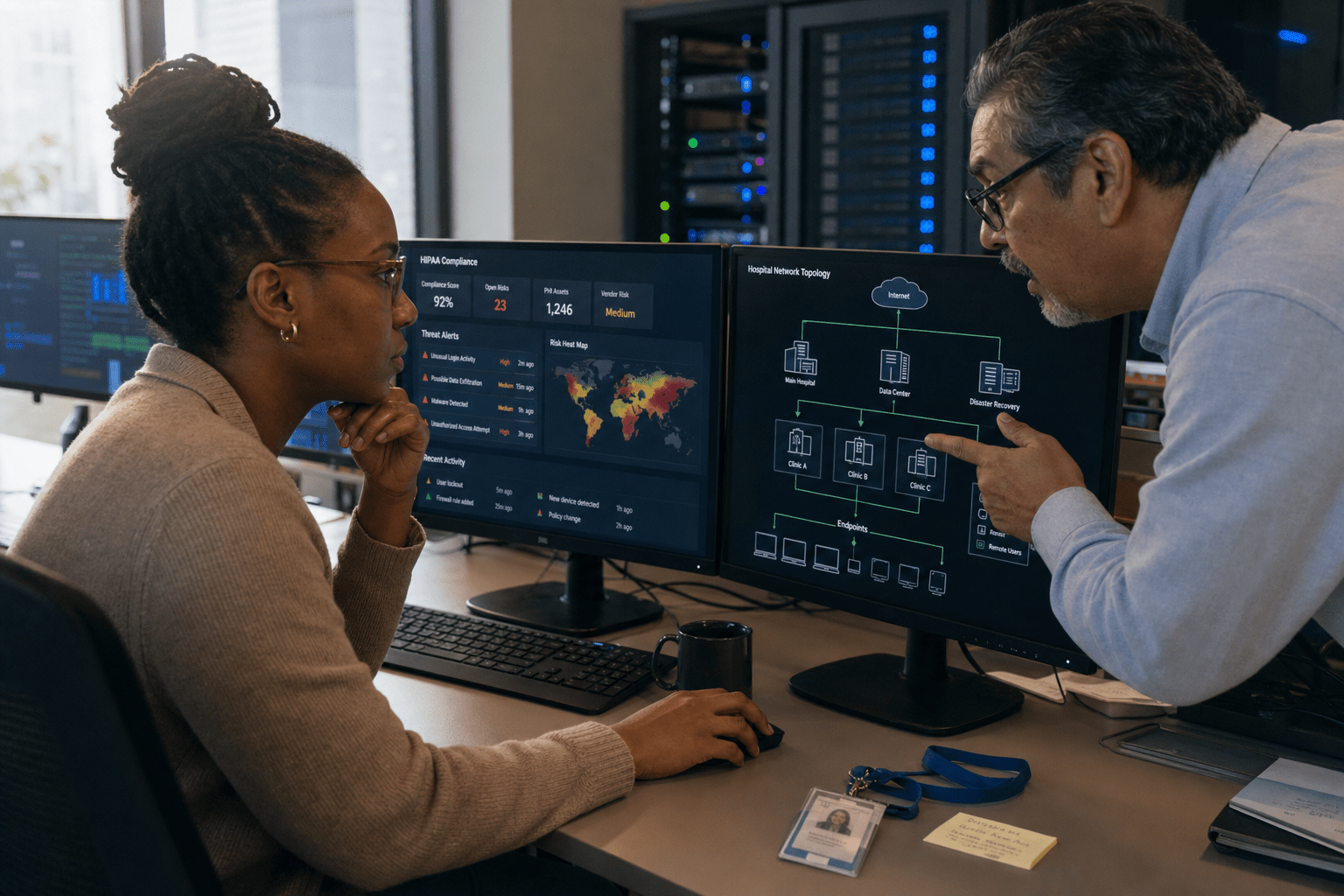
The best providers for SMB Cybersecurity in Mississippi deliver 24/7 remote monitoring and managed detection, rather than just handing small teams tools they cannot operate. Most national vendor lists rank firms by brand size and product breadth. That ranking ignores how care is actually delivered across this state: rural hospitals, critical access facilities, and independent clinics that run lean, often with one IT generalist or none at all. We work with provider organizations in exactly that position, and the partner that protects them is the one whose coverage holds at 2 a.m. when no one is on site. This guide gives you the criteria to evaluate any provider against that bar, the same criteria behind our healthcare provider evaluations in other states.
What Mississippi Healthcare Organizations Should Look For in a Cybersecurity Partner
Choosing a cybersecurity partner in Mississippi starts with five principles that separate a genuine managed security provider from a reseller of disconnected tools.
- Coverage runs around the clock. Attackers favor nights, weekends, and holidays when clinic staff are gone. A partner that only watches during business hours leaves you exposed for two thirds of every week.
- Detection is managed, not just installed. Buying an endpoint product is not security. Someone has to read the alerts, separate noise from a real intrusion, and act. That work cannot fall on a single overworked IT person.
- The model fits a thin budget. Mississippi providers operate on tighter margins than the academic medical centers most vendor lists are built for. A flat, predictable managed fee beats a six-figure tool purchase you cannot fully deploy.
- Compliance covers both layers. Federal HIPAA rules and Mississippi’s own breach-notification statute both apply. Your partner has to document safeguards for the first and prepare you for the second.
- Response is grounded in Mississippi operations. Remote coverage is fine for monitoring, but you want a partner who understands how care is delivered here and can escalate fast when something goes wrong.
These principles drive every section below. Hold any vendor you are evaluating against them.
Why National Vendor Rankings Fail Mississippi Providers
National “top cybersecurity companies” lists fail Mississippi healthcare providers because they rank firms for enterprise buyers with in-house security teams, not for clinics running on one IT generalist. When you read a list of the best cybersecurity companies for healthcare organizations, notice what the top entries assume. They assume you have staff to operate a security information and event management platform. They assume a procurement cycle measured in quarters. They assume someone on payroll whose only job is watching dashboards. A 40-bed hospital in the Delta or a three-physician practice in Hattiesburg has none of that.
We see the consequence in the field constantly. A clinic buys a respected endpoint detection product because a list recommended it, then the license sits half-configured because the office manager who “handles IT” also handles billing, scheduling, and the front desk. The tool generates alerts that no one reads. When ransomware lands, the detection that was supposed to catch it was technically present and functionally absent. The gap is not the product. The gap is operational capacity, and that is the exact gap the right partner closes. Our cybersecurity services are built to run the tools, not just sell them.
How Limited On-Site IT Staff Changes the Decision
Effective SMB Cybersecurity in Mississippi ensures the provider absorbs the operational load for organizations with minimal or no on-site IT staff. Some argue a healthcare org should hire and build security in house for full control. That holds for a large system with the headcount to staff a 24/7 security operations function. It does not hold for the typical Mississippi provider, where a single hire cannot cover nights, weekends, vacations, and sick days, and where one resignation erases your entire security program overnight.
The opposite view says outsource everything and stop thinking about it. That overcorrects. Even with a managed partner, your team still owns access decisions, staff training, and incident reporting. The realistic middle is a partner who runs the technical operation continuously while your people stay accountable for governance. We have seen both extremes fail and the blended model hold, which is why we structure engagements so the heavy, always-on work sits with us and the policy ownership stays with you.
Why Thin Budgets Point to a Managed Model
For SMB Cybersecurity in Mississippi, managed monthly models provide predictable costs and full utilization, making them ideal for lean provider budgets. The case for buying tools outright is capital control: you own the license and avoid a recurring bill. The case against it is the one we watch play out, where an unused or misconfigured tool is pure sunk cost, and the breach it failed to stop costs far more than the software ever did.
A managed subscription spreads cost evenly and, more importantly, includes the people who make the tools work. The honest tension is that a monthly fee never ends, and some leaders resist that. Both concerns are real. The deciding factor is utilization. A purchased tool nobody runs protects nothing, while a managed service is operating on your behalf every hour you pay for it. For a lean provider, that difference usually settles the question.
Why Around-the-Clock Coverage Is Non-Negotiable
Around-the-clock coverage is non-negotiable for Mississippi healthcare organizations because intrusions are timed for the hours your clinic is empty and your lone IT person is asleep. The federal government is direct about this risk. The Cybersecurity and Infrastructure Security Agency lists continuous monitoring and rapid response among its core cybersecurity best practices for exactly this reason.
One could argue that a small clinic is too minor a target to warrant 24/7 watch. Attack patterns say the opposite. Smaller healthcare providers are targeted precisely because they are under-defended and hold the same valuable patient records as a large system. The counterweight is cost, since continuous coverage sounds expensive to staff. That is true if you try to hire it, and it is the strongest argument for a managed partner, who spreads a single 24/7 operation across many clients so each one gets always-on coverage at a fraction of the standalone cost.
How HIPAA and Mississippi Law Shape the Cybersecurity Requirement
A strong SMB Cybersecurity in Mississippi program ensures compliance with both HIPAA and Mississippi state breach-notification requirements simultaneously. The federal HIPAA Security Rule requires documented administrative, physical, security training. and technical safeguards for every system that touches electronic protected health information, as the U.S. Department of Health and Human Services Security Rule guidance sets out. The right partner maintains that evidence continuously, not the night before an audit.
State law adds a second layer. Mississippi’s breach-notification statute requires that organizations notify affected residents when their personal information is exposed in a security breach. That sits alongside the federal HIPAA Breach Notification Rule, which carries its own notification timelines and thresholds. A single breach can trigger both obligations at once. A capable partner builds the logging and incident documentation that lets you meet both clocks instead of scrambling after the fact. Our cybersecurity compliance work is designed to keep that evidence audit-ready year round.
How a Partner Keeps HIPAA Evidence Audit-Ready
A cybersecurity partner keeps your HIPAA evidence audit-ready by maintaining living documentation of safeguards and refreshing it after every infrastructure change, rather than reconstructing it under audit pressure. The documentation-first view is that the HIPAA Security Rule is explicitly evidence-based, and NIST’s SP 800-66 Revision 2 maps the rule to concrete, documentable controls. Skeptics counter that constant documentation is overhead a small clinic cannot spare.
Both points have merit, and the resolution is automation plus delegation. Much of the evidence, access logs, configuration baselines, and monitoring records, can be generated automatically by the security tooling a managed partner already runs. Your staff is not hand-writing reports; the system produces them and the partner curates them. That keeps the burden off your team while the evidence stays current, which is the only state in which it is useful when an auditor or an investigator actually arrives.
How State Breach-Notification Duties Affect Response Planning
Mississippi’s breach-notification duty shapes your incident response plan by forcing a documented, time-bound notification process you must execute the moment a breach is confirmed. One school of thought treats notification as a legal task to hand to counsel after the technical cleanup. The problem is that the notification clock starts at discovery, so a slow forensic response can put you out of compliance before the lawyers are even looped in.
The other view bakes notification readiness into the security operation itself, so the data needed to assess scope and notify is captured as the incident unfolds. That is the stronger position for a lean provider with no dedicated legal or security staff. When your partner’s monitoring already records what was accessed and when, you can determine notification obligations quickly and meet the statutory window. Pairing that with an emergency cybersecurity response capability means the technical containment and the compliance clock are handled in parallel, not one after the other.
How Managed Detection and Response Protects Patient Care
For SMB Cybersecurity in Mississippi, managed detection, network security, and response places trained analysts and continuous monitoring between attackers and critical systems, containing threats before they disrupt operations. Managed detection and response, or MDR, is a service where a security team watches your environment around the clock, investigates alerts, and acts on confirmed threats, rather than leaving raw alerts for your staff to triage. For a provider where downtime means cancelled appointments and inaccessible charts, that containment speed is the difference between an incident and a crisis.
The tools alone do not deliver this. An endpoint platform can flag suspicious behavior, but flagging is not stopping. MDR adds the human judgment to confirm a real intrusion, isolate the affected machine, and shut the door before lateral movement reaches your records system. We build this into engagements with healthcare clients because the alternative, a secure healthcare workspace with detection that nobody is actively running, is the failure mode we are hired to fix.
Why Detection Without Response Falls Short
Detection without response falls short because an alert that no one acts on is the same as no alert at all, and small Mississippi providers rarely have anyone positioned to act in time. The argument for detection-only tooling is cost, since alerting software is cheaper than a full managed service. The argument against it is the operational reality already described, where a clinic’s lone IT generalist cannot watch a console overnight.
Holding both sides honestly, detection-only can work for an organization with a staffed security team to receive and action the alerts. Almost no independent Mississippi clinic or rural hospital meets that condition. For them, the response half is not a luxury layered on top of detection; it is the part that makes detection mean anything. A partner that monitors but does not respond has handed you a smoke alarm with no fire department attached.
Frequently Asked Questions
What makes a cybersecurity company a good fit for a Mississippi healthcare organization?
A good fit is a partner that delivers 24/7 managed detection and response, fits a lean budget with a predictable monthly model, and documents both HIPAA and Mississippi breach-notification compliance. Mississippi providers often run with little on-site IT staff, so the partner has to absorb the operational work rather than hand you tools to run. Evaluate every candidate against those criteria before brand reputation.
Do small clinics and rural hospitals in Mississippi really need 24/7 monitoring?
Yes, because attacks are deliberately timed for nights, weekends, and holidays when no one is on site, and smaller providers are targeted precisely because they tend to be under-defended. A breach at a small clinic exposes the same protected patient records as one at a large hospital. Continuous monitoring through a managed partner gives a lean organization always-on coverage without hiring a round-the-clock team.
How does Mississippi law change the cybersecurity requirements beyond HIPAA?
Mississippi’s breach-notification statute requires notifying affected residents when their personal information is exposed, which sits alongside the federal HIPAA Breach Notification Rule. A breach can trigger both obligations at once, each with its own timeline. Your cybersecurity partner should maintain the logging and incident documentation needed to meet both clocks without a last-minute scramble.
What is managed detection and response, and why does it matter for healthcare?
Managed detection and response is a service where a security team monitors your environment around the clock, investigates alerts, and acts on confirmed threats so they are contained early. It matters for healthcare because downtime means cancelled appointments and inaccessible patient records. MDR supplies the human response that endpoint tools alone cannot, stopping an intrusion before it reaches clinical systems.
Is a managed security service affordable for a small Mississippi provider?
A managed monthly model is usually more affordable in practice than buying tools outright, because the fee is predictable and includes the people who operate the technology. An unused or misconfigured tool is sunk cost, while a managed service works on your behalf every hour you pay for it. For a provider on a thin budget, full utilization is what makes the spend worthwhile.
Talk to a Cybersecurity Partner Built for Mississippi Healthcare
The right cybersecurity partner for a Mississippi healthcare organization is judged by one practical test: does the protection hold when your clinic is closed and no one is watching the screen? National rankings cannot answer that, because they are built for organizations with security staff you do not have. The criteria that matter here are around-the-clock managed detection and response, a budget model that fits a lean operation, and compliance documentation that covers HIPAA and Mississippi’s breach-notification duty together. A partner who meets all three runs the tools for you, keeps your evidence audit-ready, and stands between an attacker and the patient records your community depends on. That is the standard we hold ourselves to with every healthcare client we serve in this state, and it is the standard you should hold any provider to before you sign. If you want a clear read on where your defenses stand today, book a free strategy call with our team and we will walk through it with you.
Mississippi Healthcare Cybersecurity and Managed Detection Expertise from Matt Rosenthal
Matt Rosenthal, CEO of Mindcore Technologies, has over 30 years of experience helping Mississippi rural hospitals, critical access facilities, and independent clinics find cybersecurity partners who absorb the operational load entirely rather than selling detection tooling to organizations with no one available to run it. He has seen firsthand how a respected endpoint product sits half-configured at a Mississippi clinic because the office manager handling IT also handles billing and the front desk, generating alerts nobody reads until ransomware lands and the detection that was supposed to catch it proves functionally absent. Matt leads a team that delivers 24/7 managed detection and response at a predictable monthly cost sized for lean provider budgets, maintains living HIPAA documentation and Mississippi breach-notification readiness year round, and positions the human response layer between an attacker and clinical systems so a confirmed intrusion is contained before it reaches scheduling or patient records.

