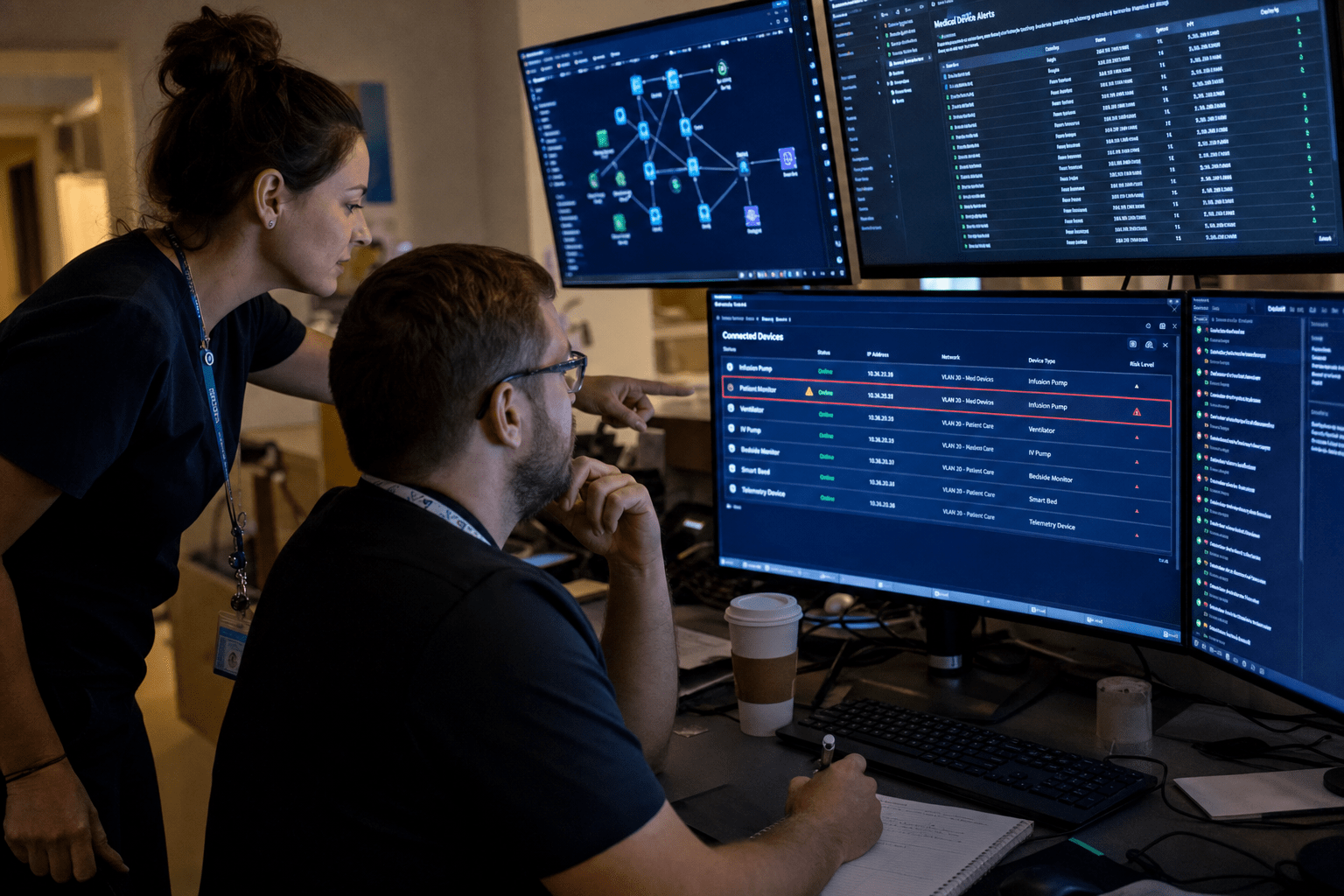
The best providers specializing in cybersecurity for healthcare companies are the ones that can see and protect connected medical and IoT devices, not just the data center and the laptops. One of the most critical areas for cybersecurity for healthcare companies is managing the thousands of devices that cannot be patched or rebooted like an ordinary computer, from infusion pumps to imaging systems, each one a potential entry point onto a network holding protected health information. A hospital, clinic, or provider network seeking cybersecurity for healthcare companies needs a partner whose strength is device-level visibility, network segmentation, and rapid response, not perimeter tools alone. This guide lays out the criteria that separate a healthcare-ready security provider from a generalist, so your organization can choose with the right questions in hand.
The 5 Criteria That Define Healthcare-Grade Security
Here is what to weigh when evaluating a cybersecurity company for a healthcare organization, drawn from where real breaches in the sector begin.
- Connected device visibility. The provider must discover and monitor medical and IoT devices that standard endpoint tools never see.
- Network segmentation. Isolating clinical devices from the main network limits how far an attacker or failure can spread.
- ePHI protection. Encryption, access control, and monitoring must center on the patient data HIPAA governs.
- Rapid incident response. A rehearsed plan matters because downtime in healthcare can affect patient care, not just revenue.
- Compliance alignment. Security has to map to the HIPAA Security Rule and produce the evidence an auditor expects.
Why Healthcare Security Is a Different Discipline
Healthcare organizations cannot rely on the security playbook that protects a typical office, because the most vulnerable systems in a hospital are the ones keeping patients alive and the ones that cannot be taken offline to patch. A generalist security vendor strong on firewalls and email filtering may have no way to even see an infusion pump or an imaging workstation, let alone protect it. We have reviewed healthcare environments where the security tools covered every laptop and server yet were blind to hundreds of connected clinical devices, which is precisely where attackers look first.
The stakes are higher than data loss. The HHS HIPAA Security Rule requires safeguards across every system touching ePHI, and the CISA advisories on active threats repeatedly flag healthcare as a top ransomware target because downtime there pressures organizations to pay fast. A healthcare-grade provider designs for device visibility, segmentation, and rapid recovery, treating the clinical network as a protected zone. Our cybersecurity services and managed IT services approach a provider organization the way the threat actually arrives, through the device nobody was watching, not only through the inbox.
Are Big-Name Security Vendors Always the Safest Choice?
There is a strong case for choosing a large, well-known security vendor for a healthcare organization. Scale brings deep research teams, mature platforms, and threat intelligence drawn from millions of endpoints, and a recognized name can reassure a board and an insurer. For a large hospital system, that depth has real value.
The counterargument is that big platforms are not automatically tuned for a specific organization’s clinical environment, and a smaller or specialized provider may deliver closer attention and faster response. A large vendor can also leave a mid-sized provider organization as a low-priority account. Neither answer is universal. A major health system may need the depth of a large platform, while a regional clinic often gets better protection from a provider that knows its environment intimately. The right choice depends on size, complexity, and how much hands-on partnership the organization needs.
Can One Provider Cover Both IT Security and Medical Devices?
It is reasonable to ask whether a single provider can secure both traditional IT and specialized medical devices, since the two require different expertise. Some organizations prefer a dedicated medical-device security specialist alongside their general security vendor, and that split can deliver real depth on the clinical side. Specialization has genuine merit.
The opposite case is equally valid. Splitting responsibility across vendors creates gaps at the seams, where each assumes the other is watching, and an attacker exploits exactly those handoffs. A single provider with both competencies sees the whole environment and closes those gaps. We have watched incidents slip through the space between two vendors. The honest read is that either model can work, but whichever is chosen, someone must own the full picture, because an unwatched seam is where many healthcare breaches begin.
Should Healthcare Security Spending Match Other Industries?
A healthcare organization watching costs may reasonably question whether it needs to spend more on security than a comparable business in another sector. Budgets are finite, and money spent on security is money not spent on care or staff, so scrutiny is fair. No organization should overspend on tools it cannot use.
The counterweight is that healthcare faces both higher threat levels and steeper penalties than most industries, which changes the calculation. A breach in healthcare carries HIPAA penalties, patient-safety risk, and ransomware exposure that a typical retailer does not face, so matching another sector’s spend can leave a provider organization underprotected. The defensible approach sizes security to healthcare’s actual risk rather than to a generic benchmark. The right level reflects the data and devices the organization holds, not what a different industry happens to spend.

How to Evaluate Healthcare Cybersecurity Providers
A disciplined evaluation protects a healthcare organization more than any product demo. Start by asking each candidate how it discovers and protects connected medical and IoT devices, and listen for whether the answer goes beyond traditional endpoints. A healthcare-ready provider will describe device discovery, clinical-network segmentation, and how it monitors systems that cannot be patched on demand. A generalist tends to describe a strong but device-blind toolset built for an office.
Then verify the program against the standards that govern healthcare. Confirm the provider maps its controls to the HIPAA Security Rule and can produce evidence for an audit, and review how it would handle a ransomware incident that threatens patient care. Ask for healthcare references, confirm round-the-clock monitoring, and review the emergency cybersecurity and compliance support available when an incident hits. Comparing candidates against how a provider built for healthcare environments operates gives useful context for what mature protection looks like.
Test Connected-Device Coverage First
Device coverage is where most healthcare security programs fall short, so test it before anything else. Ask the provider to explain how it would inventory and monitor the medical and IoT devices on your network, and whether it can detect a compromised device that cannot run a security agent. A provider that can only secure laptops and servers leaves the part of the environment attackers target most.
Confirm Segmentation of the Clinical Network
Ask each candidate how it would separate clinical devices from the general network, because a flat network lets a phishing breach reach an imaging system. A capable provider treats segmentation as foundational, not as an add-on. Segmentation limits the blast radius of any incident, which matters most where a compromised device could affect both data and patient care.
Verify Incident Response Tied to Patient Safety
Ask the provider to walk through a ransomware response in a setting where downtime affects care, not just revenue. A healthcare-ready provider describes a rehearsed plan with recovery priorities that put clinical systems first. Incident readiness in healthcare is measured against patient impact, and a provider that frames it only in financial terms has not understood the environment.
Frequently Asked Questions
What makes the best cybersecurity companies for healthcare organizations different?
The best providers can see and protect connected medical and IoT devices, not just laptops and servers, because that is where healthcare breaches most often begin. They design for clinical-network segmentation, ePHI protection, and incident response tied to patient safety. That device-level capability, mapped to the HIPAA Security Rule, separates a healthcare-ready provider from a strong generalist.
Do healthcare organizations need security beyond HIPAA compliance?
Yes. HIPAA compliance is the baseline, but it does not by itself stop a ransomware attack or secure an unpatchable medical device. Real protection requires device visibility, segmentation, monitoring, and rehearsed response on top of compliance documentation. Treating HIPAA as the finish line rather than the starting point leaves an organization both exposed and, after a breach, still liable.
Should a healthcare organization use one security provider or several?
Either model can work, but someone must own the full picture. A single provider covering both IT and medical-device security closes the gaps that form between separate vendors, while a specialized split can add depth if responsibilities are clearly assigned. The danger is an unwatched seam between vendors, which is where many healthcare breaches slip through.
How much should healthcare organizations spend on cybersecurity?
Investment in cybersecurity for healthcare companies should reflect healthcare’s actual risk, which is higher than most industries because of ransomware exposure, HIPAA penalties, and patient-safety stakes. Matching a generic cross-industry benchmark often leaves a provider organization underprotected. The right level depends on the data and connected devices the organization holds, not on what a different sector happens to spend.
What is the biggest cybersecurity gap in healthcare?
The biggest gap is usually connected medical and IoT devices that standard security tools cannot see or patch, leaving them as open entry points onto networks holding ePHI. Many organizations secure every computer yet remain blind to hundreds of clinical devices. Closing that visibility gap is often the single highest-impact step a healthcare organization can take.
Talk to a Healthcare Cybersecurity Partner
When selecting cybersecurity for healthcare companies, the key is whether the provider can see and protect the connected devices attackers actually target, not whether it has the longest list of perimeter tools. The organizations that avoid the worst breaches are the ones that screened for device visibility, clinical-network segmentation, and patient-safety-aware response first, and treated standard endpoint protection as the baseline rather than the goal. Use the criteria here to build a shortlist, test device coverage before anything else, and confirm an incident plan that puts clinical systems first. If your organization wants a partner that secures the whole environment, devices included, our security team can show you how that works. Book a free strategy call with Mindcore and we will review your current posture against the threats healthcare actually faces.
Healthcare Cybersecurity and Connected Medical Device Security Expertise from Matt Rosenthal
Matt Rosenthal, CEO of Mindcore Technologies, has over 30 years of experience helping hospitals, clinics, and provider networks build cybersecurity programs that extend protection to the connected medical and IoT devices attackers target first, not just the laptops and servers that standard security tools already cover. He has seen firsthand how healthcare environments pass perimeter security reviews while remaining blind to hundreds of infusion pumps, imaging workstations, and clinical devices that cannot run an agent or be patched on demand. Matt leads a team that treats device discovery and clinical network segmentation as foundational requirements rather than advanced features, maps every control to the HIPAA Security Rule, and rehearses ransomware response plans with patient safety priorities front and center so downtime decisions are made from a practiced playbook rather than an improvised reaction.