

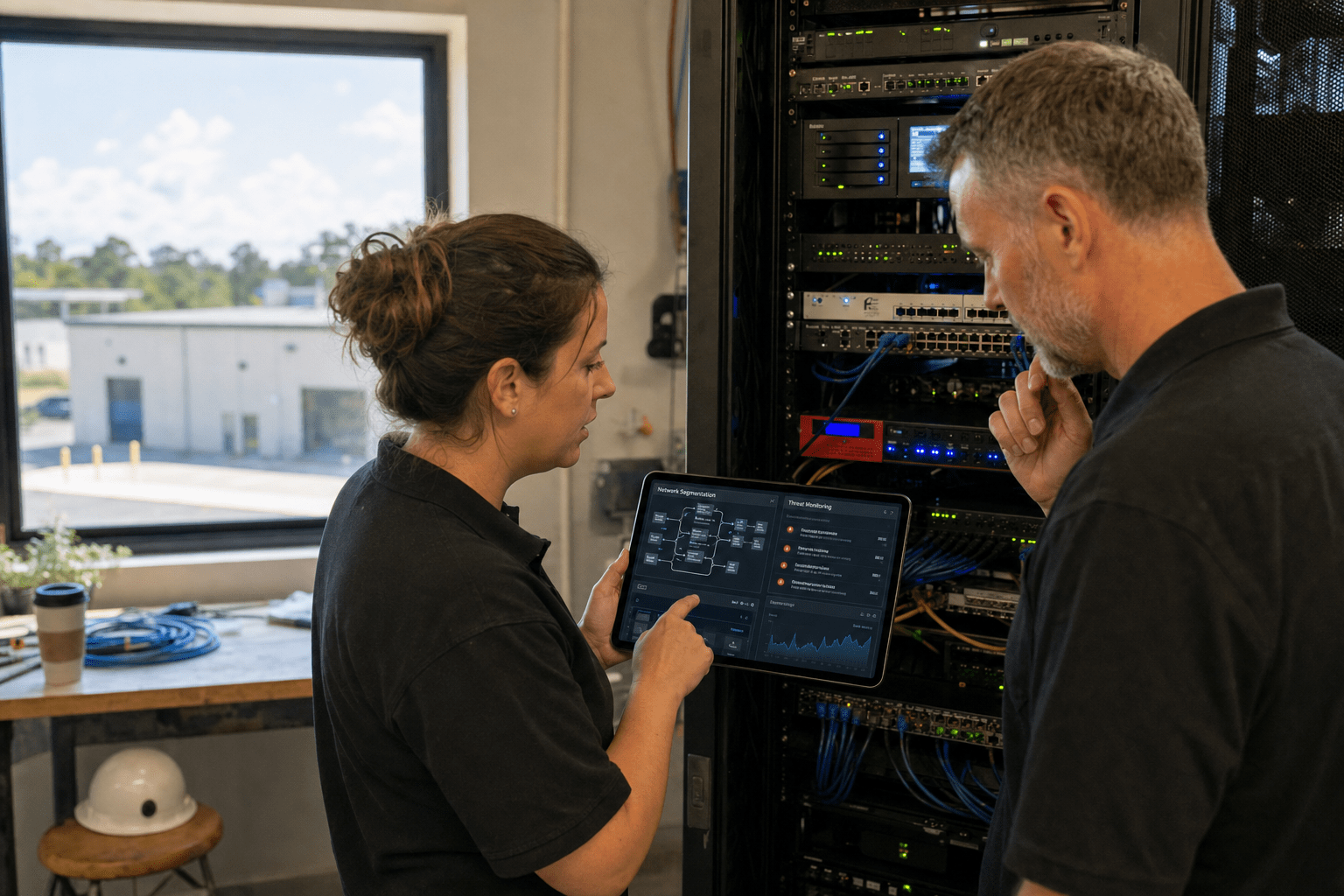
Buying network security in South Carolina comes down to four controls that have to work together: a managed firewall, staffed monitoring, network segmentation, and a response plan you have actually tested. Small and midsize firms here tend to buy the visible piece, usually the firewall, and leave the rest thin. We have run these programs for South Carolina businesses for years, and that gap is the pattern. Network Security South Carolina must account for the state’s breach history and data-security requirements, which national security checklists often overlook. Both belong in your decision before price does.
The 5 Factors That Shape Your Network Security Budget
Network Security South Carolina works best when spending aligns with actual business exposure rather than a vendor’s predefined product tier. These five factors are what we walk each SMB owner through before any quote gets signed.
- Coverage hours. An attacker at 3 a.m. gets the same automated tools as one at noon. Monitoring that stops after business hours leaves your quietest hours undefended.
- Alert ownership. Tools generate alerts, but someone has to read and act on them. Unread alerts are the same as no alerts.
- Segmentation. A flat network lets one infected machine reach payroll, customer data, and backups. Zones contain the damage.
- The human layer. Most breaches begin with a click. Staff training is a control, not an add-on.
- State context. South Carolina’s breach history and its data-security law shape both your risk and your obligations.
Why Network Security in South Carolina Starts With Layers, Not a Box
Network Security South Carolina fails most often when a business relies on a single firewall instead of building a layered security program. A firewall filters traffic at the network edge, and it does real work against automated attacks, but the threats that cause the worst damage rarely announce themselves there. The federal CISA advisories track a clear shift toward stolen credentials and vendor-connection attacks that walk straight past a perimeter device. Across our South Carolina clients, the incidents that hurt start in a mailbox or with a reused password, not at the router.
That does not mean the firewall is optional. For a small office, a well-configured next-generation firewall blocks a large volume of noise, and running without one would be careless. The realistic view is that the firewall is your foundation, not your building. A buyer who stops at the edge device has purchased one layer and mistaken it for a system, and that mismatch is where the exposure lives.
How Staffed Monitoring Earns Its Cost
Staffed monitoring is what makes a set of security tools into a working defense, because it puts a person on the alerts every hour of the day. A sensor can flag odd traffic, but a human has to judge whether it is a false alarm or the opening move of a breach. Our network security monitoring is built on that split: detection is inexpensive, and the trained response is the part worth paying for.
The counterpoint deserves weight. A three-person shop with no regulated data may not need a round-the-clock security operations center, and paying for one would be waste. The test we apply with clients is simple: would an hour of downtime or a single leaked customer record genuinely damage the business? When the answer is yes, unwatched overnight hours are the weakest link. When it is honestly no, a lighter monitoring tier makes sense, and we say so rather than push a bigger package.
How Segmentation Contains a Breach
Network Security South Carolina uses segmentation to limit attacker movement and prevent one compromised device from exposing the entire business. Segmentation splits your network into zones so that guest Wi-Fi, production systems, and finance workstations cannot freely reach one another. When one device falls, the problem stays in a single zone instead of spreading across everything you run.
It carries a real trade-off. Segmentation adds complexity, and a clumsy design can break legitimate workflows or leave a small team with a maintenance load it cannot handle. Some firms operate simply enough that heavy segmentation is more trouble than it is worth. For most, a basic divide between trusted internal systems and everything else pays off the first time a phishing click lands. Our network management team designs these zones to contain damage without slowing daily work.
The South Carolina Factors a National Plan Misses
The South Carolina factor in network security is that buyers here carry a real local memory and a real local law. In 2012 the South Carolina Department of Revenue suffered a breach that exposed the tax records of millions of state residents, and it reshaped how organizations across the state think about protecting data. That history means a South Carolina buyer often judges a security proposal against an incident they lived through, not an abstract statistic. It also means the appetite for “good enough” security tends to run lower here than a national vendor expects.
The state was also among the first to adopt a data-security law modeled on the national insurance standard, setting expectations for how businesses protect and respond to breaches of personal information. The South Carolina Department of Consumer Affairs tracks breach reporting for state residents, which puts a concrete obligation behind a security failure. A national provider quoting from out of state rarely prices that duty into their pitch, so the buyer has to weigh it themselves.
How South Carolina’s Industry Mix Changes the Threat
South Carolina’s industry mix changes the threat picture because the Upstate corridor runs on manufacturing, and manufacturers are a favored ransomware target. The region around Greenville and Spartanburg carries automotive plants, suppliers, and the small firms that serve them, and attackers know that a plant losing an hour of production loses real money. That pressure makes manufacturers more likely to pay a ransom, which makes them more likely to be hit.
The other side is fair: a service business or a small retailer in the state faces a different threat than a plant, and copying a manufacturer’s security plan onto a five-person office would waste money. The right move is to map your own operation against the NIST Cybersecurity Framework and build to your real exposure. A firm whose revenue stops when the network stops has a stronger case for redundancy and fast response than one that can run on paper for a day.
How Local Response Time Limits Downtime
Local response time limits downtime because the hours you spend waiting for help are the hours the incident keeps costing you. A national provider with a remote help desk handles routine tickets well enough. When a regional problem hits and every client in the state calls at once, a queue is still a queue, and a plant floor does not wait politely. A partner who knows your setup and your region moves faster and asks fewer questions.
The opposing view has merit. Cloud infrastructure is location-independent, so in theory support can come from anywhere, and some remote teams are excellent. In practice, the fastest recovery we see comes from a team that already understands the environment before the incident starts. That is why our South Carolina clients pair their network security with managed security services from people who know their systems in advance.
How to Choose a Network Security Partner in South Carolina
Choosing a Network Security South Carolina partner means evaluating response speed, transparency, and knowledge of the state’s industries, risks, and regulatory environment. Ask a prospective provider exactly what happens during an incident at 3 a.m. on a holiday, and listen for a specific answer with roles and timelines rather than a slogan about being always on. Ask what their security awareness training covers, because the strongest stack still fails to a convincing phishing email that a trained employee would have caught.
Honesty is the second test. A good partner shows you what they watch, what they do not, and where your gaps sit, in plain language rather than reassurance. The third test is local grounding: a provider who understands the state’s breach history, its data-security law, and the manufacturing weight of the Upstate is defending your real environment. If you want a straight read on where your network stands today, we offer a free strategy call to walk through it with no obligation to buy.
Frequently Asked Questions
How much does network security cost for a South Carolina small business?
Network security cost for a South Carolina SMB depends on your data sensitivity, staff count, and coverage hours, and it usually runs as a monthly managed fee rather than a single purchase. A managed firewall with business-hours monitoring sits at the low end, while 24/7 monitoring, segmentation, and response planning cost more. The right figure matches your actual risk, not the cheapest available tier.
Does South Carolina require businesses to report a data breach?
Yes, South Carolina requires businesses to notify affected state residents when their personal information is exposed, and the state tracks that reporting through its Department of Consumer Affairs. Those obligations are why prevention spending pays for itself. We help clients understand the duties before an incident forces the question.
What is the difference between a firewall and network monitoring?
A firewall filters traffic at your network edge, while network monitoring watches activity inside the network and flags suspicious behavior for a person to investigate. The firewall is preventive and automatic, and monitoring is detective and staffed. You need both, because an attacker who slips past the firewall is only caught by monitoring.
Are South Carolina manufacturers a bigger target for cyberattacks?
South Carolina manufacturers are a frequent ransomware target because production downtime is expensive, which makes a plant more likely to pay to restore operations quickly. That pressure raises the odds of an attack. Manufacturers here benefit from redundancy and a tested response plan more than a lower-stakes business does.
How is network security in South Carolina different from other states?
Network security in South Carolina is shaped by a well-remembered state data breach and one of the country’s earlier data-security laws, both of which raise buyer expectations and add reporting duties. A national checklist misses that context. A local partner folds it into your plan from the start.
Talk to a South Carolina Network Security Team
Network security in South Carolina is not a single product, it is a program you match to how your business runs and to the state you run it in. The firms that get this right start from their real risk, layer staffed monitoring and segmentation on top of the firewall, train their people, and account for the state’s breach history and reporting duties. The ones that struggle buy one box and hope. If you want a clear picture of where your network stands and what to fix first, our team serves businesses across South Carolina and offers a free strategy call to map it out. You leave knowing your gaps and your options, whether or not you ever work with us.

