

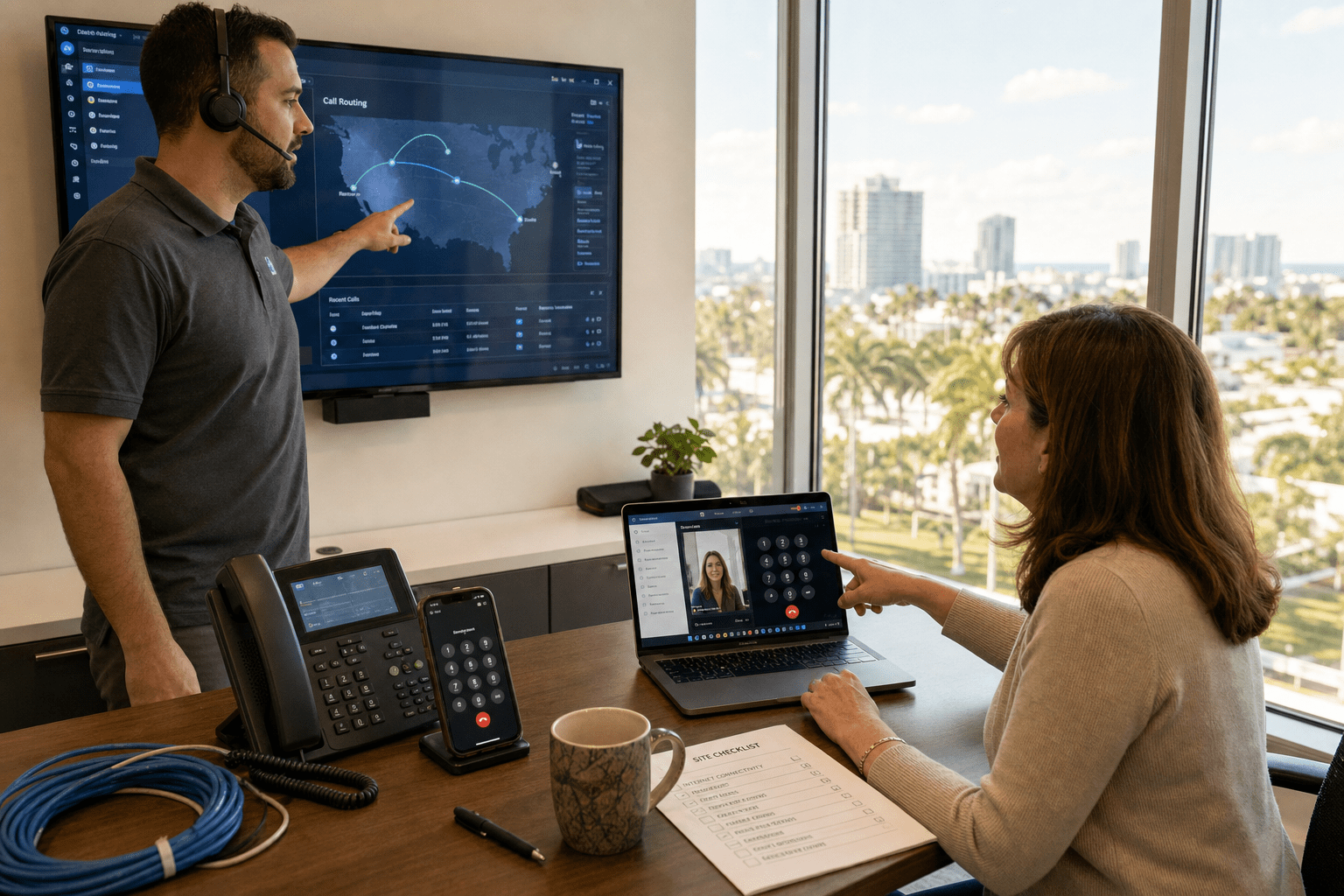
Choosing VoIP and unified communications in Florida is less about picking a phone brand and more about answering four statewide questions before you sign: how calls stay up when a storm takes out a local site, how emergency 911 routes for staff spread across offices and home desks, how you move existing numbers off the old carrier without dead days, and whether your internet at each Florida location can carry clean voice. We have set up business phone systems for companies with sites in Boca Raton, Orlando, Tampa, and Jacksonville, and the pattern holds every time. The businesses that treat this as a statewide resilience decision get a system they trust in June and in September. The ones who treat it as a single-office swap get a bill and a surprise the first time the power goes out.
What to Weigh Before You Buy in Florida
VoIP and unified communications in Florida reward the buyer who looks past the per-seat price and asks how the system behaves across every office and every season. These five points decide whether the move pays off, and each one is easy to check before you commit.
- Failover for storm season. A phone system that lives in one place fails when that place loses power or internet. A Florida buyer needs call routing that survives a knocked-out site.
- E911 across locations. VoIP moves with the device, so 911 has to know where each phone actually is. Multi-office and remote staff make this a real design question, not a checkbox.
- Number porting. Moving your existing numbers off the current carrier takes planning, and rushing it is how businesses lose calls during the switch.
- Internet quality per site. Voice needs low latency and steady bandwidth. Two Florida offices on different carriers can get very different call quality from the same platform.
- One platform or many tools. Unified communications folds calling, video, chat, and voicemail into a single app. The value is real, but only if your team actually consolidates rather than adding another login.
Why VoIP and Unified Communications in Florida Demand a Statewide View
VoIP and unified communications in Florida behave differently than a single-city buy because the state spreads businesses across coasts, carriers, and storm exposure that a one-location plan never accounts for. A company with a front desk in Fairfield and branches in Boca Raton and Orlando is not buying one phone system, it is buying one platform that has to work identically in three internet environments. The call quality, the failover path, and the emergency routing all change per site. That is why we start every Florida phone project by mapping each location’s connection and risk profile before we name a platform, and it is the step most national quotes skip entirely.
Microsoft Teams Phone or Hosted PBX
The first real fork is whether you run calling through Microsoft Teams Phone or a standalone hosted PBX, and the honest answer is that it depends on where your team already lives. If your staff runs its day inside Microsoft 365, adding Microsoft Teams Phone turns the app they already use into the office phone, which cuts training and licensing sprawl. Microsoft’s own cloud voice documentation lays out the calling plans and direct-routing options that make this work. The counterview is fair: a dedicated hosted PBX often gives deeper call-center features, hardware desk-phone support, and carrier flexibility that a Teams-first shop does not need but a high-volume phone team does. Neither is automatically right. A professional-services firm on Microsoft 365 usually lands on Teams Phone, while a business with a heavy inbound call floor often does better on a purpose-built PBX. The point is to pick from your workflow, not from a brochure.
QoS and the Internet at Each Site
Call quality on VoIP comes down to the network under it, and Florida businesses with multiple offices rarely have the same internet at each one. Voice traffic needs low latency, low jitter, and quality-of-service rules that let calls take priority over file downloads and video streams. A site on a strong fiber business internet connection can run dozens of clean lines, while a branch on shared cable can drop audio the moment the network gets busy. The optimistic take is that modern VoIP handles minor congestion gracefully, and for a two-person satellite office that holds. For a busy location it does not, because a saturated uplink garbles calls no matter how good the platform is. We assess each connection and set QoS per site, and where the link is thin we say so before the phones go in rather than after a customer complains. Our team walks through this in more depth in our guide to VoIP and internet compatibility.
Porting Numbers Without Dead Days
Number porting is the step that quietly decides whether your launch is smooth or painful, because moving established numbers between carriers runs on the losing carrier’s timeline, not yours. The FCC’s porting rules protect your right to keep your numbers, but the process still takes coordination, accurate account records, and a firm cutover window. One side says port everything at once for a clean break. The other says stage it office by office so a single hiccup does not silence the whole company. For a small single-site business, one clean port is usually right. For a multi-location Florida operation, we stage ports by site and keep the old lines forwarding until the new ones prove out, so no customer ever hits a dead number during the move.
The Florida Factor: Storm-Season Failover and E911
The Florida factor in VoIP and unified communications is that your phone system has to keep answering when a hurricane closes an office, and that resilience is exactly what a single-region quote leaves out. Cloud-based calling is one of the strongest answers to storm risk, since calls can route to cell phones, home desks, or a sister office when a location goes dark. That only works, though, if the design plans for it on purpose. The federal Ready.gov business guidance is direct that continuity planning has to match the disruptions a region actually faces, and in Florida that means multi-day power and connectivity loss somewhere in the state most years.
Failover That Survives a Knocked-Out Site
Real failover keeps calls flowing when a Florida site loses power or internet, and it is the difference between a phone system and a phone gamble. A well-designed setup reroutes inbound calls automatically to another office, to mobile apps, or to voicemail-to-email the instant a location drops. Storing that routing logic in the cloud rather than in an on-site box is what makes it survive a local outage. Some argue a single well-connected site is enough, and for a business that can simply close during a storm it may be. For anyone who still needs to answer customers while an office is inaccessible, it is not, which is why we pair Florida phone systems with a tested business continuity and disaster recovery plan rather than assuming the platform handles it alone.
E911 for Multi-Office and Remote Staff
E911 is where VoIP earns extra attention, because a phone that moves has to tell emergency services where it physically sits. With a traditional line, the address is fixed. With VoIP, a laptop softphone can dial 911 from a home office two counties away from headquarters, and the FCC’s VoIP 911 rules require the system to route that call to the right local dispatcher with a usable location. The convenience of taking your extension anywhere is exactly what makes this a design task. For a single fixed office it is straightforward. For a Florida business with several sites and remote staff, we register dispatchable locations per device and confirm the routing, so a 911 call from any desk reaches the correct responders instead of a call center in the wrong city.
How to Choose VoIP and Unified Communications in Florida Across Offices
Choosing VoIP and unified communications in Florida across multiple offices comes down to scoring each option against your real map of sites, connections, and risk rather than a generic feature list. Start by inventorying every location, its internet, and its call volume, since that single picture drives platform fit, QoS work, and failover design. From there, decide Teams Phone or hosted PBX based on where your team already works, plan the number ports site by site, and register E911 locations for every device including remote ones. Then weigh the field of carriers and providers: Florida has national platforms, regional carriers, and local integrators, and the right partner is the one who supports every one of your addresses, not just your headquarters. A provider who knows the Florida service area and will stand up storm-season failover as a required line, not an upsell, is worth more here than the lowest per-seat price. That is the buyer’s-guide test: does the plan hold for every office, in every season.
Frequently Asked Questions
How much does business VoIP cost in Florida?
Business VoIP in Florida usually runs on a per-seat monthly price, but the seat cost is only part of the picture. Number porting, quality-of-service work at weaker sites, E911 registration, and storm-season failover all shape the real total. A short assessment of your locations and internet is the only way to get an accurate number for your business rather than a headline rate.
Is Microsoft Teams Phone a good fit for a Florida business?
Microsoft Teams Phone fits well when your team already runs its day inside Microsoft 365, since it turns the app they use into the office phone and reduces training. Businesses with heavy inbound call-center needs sometimes do better on a dedicated hosted PBX with deeper call-handling features. The right choice follows your existing workflow, not the brand name.
How do I keep my phone numbers when I switch VoIP providers?
You keep your numbers through a process called porting, which the FCC protects as your right. The move runs on the current carrier’s timeline and needs accurate account records and a planned cutover window. For a multi-location Florida business, staging ports office by office and forwarding old lines until the new ones prove out keeps any customer from hitting a dead number.
Does VoIP work during a hurricane or power outage?
VoIP can keep working through a hurricane if the system is designed to fail over, because cloud-based calling can route to mobile apps, home desks, or another office when a site loses power or internet. It does not protect you automatically. The routing and continuity plan have to be built and tested in advance, which is the resilience layer a single-region quote tends to skip.
How does 911 work with VoIP across multiple offices?
With VoIP, 911 routes based on a dispatchable location registered for each device rather than a single fixed line. For a business with several offices and remote staff, every device needs its location set so a 911 call reaches the correct local dispatcher. Confirming this routing per site is a required step, since a misregistered softphone can otherwise send help to the wrong address.
Build a Phone System That Holds in Every Florida Office
VoIP and unified communications in Florida reward the business that plans for every site and every season, and it exposes the one that buys a single-office phone swap and hopes. The decisions that matter, Teams Phone or hosted PBX, quality of service at each connection, staged number porting, storm-season failover, and E911 for every device, are all answerable before you sign if you map your locations first. The businesses that get this right can answer a customer in September as easily as in February, from whichever office still has power. The ones who skip it find the gaps at the worst possible moment. If you want a clear read on what the right system looks like for your Florida offices, our team will walk each location, flag the weak links before they bite, and build a plan sized for the state you actually operate in. Book a free strategy call and we will start with the site-by-site assessment that keeps the surprises out.

