

Help desk support for nonprofits gets treated like a smaller version of the corporate version, and that framing quietly sets mission-driven organizations up to overpay for the wrong thing. A nonprofit does not run like a small business with a tighter budget. It runs on rotating volunteers, part-time staff, and a duty to protect donor and beneficiary data, all under a budget where every dollar spent on technology is a dollar not spent on the mission. The help desk that fits that reality is not the cheapest enterprise plan with a discount sticker. It is support built around constant turnover, real data protection, and pricing that respects where your money needs to go. This guide walks a nonprofit through what to actually look for, so support strengthens the mission instead of taxing it.
What Help Desk Support Means for a Nonprofit
Help desk support for nonprofits should give staff and volunteers one reliable place to turn when technology gets in the way of the work, and resolve most of what goes wrong quickly enough that nobody loses an afternoon to a login problem. That covers the everyday friction, password resets, email issues, a document nobody can open, a device that will not connect, plus the awareness to catch when a routine ticket is actually a security concern. For a nonprofit the stakes are specific: staff time is scarce, volunteers are not IT experts, and the data at risk includes donor records. Our help desk and IT support work is built around resolving issues fast and simply, because a nonprofit team should be serving its mission, not managing its technology.
Support Built for Constant Turnover
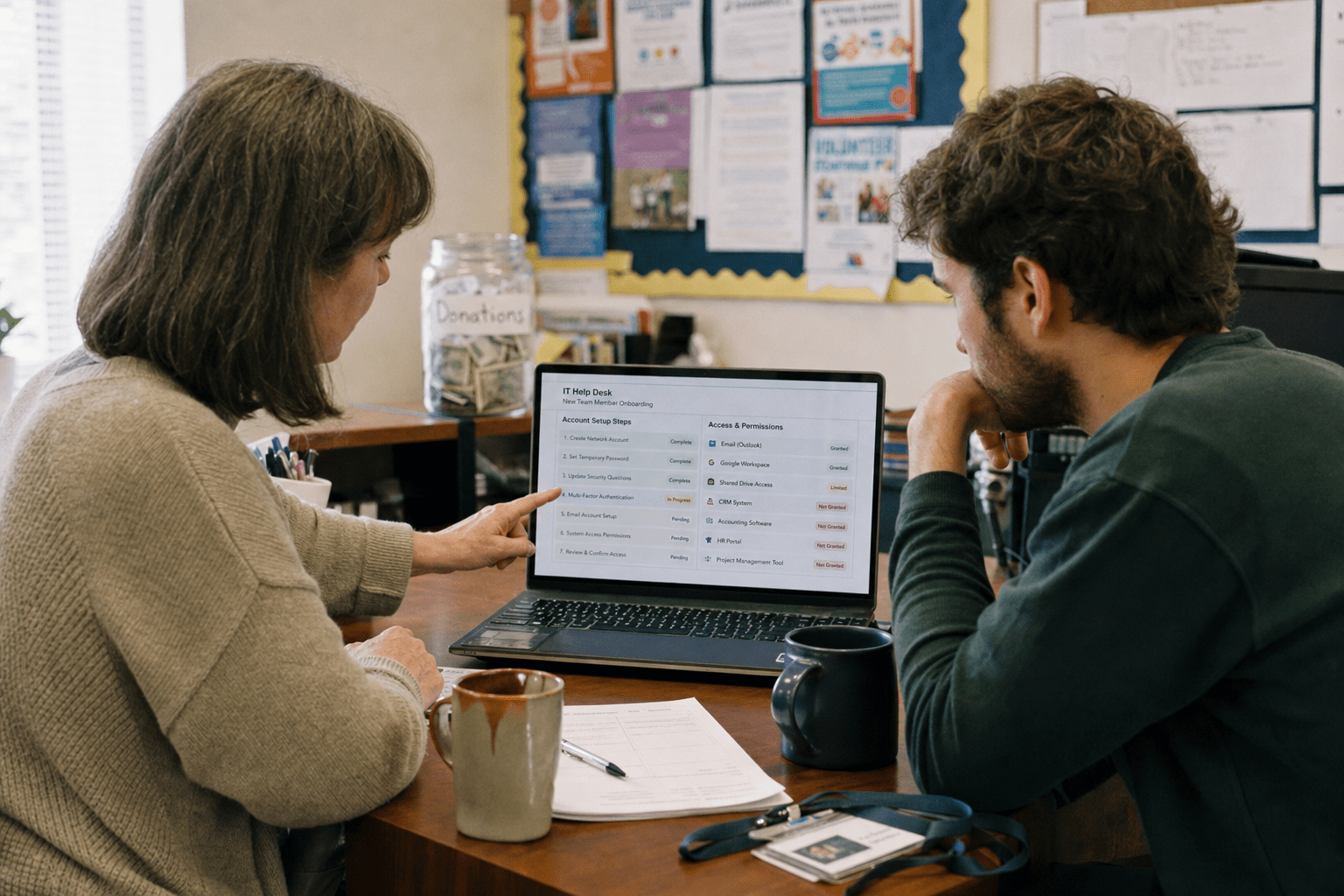
The defining feature of nonprofit IT is turnover, and a help desk that ignores it will never fit. Volunteers cycle in and out, seasonal staff come and go, and board members change. Each transition means accounts to create, access to grant, and, just as importantly, access to revoke. A help desk that treats onboarding as a one-off scramble leaves gaps every time someone joins or leaves. The counterview that a small organization can handle this informally holds right up until a departed volunteer’s account is still active months later, which is both a security hole and a compliance problem. A managed approach uses repeatable, documented processes so each arrival and departure is handled cleanly, no matter how often it happens.
Volunteers Are Not IT Staff
Help desk support for a nonprofit has to meet volunteers where they are, because the people using your systems are there for the mission, not for the technology. A support model that assumes technical fluency creates friction for exactly the people you most want to keep. Clear, patient, plain-language support matters more here than in a corporate setting where staff are full-time and trained. That does not mean dumbing anything down, it means a help desk that explains rather than lectures and fixes rather than blames. When support feels approachable, volunteers actually report problems early instead of working around them, which is how small issues get caught before they grow.
Protecting Donor Data on a Budget
Protecting donor data is a nonprofit’s quiet obligation, and the help desk is part of how that obligation gets met. Nonprofits hold sensitive information, donor payment details, beneficiary records, sometimes health or immigration data, and a breach damages the trust the organization runs on. The CISA cybersecurity best practices and the NIST Cybersecurity Framework both treat protecting this kind of data as foundational, not optional. The challenge for a nonprofit is doing it without an enterprise budget, and the good news is that the highest-impact controls, enforced multi-factor authentication, careful access management, and staff who recognize a phishing attempt, cost far less than a breach and are squarely within reach of a well-run help desk.
Security Signals Come Through the Help Desk
The help desk is usually where a security problem first shows itself in a nonprofit, because a confused volunteer reporting a strange email is often the earliest warning of an attack. A help desk trained to recognize and route those signals turns everyday support into early detection. One that just closes the ticket misses the chance. This matters more for nonprofits than for many businesses, because attackers know mission-driven organizations often run lean on security and hold valuable data. Pairing responsive support with an after-hours emergency help desk means a problem discovered on a weekend does not wait until Monday to get attention.
Pricing That Respects the Mission
Pricing is where help desk support for nonprofits most often goes wrong, and it goes wrong in both directions. The trap on one side is an enterprise plan sold at a discount that still costs more than a nonprofit should pay for what it actually uses. The trap on the other side is free or bargain tools that leave the organization under-protected and eat staff time in workarounds. The TechSoup marketplace and various vendor nonprofit programs are genuinely useful for stretching a technology budget, and worth using. But the goal is not the lowest price, it is the best fit, support scaled and priced to how your organization really works. A provider who understands nonprofits will right-size the service rather than sell you a shrunken corporate package.
How to Choose Help Desk Support as a Nonprofit
Choosing help desk support as a nonprofit comes down to a few direct questions that reveal whether a provider understands your world. How do you handle frequent onboarding and offboarding as volunteers and staff turn over. How do you support users who are not technical without making them feel that way. How do you help us protect donor data without an enterprise budget. Is your pricing built for how a nonprofit actually operates, or is it a discounted corporate plan. How do you handle a ticket that turns out to be a security concern. The answers separate providers who get nonprofits from those who see you as a smaller invoice. If the managed help desk model is new to your organization, how a managed help desk works explains the fundamentals, and if you are building support from scratch, our guide to setting up a help desk for a small organization covers the basics. As your needs grow, that help desk can expand into fuller managed IT services without starting over.
Frequently Asked Questions
How much should a nonprofit pay for help desk support?
A nonprofit should pay for support scaled to how it actually operates, usually priced per user per month or bundled into a managed IT plan, rather than a discounted enterprise package. The right number depends on your staff and volunteer count and how much support they need. Focus on fit and value over the lowest sticker price, since cheap support that wastes staff time costs the mission more than it saves.
How does help desk support handle volunteer turnover?
A good help desk uses documented, repeatable onboarding and offboarding so every new volunteer gets the right access and every departure is fully closed out. This matters more for nonprofits than most organizations because turnover is constant, and a departed volunteer with an active account is both a security risk and a compliance problem.
Can a nonprofit protect donor data without a big budget?
Yes. The highest-impact controls, enforced multi-factor authentication, careful access management, and staff trained to spot phishing, cost far less than a breach and are within reach of a well-run help desk. Protecting donor data is more about consistent basics than expensive tools, which is good news for a lean budget.
Do our volunteers need to be tech-savvy to use the help desk?
No, and a good help desk is built for that. Support should meet volunteers in plain language, explaining and fixing rather than assuming technical knowledge. When support feels approachable, volunteers report problems early instead of working around them, which keeps small issues from growing.
What is the difference between help desk support and full managed IT?
A help desk handles reactive, day-to-day support, while managed IT adds proactive monitoring, security, and planning. Many nonprofits start with help desk support and grow into managed IT as they scale. The help desk is the piece your team touches daily, so its fit shapes the whole experience.
Get Help Desk Support That Fits Your Nonprofit
Help desk support for nonprofits is worth choosing carefully because the wrong fit taxes the mission in ways that never show up on the invoice, staff hours lost to workarounds, volunteers frustrated into silence, donor data left more exposed than anyone realized. The right fit is support built for constant turnover, patient with people who are there for the cause and not the technology, serious about protecting the data donors trust you with, and priced for how a nonprofit actually runs. That combination is not the cheapest plan and it is not the fanciest, it is the one scaled to your reality. If you want a clear read on whether your current support fits your organization or is quietly costing you, our team will review how your nonprofit works, show you where support is falling short, and lay out an option sized to your budget and mission. Book a free strategy call and we will start with the turnover and data-protection questions most providers never ask.

