

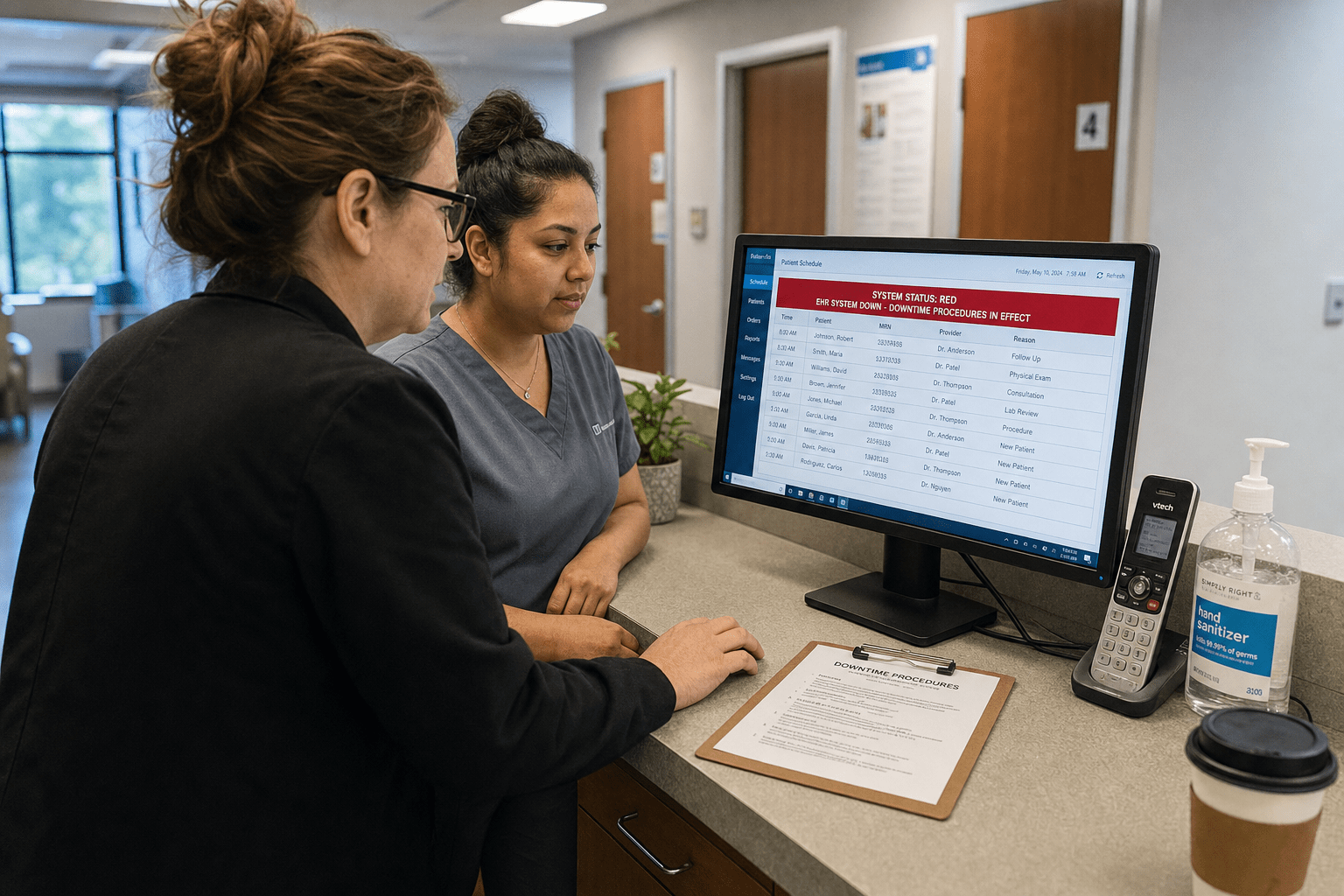
Managed IT services for medical practices should deliver four things you can verify: an EHR downtime procedure staff have rehearsed, role-based access to protected health information that follows the clinical workflow, audit evidence produced on request rather than assembled during an investigation, and named ownership of the third-party vendors your systems depend on. Most agreements we inherit promise an uptime percentage and little else. A practice signs 99.9% and does not notice that the number permits roughly 43 minutes of outage a month, which is survivable at eight in the evening and expensive at ten in the morning. What protects a clinic is the written procedure for those 43 minutes.
Five Points That Decide a Practice’s IT Experience
Practice administrators tend to be sold on compliance language and then live with operational reality, so the arguments below stay on what happens during a normal Tuesday clinic. This is written for practice managers, administrators, and physician owners at single-site and small multi-site groups, usually between 5 and 60 clinical staff.
- Downtime cost is clinical and financial at once. When charting stops, billing stops with it, and the revenue lost during a morning outage is rarely recovered by working late.
- An uptime percentage is a budget for failure, not a promise of availability. Ask how the allowance may be spent, and whether a single long outage or many short ones counts differently.
- Access has to match how clinicians actually work. A front-desk role, a medical assistant role, and a billing role touch different parts of the same record, and blanket access is how a practice fails a review it would otherwise pass.
- Audit evidence is either routine or it is a fire drill. A provider who produces access logs and patch records in a day is running the service. One who needs three weeks is building it retroactively.
- Your systems have vendors, and someone has to own them. Practices are frequently left to referee between a provider and an EHR vendor during an outage, which is the worst possible time to discover nobody owns the call.
Why Managed IT Services for Medical Practices Get Judged on EHR Uptime
Managed IT services for medical practices are judged on EHR uptime because the record system sits between every clinical decision and every dollar collected, so its availability is the practice’s availability. Our team has stood in enough waiting rooms during an outage to know that patience runs out at about twenty minutes. Three areas cause most of the pain we see when we take over an environment.
Charting Stops and Billing Stops Together
An EHR outage is usually described as a clinical problem, which understates it. Charting halts, and so does eligibility checking, claim submission, and often the payment terminal tied to the same network segment. A practice can see patients on paper for a morning. Recovering the billing for that morning takes days of retroactive entry, and some of it leaks away.
The argument for accepting this exposure is reasonable in small practices. Redundancy costs money, a second internet circuit and a tested failover path are real line items, and a clinic seeing 30 patients a day may genuinely prefer to absorb an occasional morning on paper rather than pay for continuous availability every month.
The argument against accepting it is that the cost is rarely measured before it is chosen. When we help a practice price a morning of downtime against a second circuit, the circuit usually wins, and the decision becomes obvious rather than difficult. Our position is that the practice should make this call with a number in front of it. That is part of how we scope managed IT services for clinical environments, and it is a conversation worth having before an outage rather than after one.
Uptime Percentages Hide the Shape of an Outage
Two providers can both deliver 99.9% and give a practice completely different years. One has twelve four-minute interruptions spread across evenings. The other has one 45-minute failure during a Monday clinic. The percentage is identical and the experience is not.
There is a legitimate defense of percentage-based commitments. They are measurable, comparable across vendors, and they stop a negotiation from collapsing into anecdote. A practice that insists on outage-shape guarantees may find that few providers will sign, or that the ones who will are pricing the risk heavily.
Against that, a number nobody can feel is a poor basis for a clinical decision. The workable middle we recommend is to keep the percentage and add two sentences: a maximum single-incident duration for the record system, and a requirement that planned work happens outside clinic hours. Practices weighing whether the provider is even meeting the current agreement often find our piece on why healthcare practices need managed IT services a useful frame for that review.
Vendor Ownership Is Where Availability Actually Breaks
Most clinical outages we are called into are not a failure of one system. They are a disagreement between two. The record system points at the network, the network points at the interface engine, and the practice manager is left holding a phone in each hand while a waiting room fills.
Some practices prefer to keep vendor relationships in house, and that preference has merit. Clinical staff often have direct rapport with an EHR support team, escalate faster because of it, and lose something real when a provider inserts itself into that channel.
The counterargument is that rapport does not resolve a boundary dispute at nine in the morning. What resolves it is a written statement that one party owns the outage until service is restored, whoever turns out to be at fault. We hold that ownership for our clinical clients, and for practices that want to keep clinical vendor contact internal, a co-managed arrangement lets the practice keep the relationship while we keep the escalation duty.
What Managed IT Services for Medical Practices Should Deliver on PHI Access
Managed IT services for medical practices should deliver access control that mirrors clinical roles and audit evidence that exists before anyone asks for it, because both are what a review actually examines. Neither is difficult. Both are commonly skipped, because they produce no visible benefit until the day they are the only thing that matters.
Role-Based Access Has to Follow the Clinical Workflow
Access should be built from roles that exist in the practice: front desk, medical assistant, provider, billing, and practice management. Each touches a different slice of the record. A generic staff group that reaches everything is faster to administer and impossible to defend.
Practices sometimes argue for broad internal access on care-quality grounds, and the argument is not frivolous. In a small clinic, cross-coverage is constant, and a permission boundary that blocks a medical assistant from helping in another pod creates friction that patients feel.
The resolution we use is coverage roles rather than open access: a documented elevated role that a named person can grant for a shift, with the grant logged and expiring on its own. Staff get the reach they need, and the practice keeps a record of who saw what and why. Our overview of HIPAA compliant IT services for medical practices walks through how these roles usually map on first setup.
Audit Evidence Should Be Routine, Not Retroactive
Expect your provider to produce, within one business day, a list of who accessed what during a named window, patch status by device, monitoring alert history, and a written list of anything excluded from coverage. The exclusion list is the document that matters most and the one providers are slowest to hand over.
There is a fair objection that evidence production consumes hours a small practice is effectively paying for twice, once in the retainer and once in the request. Some providers prefer to bundle reporting quarterly for that reason, which keeps the monthly fee lower.
Our view is that quarterly is too slow to catch drift and just fast enough to feel like reporting. Monthly summary with on-demand detail is the arrangement that has served our clinical clients best, and it is a fair test of whether managed security services are running as billed. Practices comparing providers on this dimension may find our roundup of HIPAA compliant managed IT providers for medical practices a reasonable starting shortlist.
The Business Associate Agreement Is a Technical Document
A business associate agreement is often treated as paperwork for the file. Read it as a technical specification instead, because it states what the provider will do with protected health information, where that information may sit, and who else may touch it. Subcontractor language is where surprises live.
Ask which subcontractors touch practice data, where backups are stored, and what happens to your data during offboarding if you leave. A provider who answers precisely has thought about it. A provider who answers warmly has not.
Two clauses deserve a slow read. The first is data location, because a backup replicated to a region you did not agree to is a problem you inherit silently. The second is the return-and-destruction clause, which states what the provider does with your data after the relationship ends, in what format it comes back, and how long they keep a copy. We have watched practices discover at departure that their historical backups were in a format only the outgoing provider could restore, which converts a routine transition into a negotiation. Ask for the export format in writing while you still have leverage, which is before you sign rather than after you give notice.
What to Expect When Something Fails
What a practice should expect during a failure is a rehearsed sequence rather than improvisation, because the difference shows up in the first ten minutes. Two areas deserve explicit language in the agreement.
A Downtime Procedure Staff Have Actually Practiced
Expect a one-page downtime procedure posted where staff can reach it: who to call, what paper forms to use, how to capture charges during the outage, and how the catch-up entry happens afterward. Then expect a rehearsal at least annually, because a procedure nobody has practiced is a document, not a plan.
Practices sometimes resist rehearsal as an imposition on clinic time, which is true. A dry run costs a morning of reduced throughput. Our experience is that the first real outage after a rehearsal costs less than that morning, and the second one costs almost nothing.
After-Hours, Weekends, and Extended Clinics
Expect coverage that matches your actual hours rather than a standard business day. Urgent care hours, Saturday clinics, and evening telehealth blocks all need the same restoration commitment as a Tuesday afternoon. Ask specifically whether the after-hours responder can make changes or only record them, since many agreements quietly offer logging rather than repair outside business hours. Dental groups face a near-identical version of this question, which our guide on managed IT services for dental practices covers from that angle.
Frequently Asked Questions
Does a medical practice need a healthcare-specialist IT provider?
A practice needs a provider who can demonstrate PHI access control, an EHR downtime procedure, and named vendor ownership, whether or not the provider markets itself as healthcare-only. Specialist positioning is a signal worth weighing, not proof on its own. Ask for the artifacts and judge those.
What uptime commitment is reasonable for a small clinic?
A 99.9% commitment paired with a maximum single-incident duration for the record system is reasonable for most single-site practices. The percentage alone permits roughly 43 minutes of monthly outage, which is why the incident cap matters more than the headline figure.
Who is responsible when the EHR vendor and the IT provider disagree?
Whoever your agreement names, and if it names nobody, the practice ends up responsible by default. Ask for a sentence stating that the provider owns the outage through restoration regardless of root cause, then holds the vendor conversation on your behalf.
How quickly should staff access be removed after a departure?
Same day, across the record system, email, remote access, phone, and any patient portal, with written confirmation back to the practice. Residual access after a departure is a confidentiality exposure that is entirely avoidable.
Should backups be tested, and how often?
Yes, with a restore test at least quarterly and a documented result, since an untested backup is an assumption. Ask to see the most recent restore test report during provider selection rather than after you sign.
Who Is Behind This Advice
Our team works inside clinical environments where the schedule is unforgiving, and that shapes how we think about availability. You learn quickly that a practice does not need the most advanced setup, it needs the setup that behaves predictably on the busiest morning of the week. Much of what is written above came from outages we were called into after the fact, where the technology was adequate and the procedure did not exist. We would rather help a practice write the procedure first. Practices in this position often start with a plain review of their current arrangement rather than a rebuild, and our work with medical practices usually begins there.
Mindcore is led by Matt Rosenthal, who focuses on making availability and security commitments measurable for clinical practices, so a practice administrator can confirm service quality without a technical background.
Talk Through Your Practice’s Current Setup
Four things separate an agreement a practice can rely on from one it merely pays for: a rehearsed downtime procedure, access that follows clinical roles, audit evidence available on request, and one party who owns an outage from start to finish. Read your current agreement against those four and the gaps tend to surface in a few minutes. None of them require changing providers. They require asking whether your provider will put each one in writing.
If you would like a second opinion on where your practice is exposed, we are glad to walk through it. Bring the agreement, the last two monthly reports if you receive them, your most recent restore test result, and a note of the hours you actually see patients. We will tell you which of the four you already have and which are missing, and if your provider is doing well, we will say so plainly. You can book a free strategy call and we will go through it together.

