

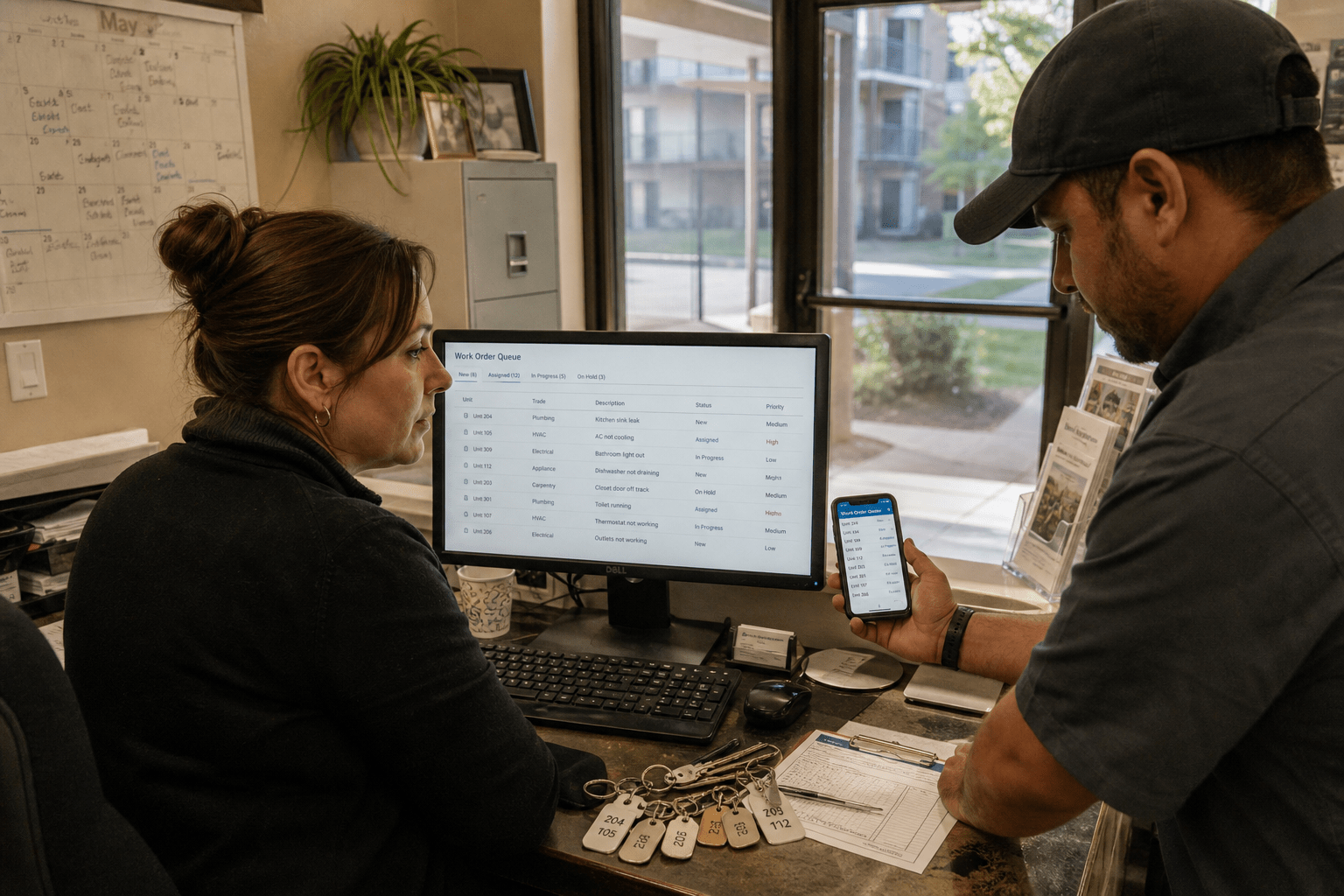
The best AI tools for property management companies in 2026 attach to three moments: the inbound lead, the maintenance request, and the renewal decision. AppFolio and Buildium embed AI inside the platform most operators already run, covering leasing, accounting, and resident messaging. EliseAI, RentEngine, and LeaseHawk handle lead qualification and tour booking. Vendoroo works the maintenance queue end to end, with operators reporting faster work order completion and far less manual coordination. Showdigs suits single family portfolios. Most companies land on two or three products rather than one, because no single vendor is strong across leasing, maintenance, and accounting at the same time. The pattern we see across portfolios is that the tool answering the phone matters far less than whether it can write back into the system of record. An assistant that books a tour nobody on site can see has created a second calendar, not a shorter workday.
Five Points Operators Should Settle Before Signing
Our team puts these five in front of property operators before any demo, because they decide the result more than the product comparison does.
- Decide what the AI is allowed to commit to. Booking a tour is low risk. Quoting rent, approving a concession, or promising a repair date creates obligations, and those need a human boundary drawn in advance.
- The handoff is the whole product. An assistant that qualifies a lead beautifully and cannot create the guest card, schedule the showing, or open the work order has moved the work rather than removed it.
- Resident data is regulated data. Applications carry identity documents, income verification, and payment details. Fair housing rules apply to automated messaging exactly as they apply to a leasing agent.
- Field staff are on phones, not desks. Maintenance techs and roving managers work from mobile devices at properties with poor connectivity. A platform that assumes a desktop and a good connection will be used inconsistently.
- Portfolio size changes the answer. Under fifty units, a lightweight assistant plus disciplined process beats an enterprise platform. Past a few hundred units, integration depth matters more than price.
Leasing AI Fails at the Handoff, Not at the Conversation
Property management AI almost never disappoints on conversation quality, it disappoints when the conversation ends and nothing happened in the system of record. This is the pattern across the operators we work with. A leasing assistant answers after hours, handles the questions well, and books a showing. Then somebody discovers the showing exists only in the assistant’s own dashboard, the guest card was never created, and the on site team learned about the appointment when the prospect arrived. The vendor demo never shows this, because the demo runs against a clean sandbox wired to a sample database. The production reality involves a property management platform with custom fields, a decade of inconsistent data entry, and permissions nobody has reviewed since the last software migration. Portfolios assembled through acquisition make this sharper still, because two or three legacy systems are usually running side by side while everyone waits for a consolidation project that keeps slipping. An assistant wired into one of them looks like a success on that property and like nothing at all on the others. Before committing to a vendor, we ask operators to name which platform is genuinely the system of record today, and to say out loud what happens to a lead that arrives for a property living in the older system. If that question produces a pause, the integration work is larger than the sales conversation suggested, and it is better to learn that before the contract than during the rollout.
Ask What the Assistant Can Write, Not What It Can Say
Evaluate leasing AI on write access rather than on conversational polish, because reading and answering is the easy half. The questions worth asking a vendor are narrow and concrete. Can it create a guest card in our platform, attach the conversation transcript, place the appointment on the correct property calendar, and update the lead source field so attribution stays intact? Can it open a work order with the right category and priority, or does it only send an email to the office? Vendors who own the platform, such as AppFolio and Buildium, answer these easily because the AI lives inside the same product. Third party assistants vary widely, and the integration is where the difference shows. Get the answers demonstrated against a copy of your own data, not against the sample tenant.
Automated Messaging Sits Inside Fair Housing
Every automated message to a prospect or resident is a communication the company is accountable for, and handing the script to a vendor does not move that accountability. Review the wording the assistant uses for screening questions, availability, and pricing, and confirm it treats every inquiry consistently. Watch for anything that could steer prospects toward or away from properties, or that varies its helpfulness by how the inquiry is phrased. Keep a full log of automated conversations, retained the same way a leasing email would be. Assign an owner internally for script review at a set interval rather than treating the launch configuration as permanent. This is straightforward governance work, and it is the part most operators skip.
Best AI Tools for Property Management Companies Along the Resident Lifecycle
The best AI tools for property management companies sort by lifecycle stage, and buying for one stage at a time gives operators a number they can actually measure. Leasing is judged on speed to first response and tours booked. Maintenance is judged on time to close a work order. Renewals are judged on retention. A single platform rarely wins all three, and treating them as separate purchases keeps a weak result contained.
Leasing, Lead Response, and Tour Booking
Leasing automation produces the fastest measurable return because unanswered inquiries are pure lost revenue and the metric is unambiguous. AppFolio Leasing AI qualifies leads and schedules showings without staff involvement, which suits professional operators running fifty units or more. EliseAI and RentEngine compete strongly on the same ground, and LeaseHawk brings its LeadScore capability to phone conversations, transcribing and analyzing every call so marketing spend can be judged against real conversion rather than guesswork. Showdigs is built for single family portfolios, where showings are geographically scattered and self tour logistics matter more than call volume. Measure the change from your current baseline: how many inquiries arrive outside office hours, and what share of those convert to a booked tour today.
Maintenance Coordination and Work Order Flow
Maintenance AI attacks the coordination overhead that consumes property manager hours without producing anything billable. Vendoroo runs work orders end to end, taking the resident report, triaging it, dispatching a vendor, and following up, with operators citing meaningfully faster completion and a large reduction in manual coordination effort. The value is not the triage itself, it is removing the chain of phone calls between resident, manager, and vendor. For this to work the vendor list has to be current, trade categories have to be right, and someone must own the exception path when a job goes sideways. Field technicians receive this work on phones, which is why device management is not optional here. Our mobile device management practice exists because portfolios routinely have unmanaged personal phones holding resident contact details and unit access information.
Accounting, Renewals, and Reporting
The back office is where AI produces quieter gains that compound. Buildium embeds its Lumina capabilities across accounting, communications, leasing, maintenance, and reporting while keeping approvals with humans, which is the correct arrangement for anything touching money. AppFolio and AvidXchange are strong on accounts payable, where invoice coding and approval routing consume real hours every month. On renewals, the useful function is prediction rather than automation: surfacing which residents are likely to leave early enough for a human to intervene. Treat that as a prompt for a manager, never as an automatic pricing decision. Broader thinking on where AI belongs in staff workflows sits in our piece on AI transforming employee management.
Reporting, Owner Communication, and the Data Underneath
Owner reporting is the quiet use case that operators underrate, and it depends entirely on data quality rather than on model capability. Third party managers spend real hours each month assembling statements, variance explanations, and narrative summaries for owners who each want something slightly different. AI drafts that narrative well once the numbers are trustworthy, pulling the variance commentary from the ledger and producing a first pass a manager edits rather than writes. The catch sits upstream. If expense coding is inconsistent across properties, if work orders are categorized by whoever happened to open them, and if unit level data was migrated loosely during an acquisition, the generated commentary will be fluent and wrong, which is worse than a blank page because it reads as authoritative. Clean the chart of accounts and the work order categories before pointing anything at owner reporting. Operators who do that first tend to report the fastest payback of anything on this list, because the work removed is senior time rather than clerical time.
What These Platforms Need From Multi Site IT
Property companies run distributed operations across leasing offices, on site staff, and field technicians, and AI platforms assume a level of connectivity and account hygiene that many portfolios do not have. This is the practical gap. Leasing offices often run on consumer grade internet with equipment nobody manages, shared logins are common because staff turnover is high, and multi factor authentication is inconsistent. Consolidating identity so each person has a named account, putting proper network management on the property offices, and running a real patching cadence as described in how to implement a vulnerability management process are the prerequisites. Operators with heavily distributed teams should also look at hosted desktops, since cloud desktop platforms solve the mixed hardware problem that property companies accumulate over years of acquisitions.
Shared Logins Are the Habit That Blocks Everything
Shared accounts are close to universal in property operations, and they quietly prevent almost every control an AI platform assumes is present. The reasoning behind them is understandable. On site roles turn over frequently, a leasing office runs long hours across several people, and creating individual accounts each time feels like friction nobody has time for. The cost arrives later. With a shared login, an audit trail cannot say who approved a concession or who released a unit, multi factor authentication becomes impractical because the second factor lives on somebody’s personal phone, and an offboarding never really completes because the credential simply stays in circulation. Add an AI assistant to that and the platform inherits the ambiguity: its actions attribute to an account rather than to a person. The fix is unglamorous and worth doing before any rollout. Give every person a named account, tie property level permissions to roles rather than to individuals, and make account creation part of the same onboarding step that issues a key fob. Operators who get this right find that later technology decisions become much simpler, because every platform they evaluate assumes exactly this arrangement.
Frequently Asked Questions
What are the best AI tools for property management companies right now?
AppFolio and Buildium lead for operators wanting AI inside the platform they already run. EliseAI, RentEngine, and LeaseHawk are strong standalone leasing assistants. Vendoroo handles maintenance coordination end to end, and Showdigs fits single family portfolios. Most companies run two or three rather than one.
Can AI handle leasing calls without a human?
For routine inquiries, availability questions, and tour scheduling, yes, and after hours coverage is where the return shows up fastest. Pricing decisions, concessions, exceptions to screening criteria, and any complaint should route to a person. Draw that boundary before launch rather than discovering it through a bad interaction.
Does AI leasing software create fair housing risk?
The risk exists and it is manageable. Automated messaging is company communication, so scripts need review for consistent treatment of every inquiry, conversations need retention, and someone internally should own periodic script review. Handing configuration entirely to a vendor without that oversight is where operators get into trouble.
How much does property management AI cost?
Platform embedded AI is usually bundled or priced per unit per month, which suits operators already on that system. Standalone leasing assistants typically price per property or per conversation volume, and maintenance coordination platforms often price per work order or per unit. Compare against the staff hours each one actually removes.
What size portfolio justifies AI tools?
Around fifty units, leasing automation starts paying for itself through captured after hours inquiries. Maintenance coordination tools need enough work order volume to matter, usually a few hundred units. Below those thresholds, tightening process and response discipline generally returns more than software does.
Who Is Behind This Guidance
Mindcore supports property operators on the infrastructure their software sits on: multi site networking for leasing offices, device management for field staff, identity consolidation after acquisitions, and the vendor security reviews that decide whether a platform should hold resident data. That is why this article leads with the handoff into the system of record rather than with a ranking. We have watched capable leasing assistants get switched off because nothing they did ever appeared where the on site team could see it. Matt Rosenthal, who leads Mindcore, has aimed the company at this exact middle market position: operators large enough to need real infrastructure engineering, lean enough that nobody internally has time to own it. Running the portfolio stays with you. Making the technology underneath dependable is our part.
Book a Free Strategy Call Before Your Next Platform Decision
Choosing among AI platforms becomes much simpler once an operator names the stage to fix and confirms the tool can write into the system of record rather than only talk to people. Leasing, maintenance, and back office are three purchases with three separate measures, and running them one at a time against a baseline agreed in advance teaches the company something real each quarter. Ahead of any rollout, consolidate logins into named accounts, get field devices under management, and put the property office networks on something you can monitor. Those decide whether the platform you choose gets used consistently or quietly abandoned by the on site team. If you want an outside read on where your portfolio stands, we will assess it and say plainly what needs attention first. Book a free strategy call with our team. Operators weighing the wider collaboration question may also find how to choose the best team collaboration tools and our notes on Microsoft 365 management for construction companies useful, since the multi site problems rhyme.

