


The types of VoIP services businesses actually choose between come down to five: hosted cloud PBX sold per seat, SIP trunking that connects a phone system you already own to the internet, an on-premises IP PBX you operate yourself, Microsoft Teams Phone in one of its three connection models, and contact center platforms that are built and priced differently from all of the above. Consumer VoIP and developer voice APIs sit alongside these and rarely belong in a business phone decision. Most mid-market organizations land in hosted cloud PBX or Teams Phone, and the deciding factors are usually not features. They are your existing Microsoft licensing, whether you have capital tied up in a phone system that still works, and whether any part of your operation needs analog endpoints or a genuine contact center. We recommend you settle those three questions before taking a single vendor demo, because a demo will not distinguish between the categories for you.
Overview
- Five categories cover almost every business decision. Hosted cloud PBX, SIP trunking, on-premises IP PBX, Teams Phone, and contact center platforms.
- Your Microsoft licensing often decides it. Organizations already paying for the right tier frequently find Teams Phone cheapest by a wide margin.
- The network matters more than the platform. Voice quality problems are almost always local network problems, and no vendor fixes those for you.
- Analog endpoints are the hidden scope. Fire alarm panels, elevator phones, and security dialers do not migrate to a softphone.
- E911 is a legal requirement, not a feature. Kari’s Law and RAY BAUM’s Act obligations apply to your deployment regardless of which platform you pick.
The 5 Why’s
This is written for IT managers, directors, and operations leaders at organizations between roughly one hundred and a few thousand employees who are replacing a phone system, consolidating after an acquisition, or being pushed off copper by a carrier. The typical environment has a Microsoft 365 tenant, an aging on-premises phone system or an early cloud provider nobody loves, and a mix of desk phones, softphones, and analog lines nobody has inventoried.
The immediate driver for a growing share of these projects is regulatory rather than technical. Copper retirement has accelerated sharply: the FCC’s March 2026 order gave carriers blanket authority to grandfather legacy copper services without a federal filing and shortened notice periods, and major carriers have been filing discontinuance notices and decommissioning wire centers through 2026 with full retirement targeted across the rest of the decade. Organizations that expected to choose their own timing are being handed one.
Sector conditions shape the requirements. Healthcare providers need call recording that fits HIPAA obligations and analog paths for legacy clinical equipment. Legal and financial firms carry recording consent and retention requirements. Manufacturers need overhead paging, ruggedized handsets, and coverage across plant floors. Hospitality and multi-site retail need per-site routing and emergency location accuracy for staff who move between buildings.
The consequence of choosing on price alone is a platform that works for desk workers and fails for the parts of the operation nobody surveyed, discovered after the contract term has started.
The Main Types of VoIP Services Compared
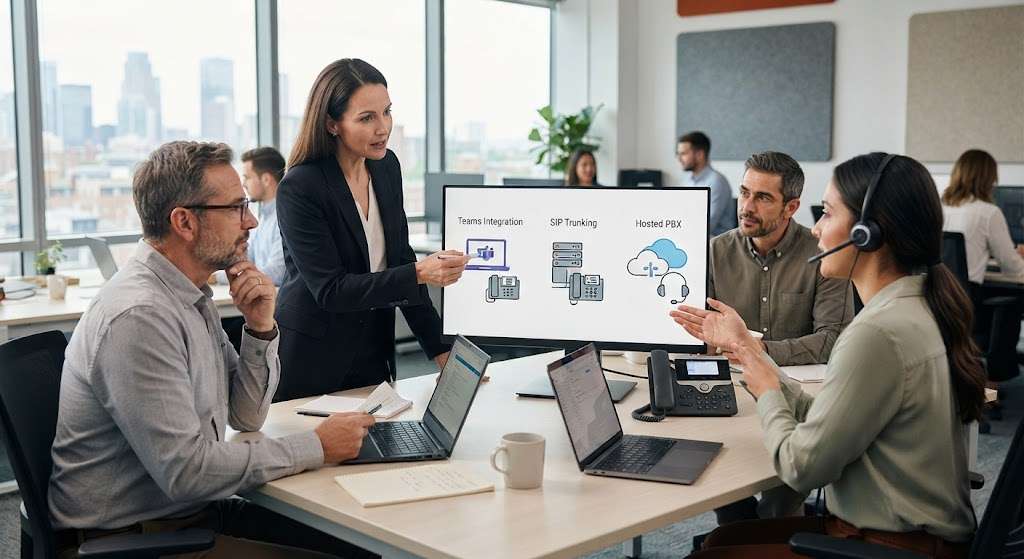
Hosted cloud PBX, often sold as UCaaS. The provider runs everything and you buy seats monthly. Calling, messaging, meetings, mobile apps, and administration arrive as one bundle. Lowest operational burden, fastest to deploy, most predictable cost, and the least control over the underlying platform. This is where the majority of mid-market organizations end up.
SIP trunking. You keep your existing phone system and replace the copper or PRI circuits feeding it with internet-delivered trunks. Cheapest path if you have a functioning PBX with useful life left, and it preserves configuration and handsets. You remain responsible for the phone system, its patching, its licensing, and its failure modes.
On-premises IP PBX. You own and run the platform, whether commercial or open source. Maximum control, maximum customization, and full responsibility for lifecycle, security patching, and staffing. Still the right answer for organizations with unusual integration requirements, strict data residency needs, or existing expertise they want to keep using.
Microsoft Teams Phone. Calling inside Teams, available three ways: Microsoft’s own calling plans, Operator Connect where a carrier is provisioned through the Teams admin center, or Direct Routing where you connect your own carrier through a session border controller. For organizations already licensed at the right tier and already living in Teams, this frequently wins on cost and adoption at once. It is weaker where you need deep contact center function or extensive analog support.
Contact center platforms, sold as CCaaS. A different category with different economics. Queueing, skills-based routing, workforce management, quality monitoring, and reporting built for teams whose job is handling call volume. Buying a business phone system and expecting it to serve a real contact center is one of the more common and expensive mistakes in this space.
Two categories worth naming so you can rule them out: consumer VoIP, which lacks the administration, emergency location handling, and support commitments a business needs, and voice APIs, which are for embedding calling into software you are building rather than for running a phone system. Sorting your requirements against these categories is the part of the project we handle inside an IT assessment, because vendors compete within a category and rarely help you choose between them.
Which Type of VoIP Service Fits Your Business?
Answer three questions and the category usually picks itself: what Microsoft licensing do you already pay for, does your current phone system have useful life left, and does any part of your operation need a real contact center or analog endpoints.
If you are already licensed at a tier that includes or cheaply adds Teams Phone, and your users live in Teams, that is the default worth disproving rather than the option worth considering. If you bought a phone system recently and it works, SIP trunking preserves that investment while removing the copper dependency, and it is usually the least disruptive project available. If neither applies, hosted cloud PBX is the path of least resistance and the one with the shortest deployment.
The answer shifts under a few conditions. Organizations with a genuine contact center should buy a contact center platform for that team and a simpler system for everyone else, rather than forcing one product to do both jobs badly. Organizations with heavy analog requirements, meaning fire panels, elevator phones, gate intercoms, or clinical equipment, need to price analog telephone adapters, cellular POTS replacement devices, or a hybrid design before comparing per-seat rates, because that scope frequently costs more than the seats do. Multi-site organizations with poor connectivity at some locations should look hardest at survivability, since a cloud platform with no local fallback means a circuit outage is a total phone outage at that site.
What we recommend you do about it:
- Check your Microsoft licensing before anything else. The answer materially changes the cost comparison and takes one afternoon to establish.
- Inventory every analog endpoint in the building. Walk the site if you have to. These are the items that turn a clean project into a change order.
- Separate contact center users from everyone else. Count them, then price them separately. Blending the two produces the wrong platform for both.
- Ask what happens at a site when the internet drops. Local survivability, cellular failover, and automatic forwarding are design decisions, not features you enable later.
- Do not let a demo define your requirements. Write what you need first, then evaluate against it, or you will be sold the category the vendor sells.
What Does Your Network Need Before You Switch?
Enough bandwidth with headroom, quality of service that actually prioritizes voice, a separate voice VLAN, and switches with the power budget to run the phones. Voice quality complaints after a cutover are almost always local, and the platform vendor cannot fix your LAN.
The bandwidth requirement is modest and the quality requirement is not. Each concurrent call consumes on the order of a hundred kilobits per second with overhead depending on codec, so capacity is rarely the constraint. What breaks calls is jitter, latency, and packet loss, and voice tolerates very little of any of them. A connection that streams video perfectly can still deliver bad calls, because video buffers and voice cannot. That is why quality of service marking, and honoring those markings end to end across your switches and your circuit, matters more than raw throughput.
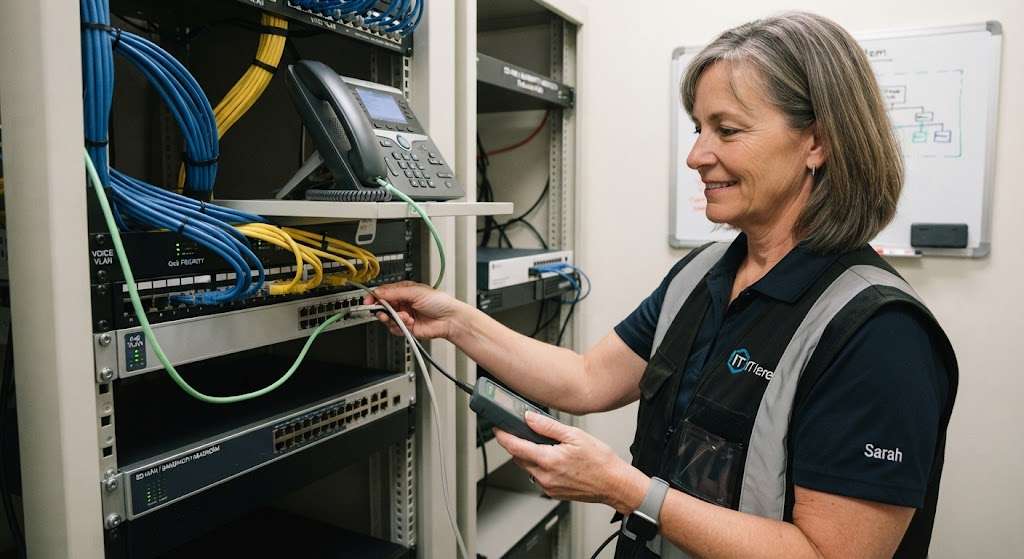
The work required varies with what you already run. Organizations on modern managed switches with existing VLAN segmentation and an SD-WAN overlay may need only configuration and testing. Organizations on unmanaged or aging switches often discover that the phone project is actually a network refresh, and the power budget is the usual surprise: desk phones drawing power over ethernet can exceed what an older switch can deliver across every port at once, which produces intermittent failures that look like phone problems. Sites relying on a single circuit need a second path before voice becomes the thing that stops when the circuit does, which is where this decision overlaps with business continuity planning.
What we recommend you do about it:
- Run an assessment against real traffic, not a speed test. You need jitter, latency, and loss measured over days, including your busiest hours.
- Put voice on its own VLAN. Segmentation is what keeps a backup job or a large file transfer from degrading calls.
- Verify quality of service is honored end to end. Marking traffic your switches or carrier ignore accomplishes nothing.
- Check the power budget on every switch. Total draw across all ports, not the per-port rating, is what determines whether phones stay up.
- Design failover before cutover. Cellular backup, secondary circuits, or automatic forwarding to mobile numbers, tested rather than assumed.
What Do Buyers Miss Until After They Sign?
Emergency calling obligations, number porting timelines, call recording compliance, analog endpoint scope, and contract terms. In that order of how often it causes trouble.
Emergency calling is first because it is a legal requirement rather than a feature. Kari’s Law requires that users be able to dial 911 directly without a prefix and that a notification go to an on-site contact when they do. RAY BAUM’s Act requires that a dispatchable location, meaning enough address and interior detail to actually find the caller, be conveyed with the call. Those obligations attach to how you deploy, and they get considerably harder with softphones and remote workers whose physical location changes. Ask every vendor how location is determined for a laptop softphone, and make sure the answer satisfies you before signing.

Recording is where requirements diverge most by industry. Healthcare organizations recording calls that discuss patient information need the vendor under a business associate agreement, which is contractual rather than technical, and it belongs alongside the rest of your healthcare IT compliance obligations. Financial services firms face retention and supervision expectations. Organizations taking card payments by phone need pause-and-resume recording so card data is never captured. Firms operating across state lines should confirm consent handling, since some states require all parties to consent to recording rather than one. Organizations with none of these obligations can treat recording as an ordinary feature and move on.
What we recommend you do about it:
- Get emergency calling behavior in writing. How location is set for desk phones, softphones, and remote users, and who receives the on-site notification.
- Never cancel the old service before the port completes. Porting takes longer than anyone promises, and a cancelled number is difficult to recover.
- Confirm which numbers can port at all. Numbers tied to certain carrier arrangements or bundled services sometimes cannot, and finding out late derails a cutover.
- Match recording capability to your actual obligation. Business associate agreements, retention periods, consent handling, and payment pause behavior are contract questions, not checkbox features.
- Read the term, the escalator, and the hardware arrangement. Multi-year agreements, annual increases, and rented handsets you must return change the real cost substantially.
- Price the analog scope explicitly. Fire panels, elevator phones, and security dialers need their own line item and their own replacement plan.
Business Phone Expertise from Matt Rosenthal
In 30 years of moving organizations between phone systems, I have seen the same project derailed the same way more times than I can count. Somebody compares per-seat pricing across three vendors, picks the cheapest, and then discovers the elevator phone, the fire panel, and the fax line in accounting were never in scope. What I have seen firsthand is that the analog endpoints and the local network determine whether one of these projects goes smoothly, and neither of them appears in a vendor proposal. Our team walks the site and tests the network before recommending a platform. See our managed IT services and IT assessment process.
What to Settle Before You Take a Demo
Choosing among the types of VoIP services is easier than most buyers expect, because the categories are genuinely distinct and three questions narrow them quickly. What is hard is the scope around the choice: the analog endpoints nobody inventoried, the network that has never carried real-time traffic, the emergency calling obligations that attach to your deployment rather than to your vendor, and the numbers that have to port cleanly on a date you have already announced internally.
Start with your Microsoft licensing, because it can eliminate or elevate an entire category in an afternoon. Then walk the building and write down every analog line and what it connects to, including the ones in the elevator, the sprinkler room, and the back office. Then assess the network against real traffic over real business hours rather than a speed test. Those three pieces of work will tell you more about which platform fits and what the project actually costs than any comparison of feature matrices.
If a carrier has already sent you a copper discontinuance notice, treat that timeline as fixed and work backward from it. If one has not, this is a better project to run on your own schedule than on theirs, and the notice periods available are shorter than they used to be.
If you are replacing a phone system this year, the analog inventory and the network assessment are where to start. Contact Mindcore to request a voice readiness assessment.

