

Mindcore provides IT support to Baton Rouge organizations across the Capital Region and the Mississippi River industrial corridor, with a focus on environments where a network problem stops production rather than inconveniencing an office. We work with petrochemical and refining operations, plastics and specialty chemical manufacturers, aerospace and defense suppliers, port and logistics operators, engineering and construction firms, and healthcare providers. Support runs from our Louisiana operations in New Orleans, roughly eighty miles away, which puts Baton Rouge inside genuine same-day onsite reach rather than dispatch from another state. If you are evaluating providers, send us the same scope document you sent the others and ask for line-item pricing against it.
What Our Baton Rouge IT Support Covers
Service desk and end user support. Ticket intake by phone, email, and portal, with response and resolution commitments written into the agreement rather than implied by it.
Managed infrastructure and cloud. Servers, networking, virtualization, and Microsoft 365 or hybrid environments monitored and maintained, with third-party application patching rather than Microsoft updates alone.
Cybersecurity and security operations. Endpoint detection and response, identity and access controls, email security, and monitoring. See our cybersecurity services.
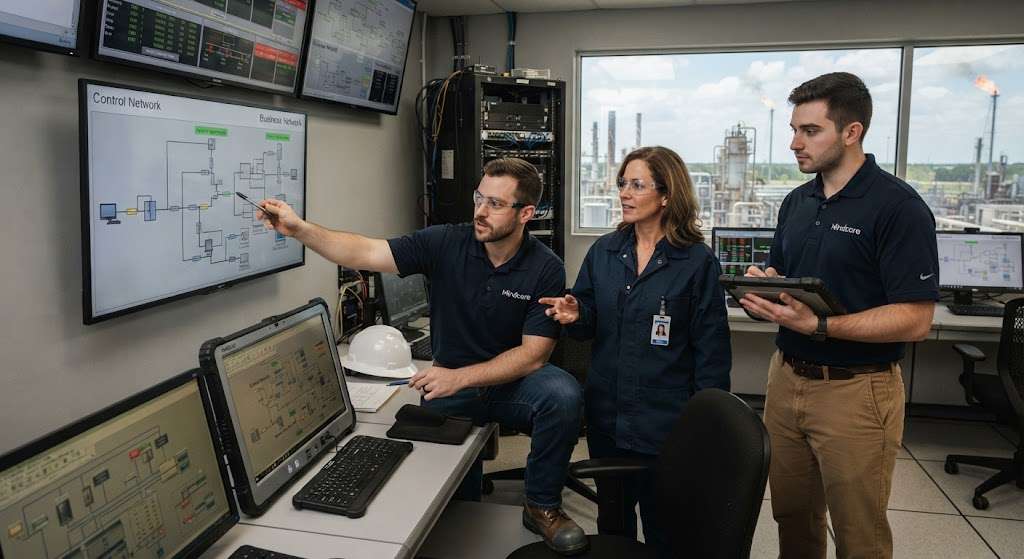
Plant network and OT-adjacent support. Segmentation between business and control networks, vendor remote access control, and asset visibility on the industrial side of the boundary.
Backup and disaster recovery. Immutable backups, recovery objectives set per system, and replication outside the Gulf Coast storm corridor. Covered in depth in our business continuity planning work.
Compliance and export control support. NIST 800-171 and CMMC readiness, ITAR access control, HIPAA, and the security requirements customers impose on suppliers.
Co-managed IT. Security operations, after-hours escalation, and project capacity layered onto an existing plant or corporate IT team rather than replacing it.
How We Serve Baton Rouge
Most of a managed services relationship is delivered remotely, and that is true of every provider regardless of address. Monitoring, patching, ticket resolution, security operations, and cloud administration do not require proximity.
What proximity affects is hands-on work, and in industrial environments that matters more than it does in an office. Cabling in a plant, switch replacement in a control room, and a problem that needs somebody standing in front of the equipment cannot be handled from a portal. Eighty miles from New Orleans makes Baton Rouge a routine drive rather than a travel event, which is a materially different arrangement from a provider dispatching across state lines.
If your operation needs a committed onsite response window, raise it during evaluation and get the number in the agreement. For a plant with production at stake, that requirement is legitimate and should shape your decision rather than being treated as a preference.
Where Plant IT Differs From Office IT
The mistake we see most often in industrial environments is a provider applying office practices to the plant floor.
Control systems do not tolerate the tools that work everywhere else. Active network scanning can knock a PLC offline, so asset discovery on the control network has to be passive. Endpoint agents are frequently unsupported on HMIs and engineering workstations, and installing them anyway can void a vendor support agreement. Many of those workstations run operating system versions that will never be patched again, because the application vendor certified them against that version and nothing newer, which means the answer is compensating controls and segmentation rather than a patch cycle. Change windows follow turnarounds and production schedules, not an IT maintenance calendar.
The boundary between business and control networks is where most of the practical work sits. Segmentation designed around zones and conduits, in line with the industrial security standards plants already reference, limits what an incident on the business side can reach. Vendor remote access deserves particular attention: system integrators and equipment manufacturers commonly hold standing VPN access into control environments, and brokered access through a jump host with time-bound credentials and session recording is a straightforward improvement most sites have not made.
One thing that surprises people: configuration and program logic backups for controllers and distributed control systems are missing far more often than server backups are. If the recovery plan for a controller failure depends on a laptop in an engineer’s desk drawer, that is worth fixing before anything else on this page.
Aerospace, Defense, and Export Control
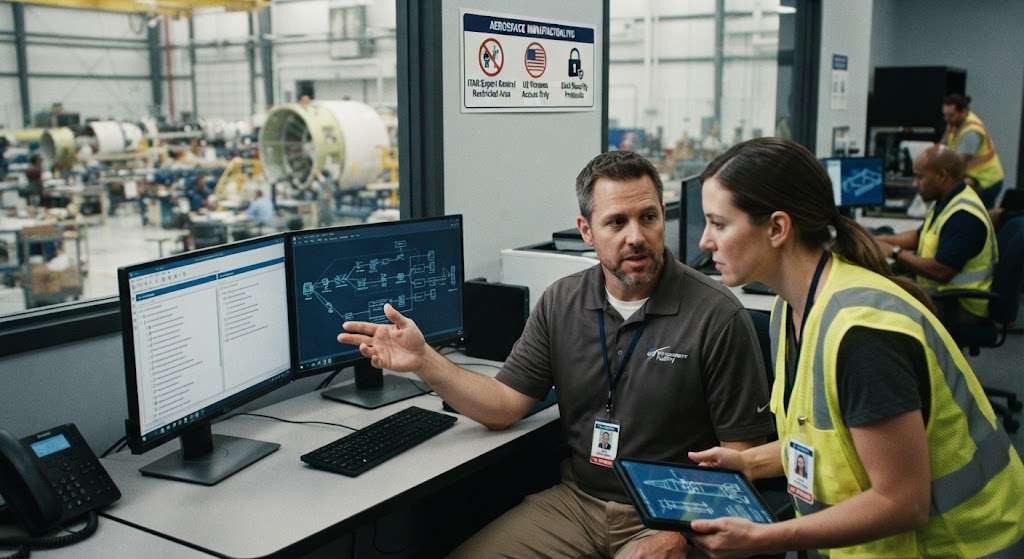
Louisiana’s aerospace base, centered on the Michoud Assembly Facility and its supplier network, brings a requirement most general IT providers handle badly: export control.
Technical data subject to ITAR cannot be accessed by non-US persons without authorization, and that constraint reaches directly into IT decisions. It affects which cloud tenants and regions you can use, how identity and access controls are structured so that citizenship status actually gates access to the right file shares and applications, whether encryption is implemented in a way that supports the end-to-end encryption provisions, and critically, who staffs your help desk. A support technician offshore with administrative access to systems holding export-controlled technical data is a compliance problem regardless of intent.
That last point is worth asking every provider you evaluate, including us. Where is your service desk staffed, where is your network operations center, and do any subcontractors hold administrative credentials in my environment.
Suppliers doing Department of War work carry NIST 800-171 and CMMC obligations alongside export control, and those two programs overlap without being identical. Note that the CMMC program changed materially in July 2026, when Phase II third-party certification requirements were suspended pending a program review while self-assessment obligations remained in force. Start by confirming what your current contracts and flow-down clauses require rather than what a headline said. See our CMMC compliance services.
The Chemical Corridor Compliance Picture
Worth stating plainly because many providers get it wrong: the federal Chemical Facility Anti-Terrorism Standards program has been unenforceable since its statutory authority lapsed in July 2023, and CISA continues to state that it cannot enforce those regulations. Facilities were encouraged to maintain their existing security measures voluntarily.
The practical consequence is not that requirements went away. It is that they now arrive from somewhere else. Insurers ask about segmentation and access control at renewal. Corporate parents impose standards across sites. Customers send questionnaires. And for pipeline owners and operators, TSA security directives issued after the Colonial Pipeline incident carry their own obligations independent of the chemical program.
If your site built a security posture to satisfy a federal inspector who is no longer coming, the posture is still doing useful work and the documentation is still worth maintaining. What changed is who asks to see it.
Gulf Coast Continuity Is Part of the Job
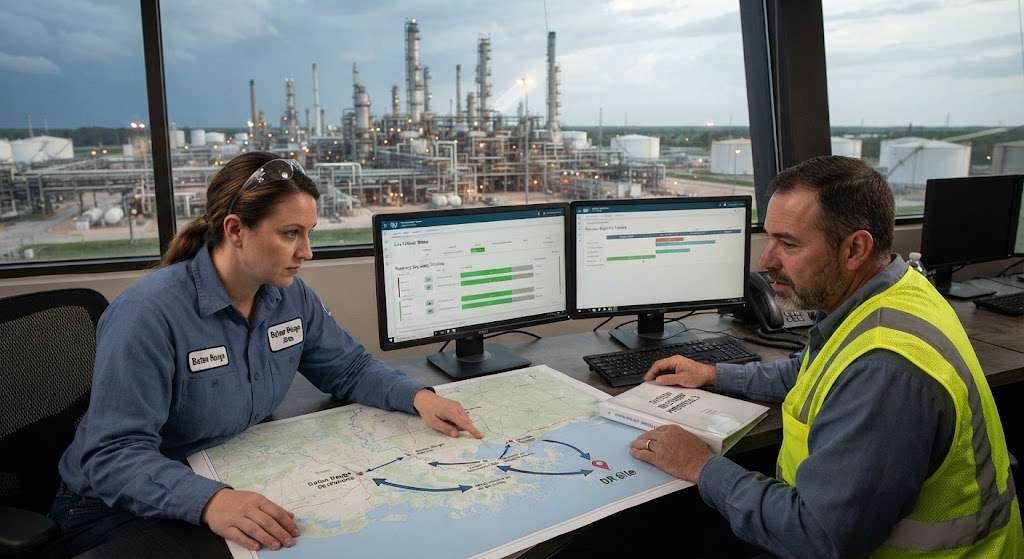
Baton Rouge is not coastal and it is not out of reach. Storms that come ashore in south Louisiana reach the Capital Region with enough force to take down grid power for extended periods, and a recovery copy inside the same regional power and fiber footprint is not a recovery copy.
We plan recovery for Louisiana clients with replication outside the corridor, recovery objectives defined per system rather than one number for the company, at least one immutable copy that neither ransomware nor a failed restore can reach, and live failover testing scheduled outside hurricane season. For industrial operations the recovery order matters more than for most businesses, because bringing systems back in the wrong sequence can mean bringing production back late.
Common Questions About IT Support in Baton Rouge
Do you have an office in Baton Rouge? Our Louisiana operations run from New Orleans, about eighty miles away, and we cover Baton Rouge with remote delivery plus regular and dispatched onsite support. It is a fair question to ask any provider, and the distance matters less than what they will commit to in writing.
Do you work on control systems? We work on the network and security boundary around them, vendor remote access, segmentation, and asset visibility. Control system engineering itself belongs with your integrator or OEM, and any provider claiming to do both should be asked to be specific about which.
Where is your service desk staffed? Ask us directly, and ask every provider you evaluate. If you hold export-controlled data, the answer is a compliance question rather than a service preference.
What size organizations do you work with? Typically from around one hundred employees upward, where there is enough complexity to need managed infrastructure, security operations, and compliance support.
Do you work alongside internal or plant IT? Yes, and in industrial environments that is usually the better arrangement. Plant staff keep the work that requires site knowledge while we cover security operations, after-hours escalation, patching, and project capacity.
Talk to Us About Your Baton Rouge Operation
If you are evaluating providers, send us the same scope document you sent the others and ask for line-item pricing against it. If you do not have one, we will help you build it, because a comparison built on mismatched scope will mislead you no matter who wins.
Contact Mindcore to request an IT and OT boundary assessment for your Baton Rouge site.

